Canadian autoworkers union Unifor sets bargaining deadline with Ford
Published in Business News
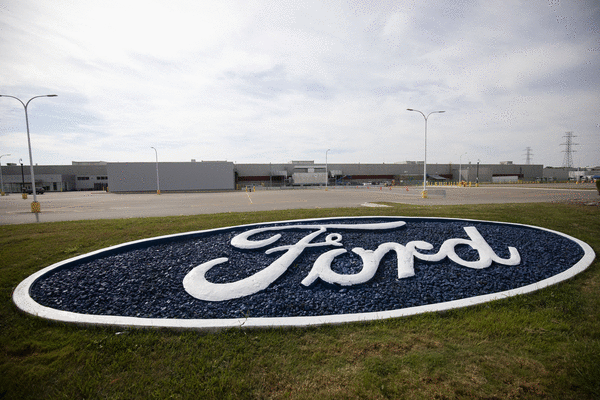
DETROIT -- Canadian autoworkers union Unifor set a bargaining deadline of July 10 for contract talks with Ford Motor Co. as the labor group seeks stability amid "crisis" for members affected by layoffs, U.S. tariffs and the ongoing review of the nation's trade agreement with the United States and Mexico.
Contracts with Detroit's three automakers don't expire until September. Unifor chose the Dearborn automaker as the company to start the pattern, expecting that it can work constructively with Ford and seek to have General Motors Co. and Jeep and Chrysler maker Stellantis NV follow. Although Ford changed plans for its Oakville Assembly Complex outside Mississauga, Ontario, away from launching a three-row, electric SUV in response to declining EV demand, it's moving forward with launching Super Duty production there this year. Meanwhile, GM and Stellantis have plants sitting idle in Canada.
"We have a long history of reaching higher agreements with the Ford Motor Company," John D’Agnolo, Unifor Ford master bargaining chairperson, said in a briefing following the handshake that began negotiations. "We've worked through difficult issues before. We believe negotiating right here, right now, is the best option to reach an agreement that can be carried across the Detroit Three."
Ford spokesperson Said Deep said in a statement that company values its long partnership with Unifor and begins the talks with respect for the collective bargaining process and the role Ford's employees play in the company's performance.
"We look forward to constructive, good-faith discussions to reach a fair agreement with the goal of providing stability for our workforce," he said, "while securing the long-term competitiveness of our Canadian manufacturing operations."
The talks come with difficult timing. The United States and Canada are in the middle of a review with Mexico of the trilateral trade agreement the parties signed in 2020. Following the imposition of new tariffs under President Donald Trump on vehicles and automotive parts and reports that the United States is seeking U.S. content requirements as high as 50% on imports, it's unclear what the final trade rules will end up being.
Nonetheless, Unifor President Lana Payne said her members can't wait, especially those laid off at GM's CAMI Assembly in Ingersoll, Ontario, where it ended production of the Chevrolet BrightDrop commercial electric van in October, and Stellantis' Brampton Assembly Plant, whose Jeep Compass SUV production allocation was moved to Belvidere, Illinois, following new U.S. tariffs. That plant has been idle since the end of 2023 when it ended production of the Chrysler 300 and previous-generation Dodge muscle cars.
"It's too risky to wait," Payne said during the briefing. "How do we know when it's going to be settled? We don't know that, but we do know ... the circumstances that we're dealing with right now. And we have a lot of members, by the way, who need answers. Maybe not as much with Ford Motor Company, but at Brampton and at CAMI, and a number of our other facilities, waiting a year is not going to improve the conditions for them. We need it to get at a bargaining table now, and that's why we're here."
Unifor is seeking a three-year contract, Payne said, that offers job security with future product commitments, enhances pensions and retirement benefits, increases wages and strengthens income protections. She declined to specify what will happen if a tentative agreement isn't reached by July 10, but said there would be a discussion.
"This agreement must deliver economic progress for working people," she said. "Automakers continue to benefit from their skill, from their productivity, and commitment. We want a strong agreement that recognizes their contribution."
Payne already has said she wants to see the United States' auto tariffs instituted under Trump removed and has urged Canadian federal policy to prioritize domestic automotive manufacturing investments. She referenced the 5 million vehicles imported into North American annually that aren't built here.
"We can't just be a nation that takes things out of the ground and exports those things. We must also be a nation that builds things, and part of that also means getting a trade deal that works for us, but it also means improving and having strong policy at the federal level, so that we are encouraging manufacturing in our country, and that we are providing benefits to those who actually are building in Canada versus those who are not."
©2026 www.detroitnews.com. Visit at detroitnews.com. Distributed by Tribune Content Agency, LLC.










Comments