Hybrid electric aircraft reach new heights as climate rules loom
Published in Business News
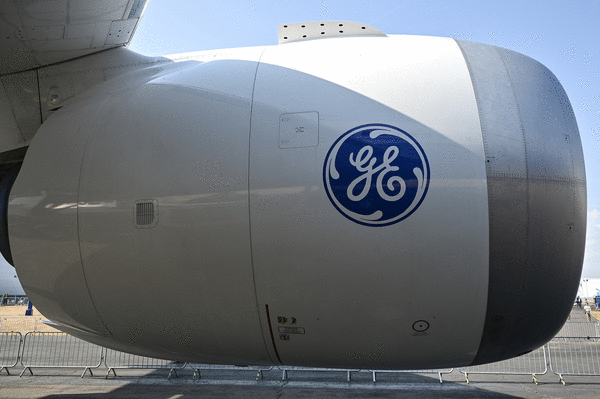
FARNBOROUGH, England — In a first for the aviation industry, GE Aerospace flew its experimental hybrid electric aircraft over the Atlantic Ocean.
In test flights, it has successfully flown the aircraft at an altitude of 30,000 feet, matching the altitude most passenger aircraft fly today and successfully taking the technology out of its simulator testing and into the real world, GE announced Monday.
Hybrid electric aircraft — which combine a traditional gas turbine with an electric power train in an effort to lower carbon emissions and save airlines cost on fuel — are still a long way from reality.
But GE and its partners in the hybrid electric project, including NASA, say the high-altitude flight tests represent a significant step toward bringing the technology to the commercial market. GE brought its hybrid electric flight demonstrator, a modified Saab A340B, to the Farnborough Airshow, the industry’s marquee trade event that kicked off on Monday.
Mohamed Ali, president and CEO of GE Aerospace Commercial Engines and Services, told reporters at a news briefing Monday that “this is not a lab experiment or a one-off prototype.” The flight tests “help validate hybrid electric technology as a credible path for next-generation engine systems,” he said.
To make the flight test a reality, GE partnered with Boeing subsidiary Aurora Flight Sciences, which works on autonomous flight systems, and startup Beta Technologies, one of several companies working to develop an electric vertical takeoff and landing, or eVTOL, aircraft. Like hybrid electric aircraft, eVTOLs are meant to reduce carbon emissions and have been slow to take off, though those companies’ leaders say they are making progress.
NASA provided funding and testing capability for the hybrid electric project. GE tested its experimental system at NASA’s facility in Ohio, where it reached simulated heights of 45,000 feet.
NASA Administrator Jared Isaacman attended the news conference Monday, telling reporters that this partnership was a good example of how NASA should work with the commercial industry. NASA “pushes the frontier”; then, when there’s a breakthrough, it works with the industry to translate that to a practical use case, he said.
“When NASA began exploring this technology nearly 15 years ago, many questioned whether it could ever become practical at scale,” Isaacman said. “We spent years working through the hardest technical problems. … Now, alongside GE Aerospace, we made those systems light, more efficient and ready for the demands of flight.”
But its still not clear how GE, NASA and their partners will turn the flight demonstrator into a commercial project. Ali, from GE, declined to answer questions about what comes next for the hybrid electric project and what the company needs to learn to make a product from the so far experimental project.
“Stay tuned,” he said instead.
The project is still in a “tech development phase,” Ali said, and GE is researching and validating various “building blocks” that will one day bring the hybrid electric system to life.
On the Saab flight demonstrator GE brought to Farnborough, only the plane’s right engine has been modified. It has double the power of a traditional engine on the left side, according to Christine Andrews, GE’s hybrid electric systems leader.
The system allows the flight crew to essentially switch the hybrid electric system on and off, Andrews said. In order to reach its high-altitude milestone, the crew added more power to its traditional CT7 engine, with the hybrid electric system giving it a boost. That brought the test plane above its usual altitude between 26,000 and 28,000 feet in the air, Andrews said.
The hybrid electric engine sits inside an inverted nacelle to provide extra ventilation, GE said.
The flight demonstrator took a roughly weeklong tour on its way to Farnborough, Andrews said, making stops in New York, Canada, Greenland, Iceland and Scotland along the way. On Monday, it flew over the airshow grounds.
©2026 The Seattle Times. Visit seattletimes.com. Distributed by Tribune Content Agency, LLC.









Comments