UNLV's insurance degree program to combat aging industry's 'silver tsunami'
Published in Business News
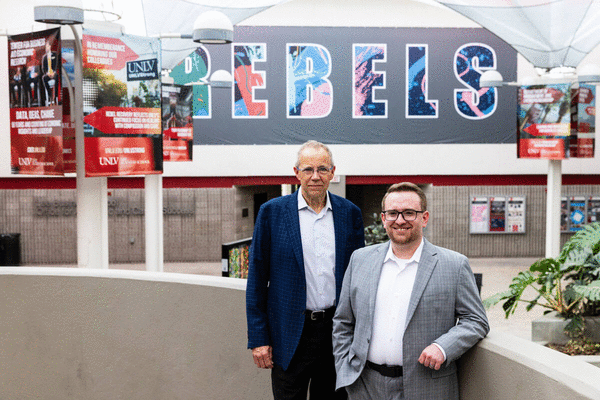
The quickest way to clear a room full of people is to tell them that you work in the insurance industry.
“Because they think you’re going to try to sell them life insurance or something like that, when the reality is nothing could be further from the truth,” said Patrick Hanley, a former industry executive and current director of the UNLV Kerestesi Center for Insurance and Risk Management. “It’s easily the greatest industry you’ve never heard of.”
The perception of the insurance industry — and the younger generation’s hesitancy to join it — has led to what some have called the “silver tsunami,” an impending workforce crisis in which nearly half of the nation’s insurance professionals are expected to retire in the next 10 to 15 years.
The mass exodus from the industry — in which less than 25 percent of professionals are under the age of 35 — is projected to produce a gap of about 400,000 jobs.
“This industry is aging out and is desperately in need of talented people to come in and replace the folks that are retiring out of the industry,” Hanley said. “What wound up happening was we got this merry-go-round of people jumping from company A to company B, C and D, and getting increases in salary along the way, rather than bringing young people into the industry and training them up.”
To help fill the future shortfall, UNLV has created Nevada’s first bachelor’s degree program in insurance and risk management. UNLV is one of only four major West Coast universities to offer the program, which launched in September with 46 students.
“The goal is to create a pipeline from us to the industry, particularly in the West Coast,” said John Starkey, associate director of the Kerestesi Center, which launched in 2023 in UNLV’s Lee Business School.
Tuition costs covered
Tuition costs for the entire first class, or cohort, were covered by a gift from the Nevada Surplus Lines Foundation, which also helped create the Kerestesi Center with a $5 million gift.
After witnessing the success of the new program, the foundation recently awarded another $2.6 million to UNLV to offset tuition costs for the next three classes. The new gift will support a total of up to 180 insurance and risk management students.
The program has 84 active students, with approximately 40 expected to comprise the first IRM graduating class in May of 2027. Twenty-six students have already secured internships in Nevada and several other states.
“The program has exceeded our expectations. I couldn’t be more pleased with the quality of the students,” Hanley said. “As they’re learned more about this industry, their desire to get into it and their excitement for the industry has grown exponentially since August of last year.”
Starkey said it has been rewarding to watch the students’ perceptions of the industry change after entering the program.
“It has been funny to watch students who were hesitant to go into it, and maybe the scholarship attracted them,” he said. “But once they’re in, we notice they’re getting enlightened, ‘Oh, this is what this industry is about. This industry’s about protecting people. This industry’s about figuring out math and scale problems, when there’s a natural disaster and how we can work to insure and help all the people impacted by it.
“Insurance is often seen as a dirty word. We’re changing that and our students are helping us change that because right now they’re working in the industry and they’re loving it.”
Good pay, stable industry
Hanley said one of the challenges in talking to prospective majors in insurance and risk management is explaining to them that it is a viable industry that they can take pride in.
“It’s an industry filled with great opportunities, great people and good pay,” he said.
Starkey said the average annual starting salary in the industry ranges from $70,000 to $75,000, with the potential to reach six figures within a few years.
“Especially if you start in commercial insurance, you can easily make $100,000 within three to five years,” he said. “If you do finance, it usually takes at least a decade to break $100,000. So insurance is also a quicker way to make more money compared to some other industries.”
Another big selling point, Hanley noted, is that the industry is very stable.
“It’s recession proof. It was pandemic proof. It’s everything proof,” he said. “Because as long as there are people and as long as there are businesses, there has to be insurance.
“It is one of the most stable industries, bar none, in terms of your ability to get a job and keep a job.”
‘Insuring body parts for celebrities’
Las Vegas native Haydee Herrera, entering her senior year at UNLV, is a standout student in the inaugural cohort. The Las Vegas Academy graduate hadn’t considered a career in the industry until a scholarship became available.
“It was definitely a very easy choice for me, especially as a first-generation college student,” said Herrera, 20. “I have a single mom and wasn’t sure if college was going to be an option for me. Because of that incentive, I’m very glad I’m able to pursue this career and path in my life.”
Herrera, who has a summer internship with NFP, an Aon company in Westlake Village, California, said she had a misconception about the industry before entering the program.
“I wish everyone knew how those misconceptions were so wrong about insurance,” she said. “Before I thought there’s only agents that sell the basics — your auto, home or life insurance. But there’s so much more to it than that.
“Right now, I’m really interested in the entertainment side of insurance, like insuring body parts for celebrities or insuring big events like Formula One.”
Many celebrities have insured certain body parts to protect against potential income loss. Former soccer star and model David Beckham insured his legs and face for $195 million, according to Time, and soccer star Cristiano Ronaldo took out a $144 million policy on his legs. Singer Mariah Carey insured her vocal cords and legs for $35 million each while on tour in 2016, TMZ reported. Chef Gordon Ramsay insured his tongue for $10 million to protect his palate, according to Mashed.
Herrera plans to pursue a position as a broker in excess and surplus insurance, which is a specialized market that insures things standard carriers won’t cover.
The coming silver tsunami has given her confidence she’ll be able to find a job when she graduates next year.
“I know currently a lot of people will graduate and not find a job for years. It’s really hard to find jobs,” she said. “So seeing 400,000 professionals will be retiring, it’s very appealing.
“I’m very confident because we have all the help from the staff and I know I’m qualified for a job. It’s not just going to be handed to me.
___
©2026 Las Vegas Review-Journal. Visit reviewjournal.com.. Distributed by Tribune Content Agency, LLC.







Comments