Meet the Minnesota man winning your prediction market wagers
Published in Business News
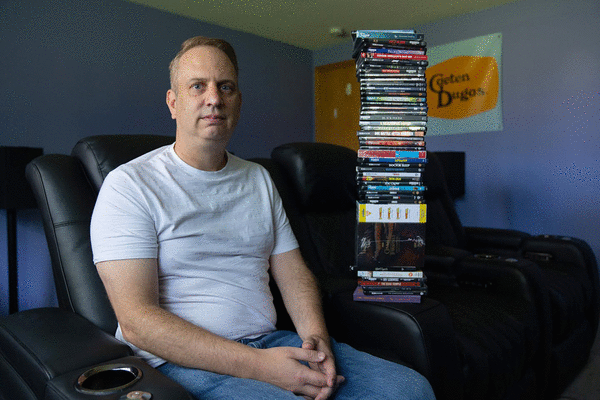
Caleb Davies holds a rare title in the prediction market world: Millionaire winner.
The middle-aged suburban dad relies on a skilled background in finance and tech, plus computer forecasting tools he personally developed, to put real stakes on some of his biggest interests. These days he primarily plays in so-called culture markets, which let users bet on what the hottest songs or movies will be.
His income from winning those wagers is in jeopardy. State officials are locked in a legal battle with the federal government over Minnesota’s new law, which is the nation’s first to make certain prediction market bets a felony.
The legal battle centers on on whether the state or the feds should regulate prediction markets, which hinges on whether they’re treated as gambling or investing. Enforcement is slated to start in two weeks.
As prediction market apps like Kalshi and Polymarket have become widely popular, the platforms have been flooded with what Davies calls “dumb money.”
The 46-year-old Brooklyn Park resident is raking in bigger profits.
“Your Average Joe is not going to win at this,” said Davies, who estimates his overall earnings at about $1.1 million.
Davies’ success illustrates a key concern some consumer advocates have raised about the inexperienced traders signing up for Kalshi and Polymarket: The person you’re betting against has the tools and know-how to beat you every time.
Davies has more than 10 years of experience as a trader, a background working with financial institutions and training as an IT professional. He also possesses a trove of data collected from Rotten Tomatoes and Spotify and has built computer models that help him consistently predict the future with profitable accuracy.
The big prediction market operators are actively working to separate themselves from being associated with traditional gambling, but recent research suggests some users may fare worse than if playing slot machines in a casino.
The volume of trading on the big platforms has ballooned by billions, fueled in large part by people wagering on sports. Wall Street firms are getting in on the action. And so-called sharp traders like Davies sometimes work together, pooling niche expertise to create the next best thing to a crystal ball.
It’s unclear how long the run will last in Minnesota.
The legal fight over who should regulate prediction markets has highlighted lax regulation of the industry under the Trump administration. Critics say the federal Commodity Futures Trading Commission (CFTC), tasked with overseeing the markets, looks more like a guard dog than a watchdog these days.
The federal regulator has sided with the big industry players in several conflicts with states attempting to regulate prediction markets like gambling.
“Essentially, it’s turned into a cheerleader” for the industry, Benjamin Schiffrin, of the consumer advocacy group Better Markets, said of the CFTC.
Minnesota last year placed certain prediction market trades under its anti-gambling statute as felonies, and outlawed the practice of advertising them, effective Aug. 1. A federal judge in Minneapolis will decide whether to temporarily halt the law’s enforcement while the lawsuit to block it grinds on.
The upcoming legal decision could eliminate the availability of some bets on Kalshi and Polymarket for Minnesotans. In Nevada, for example, the platforms are already restricting some access to residents based on a court order there. Kalshi earlier this month lost a court battle in New York, which has tried to regulate the tech firm’s sports contracts like online gambling.
Davies has accepted that Minnesota’s ban could kill his side-hustle.
He’s already maxed out his retirement accounts, outfitted his living room with new furniture, bought a new electric vehicle and installed a $40,000 home theater in his basement. And he’s become a globe-trotter — having now visited 48 countries.
“I’ve got enough of a cushion left over. And all the major bills are covered, that if this income source went away entirely, it’s not really gonna change much at this point,” he said.
It all started with a $300 wager.
Davies smelled easy money when he saw a Facebook ad for a prediction market asking if Joe Biden would run for president in 2015. At the time, Hillary Clinton had already secured her place as the Democratic nominee, he thought, and rather than spend time arguing in the comments section of an online newspaper — his hobby back then — he decided to put his money where his mouth was.
His first trade went on PredictIt, a prediction market site that emerged in 2014 offering bets on political outcomes. Davies won and started betting more when a contest caught his interest. He developed computer tools to help him forecast election outcomes and predict the number of votes a presidential appointee would get in the U.S. Senate.
“It wasn’t a lifestyle or even a very consistent hobby. It was more like something I would do every once in a while,” Davies said.
That changed about five years ago when Kalshi and Polymarket were coming on the scene, he said, and “suddenly you could bet on everything.” He soon realized he could combine his love of movies and music with his aptitude for math to earn a lot more supplemental income. The hours of research he would put into what critics would rate a movie on Rotten Tomatoes, or how well a pop song would perform on Spotify, was fun for him.
In 2024, he said, his earnings started to take off as Kalshi widened the market contracts offered. In March of that year, Davies put $10,000 into his account. He ended the year with more than $200,000, he said.
“I was able to build my bankroll very quickly,” said Davies, who now ranks among the top traders publicly listed on Kalshi. “It’s more than I make working. It’s been an incredible run.”
The explosive growth of prediction markets is inspiring more research on who tends to win and how often.
Earlier this year the Wall Street Journal reported the vast majority of people on Polymarket were losers, with about 67% of profits landing in 0.1% of accounts. Those retail traders were dumping money as Polymarket paid young social media influencers to falsely claim huge earnings, the newspaper found.
Kalshi has said publicly that about three people lose wagers for every winner. The New York-based tech company, which claims to have roughly 90,000 Minnesota users, does not publicly share its data in the same way Polymarket does.
Last month researchers with Roosevelt Institute, a left-leaning think tank, published a report saying retail investors had lost about $583 million on the platform. Unlike casinos and sports books, the report said, the platform enables sophisticated traders to take advantage of “ordinary participants.”
“In some ways it’s really worse than traditional gambling,” said Brad Lipton, one of the project’s researchers. “Oftentimes it’s much clearer who you’re betting against. Pulling the lever on a slot machine, it’s pretty clear you’re betting against the casino. Whereas on prediction markets, there’s really not nearly as much transparency about what’s going on.”
Kalshi fiercely disputed Roosevelt’s findings, saying the conclusions were based on flawed analysis.
Prediction markets are also up against growing concern about the potential for insider trading and manipulation. A little over a week ago, the White House said President Donald Trump’s teleprompter operator had been placed on leave during an investigation involving bets on prediction markets, which host “mention markets” wagering what a famous person will say.
Davies, the Minnesota prediction market trader, does not win every time. Instead his models let him win often enough to stay in the black.
He also considers himself a sort of skilled poker player. And like the rise and fall of online poker, Davies sees problems brewing for prediction markets.
Recently, Davies discovered someone online placing long-shot wagers on the number of times a specific song will get played on Spotify. The predicted outcomes appeared statistically impossible. In one case, the rival better was placing a wager that indie pop artist Malcom Todd’s “Earrings” would rank as a top song. Davies lost $4,500 on the deal — then investigated the data.
He discovered the song’s play ranking benefitted from a spike in listening on Spotify that Davies says must have been manipulated through a process known as “botting” — a computer manipulation of song plays to boost rankings. Davies ran the numbers for real and found the odds of Todd’s song becoming immensely popular for a day at about one versus a number that was 77,000 times more than the number of stars in the universe.
Davies said he identified this real case of fraud and brought the problem to Kalshi — but he was displeased with the response. The company told him in an email the statistical shift could have been caused by other factors.
The experience has soured him on trading Spotify rankings — so much that he may stay out of the game, even if Kalshi puts up another bet. For now, he still has money riding on the year’s top track, and he thinks “Babydoll” by Dominic Fike should win.
“If I can figure it out, it’ll be quite profitable,” he said.
©2026 The Minnesota Star Tribune. Visit at startribune.com. Distributed by Tribune Content Agency, LLC.







Comments