How climate change could redraw California's wine map
Published in Business News
It was Labor Day 2017, and the remote thermometer at McIntyre Estate Vineyard in Monterey County’s Santa Lucia Highlands was registering a noontime temperature Steve McIntyre couldn’t quite believe: 104 degrees.
McIntyre jumped in his car, hoping the sensor was broken. Twenty miles later he stepped out into the searing air at his vineyard and knew there was no mistake. It would hit 116 before the day was over, the hottest since he first planted the site in 1973.
“It felt like a gut punch,” he said.
The U.S. is the largest wine-producing country outside Europe, and 80% of that output comes from California. For an industry in which even subtle shifts in temperature or humidity can transform a harvest’s value, increasing extremes and unpredictability pose an existential threat.
Extreme heat can kill a vine just as it can a human. As temperatures rise, so does the speed at which vines pull water from the soil. Once a plant starts losing water faster than it can rehydrate, it mounts a perilous last-ditch effort to save itself.
The stomates — the parts of the leaf that control gas and water exchange — close up in an attempt to reduce water loss. Photosynthesis slows to a crawl. That can kick off further complications that, without emergency intervention, can be fatal.
“It’s just like a cascade of things that start happening,” said McIntyre, who also runs the vineyard management company Monterey Pacific. “I really do compare it to a human with heat stroke.”
This month, researchers from Japan’s Tohoku University published a granular investigation of California viticulture in a changing climate. After mapping a roughly 16-square-kilometer grid of the state, the team ran each cell through multiple climate models to generate data on current and future weather conditions. They then fed that information into an algorithm to analyze wine cultivation suitability over time.
What they found was a redrawn map of California’s prime wine regions.
The team based its definition of suitability primarily on total annual precipitation, cumulative temperature across the growing season, minimum temperature of the coldest month and vapor pressure deficit, meaning the difference between the amount of moisture in the air at a given point and the amount it could hold when saturated.
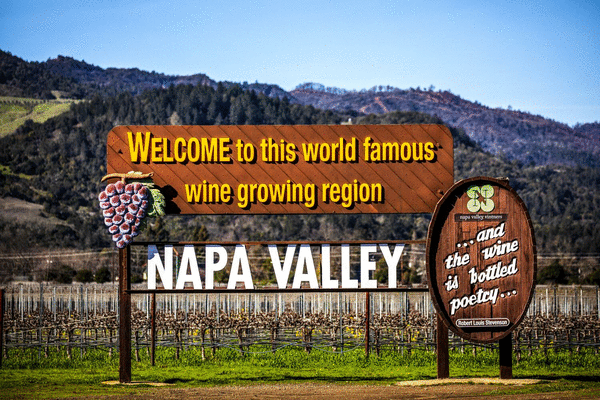
Under their model, suitability for grape cultivation may decline over the next 70 years in Napa and Sonoma counties, which currently dominate the state’s premium wine market. Expected climate changes like increased precipitation, lower relative temperature increases and a decrease in extreme fire-weather days in Monterey and Mendocino counties, in contrast, would significantly increase the area’s suitability for wine production.
Viticulturists and researchers have been sounding the alarm about a changing climate’s potential to upend this signature state industry for decades. In 2011, a Stanford University study projected that land suitable for cultivating premium wine grapes in California’s North Coast region, which includes Napa and Sonoma, could halve by 2040. Winegrape-bearing acreage in California has shrunk steadily since 2013.
Yet these outcomes aren’t inscribed in stone. The model didn’t account for climate adaptations, which virtually all of California’s winemakers are already implementing.
McIntyre’s Chardonnay and Pinot Noir vines survived the 2017 heat wave, in part because the vineyard was already experimenting with shade canopies and could roll them out across the site quickly.
Elsewhere, winemakers are adopting misters and low-water irrigation systems, replanting their rows in directions that avoid the peak of the afternoon sun and even experimenting with heat-tolerant grape varietals.
“By changing when the grapes are picked or how they are managed in the field, growers can adapt to global warming without completely replacing their crops,” said Yusuke Hiraga, an assistant professor of engineering at Tohoku University and the lead author of the study. “These flexible management techniques are expected to be highly useful in protecting wine quality.”
©2026 Los Angeles Times. Visit at latimes.com. Distributed by Tribune Content Agency, LLC.










Comments