Las Vegas startup turns desert air into water
Published in Business News
It sounds like an illusion from a Las Vegas magic show.
Watch as we pull water out of thin air.
But it’s not a trick. Las Vegas-based WAVR Technologies can actually turn air into water.
The deep tech startup that spun out of UNLV is commercializing atmospheric water harvesting systems that extract water directly from the air — even in desert environments at humidity levels as low as 10 percent.
The biomimetic inspiration for the technology came from an Australian tree frog that stays hydrated by absorbing water and moisture directly through its skin.
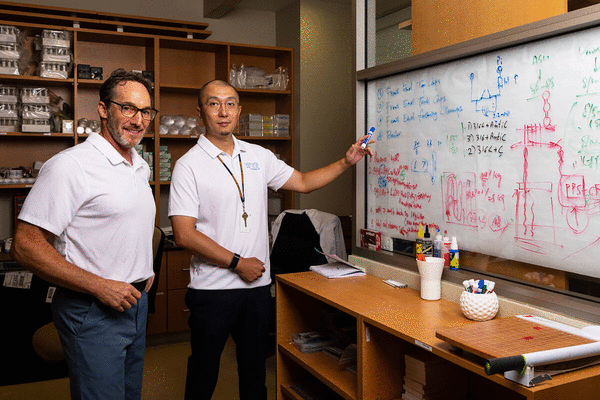
“Like the tree frog is able to drink from the air by attracting moisture through its skin into its salty body, we have developed a synthetic version of the frog skin,” WAVR co-founder and CEO Rich Sloan said at the company’s lab at Roseman (University) Bioventures in Summerlin. “And it performs just like the frog, and we can absorb ambient moisture through the membrane into the body of our product.
“But we continue to evolve the technology. Every few months, we have a new generation of technology. These guys are truly brilliant. So we’ve moved past this.”
Dr. Yiwei Gao, WAVR’s chief technology officer, co-founded the company with Sloan and Dr. Jeremy Cho, Gao’s professor at UNLV, where they patented the device during Gao’s Ph.D. project.
When WAVR launched in 2024, it was producing only a few milliliters of water a day. But now it produces up to 20 liters of water per day per unit. Sloan projects the company to produce 10,000 gallons of water per day per unit by the end of 2027.
“We’re scaling the technology very rapidly,” said Sloan, a serial entrepreneur. “We envision really large systems. A 10,000 gallon per day system fits in about the size of a shipping container.”
WAVR also has smaller pilot systems in the medical field used for kidney dialysis that make five gallons of water a day.
Sloan explained WAVR’s system for turning air into water in the simplest terms.
“It has a special way of soaking up moisture that is in the air, even when it’s dry outside, in almost magical levels of productivity,” he said. “And then we have a hot process on the back end that makes it into a steam. Which then condenses into pure water.
“And it’s a continuous operating system 24 hours a day, 365 days a year.”
$4 million raise
The startup is raising a total of $4 million, including $1.25 million in investments received so far, and has booked $975,000 in revenue.
It has received grants from the National Science Foundation and WaterStart, as well as investments from Desert Forge Ventures, a Las Vegas-based venture capital fund that launched last year and is led by former UNLV president Len Jessup.
“WAVR is solving one of the most urgent challenges facing the American West: reliable access to water,” said Jessup, managing partner of the fund. “Their technology is uniquely capable of operating in the most water-stressed environments, and WAVR is exactly the type of team we had in mind when we launched the fund.”
Desert Forge Ventures made its very first investment into WAVR of $500,000 last year and recently signed a term sheet to lead the seed round for the company with an additional $250,000 investment. It has also formed a co-investment Special Purpose Vehicle capped at $1.5 million that is open to investors in the community. The investment deadline is Aug. 31.
The investment by Desert Forge will qualify WAVR for matching funds of up to $1 million from Nevada’s Battle Born Growth Escalator fund. Battle Born Growth, Nevada’s State Small Business Credit Initiative, matched the original investment of $500,000 in 2025.
“WAVR is a great example of what can happen when we take a different approach to traditional economic development and help move an innovative technology from the laboratory to development and towards commercialization,” said Karsten Heise, Governor’s Office of Economic Development senior director of strategic programs and innovation. “That’s really a main role of our Innovation Based Economic Development division, to identify promising technologies and to turn those into companies by helping to create the necessary conditions for them to grow right here in Nevada.
“WAVR shows the impact that kind of targeted support can have to address key challenges unique to Nevada such as water scarcity.”
‘Unicorn company’
According to groundbreaking research led by Cho at UNLV, the first 30 feet of the Clark County atmosphere holds enough water to cover the region’s daily consumptive water use.
“But you would never think that because it’s so dry here,” Sloan said. “Las Vegas is ground zero for water stress. So there is no better place to develop a solution to the problem than the place where the problem is the worst.”
While WAVR hopes to ultimately help solve the world’s water challenges, it is focused first on solving industry’s water needs.
“And (artificial intelligence) data centers are at the top of the industry list,” Sloan said.
The proliferation of AI data centers has sparked concerns across the country over the massive amount of water needed to cool them.
WAVR, which produces reverse osmosis grade water, aims to solve that problem.
“We want to make machines that make that water at the point of use,” Sloan said. “So instead of being solely dependent on municipal water, we can give you an alternative source of water and give you a path to zero dependency on municipal. That would be huge.
“And it’s completely drought proof.”
The company also has created a separate loop in its device that strips out more than 95 percent of the electricity that otherwise would be required.
Sloan said it might take decades for the technology to make a meaningful impact in refilling Lake Mead. But he can see Las Vegas someday producing a meaningful amount of its own water from the air.
“The ultimate evolution of this is we’re able to attract industries and know that they have the water that they need, so that it doesn’t threaten the water that we’re already counting on from Lake Mead,” he said. “We want to build a success story that is special for this ecosystem. The second thing is it would be great for it to be a big financial win. We want to build what’s called a unicorn company, meaning it surpasses a billion dollars in value one day. So we’re very ambitious.
“The third thing is the impact level, which is we want, over the life of this company, to add billions of gallons of water to the human use cases. If we achieve some variation of those goals, there will be a lot of benefits created for humanity.”
___
©2026 Las Vegas Review-Journal. Visit reviewjournal.com.. Distributed by Tribune Content Agency, LLC.






Comments