Minnesota quartz company caught in fallout from lung disease outbreak sickening California workers
Published in Business News
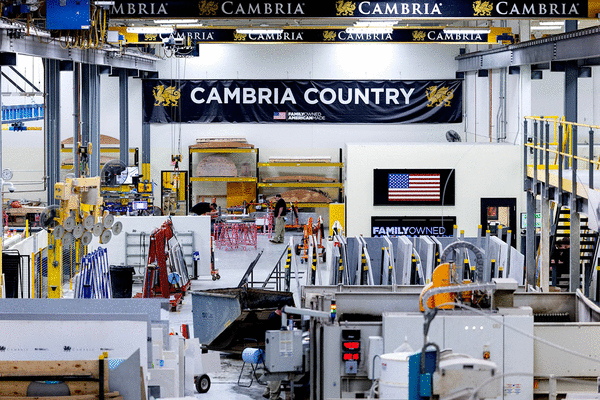
Gustavo Reyes Gonzalez spent years in Southern California cutting and polishing slabs of crushed quartz manufactured by Minnesota’s Cambria and several other companies, fashioning the stone into popular and affordable kitchen and bathroom countertops.
Cutting the stone, he said through a translator, produced clouds of dust in the Southern California shop where he worked for more than a decade.
Little did he know, those clouds were laden with silica. Gonzalez developed a persistent cough. The doctors’ eventual diagnosis: silicosis, an incurable lung disease. In 2023, Gonzalez, who is 36, became one of dozens of workers who had lung transplants. He sued, and in 2024, a jury awarded him $52.4 million.
Le Sueur, Minnesota-based Cambria, the largest U.S.-based manufacturer of processed quartz, is liable for 10% of the award. It and several other suppliers now face hundreds of lawsuits from silicosis-stricken workers like Gonzalez who were not their own employees.
The mounting legal costs combined with tougher regulations being enacted in California could exact a heavy toll on the booming stone industry and one of Minnesota’s largest and most successful manufacturing companies.
Cambria denies it’s at fault. The company is also helping push federal legislation that would shield manufacturers like it from workers’ silicosis lawsuits.
“You have companies like ours caught up in this that are working really hard to create a product that is perfectly safe if handled properly,” said Andrew Eich, Cambria’s president.
Unlike most states, California has made a major effort investigating silicosis cases in the engineered stone industry.
“What we have learned in the past decade or so is that engineered stone is a particular danger,” said Dr. Amy Heinzerling, who leads the California Department of Public Health’s emerging workplace hazards unit. “This is just a hard material to work with safely.”
California sees outbreak of silicosis
The cutting of the stone — and the methods used to do so — is central to the debate over worker safety and liability.
Processed quartz countertops like Cambria’s are not dangerous to consumers, and silicosis hasn’t been a significant issue among workers who manufacture the engineered stone.
Cambria, which calls its product “natural quartz surfacing,” says it has had zero silicosis cases at its three cutting shops.
Company officials blame California’s outbreak on “sweatshop” stone fabricators who aren’t complying with safety rules, coupled with state regulators who’ve failed at enforcing those rules.
“It’s criminal what these shop owners are doing,” Eich said. California is an outlier, he added. “If this really was a true issue with the product, you would have this everywhere, but you don’t.”
While California cases have been increasing, Minnesota has experienced a decline in silicosis cases over the past 15 years, according to the Minnesota Department of Health (MDH).
Yet, “recent events in other states have raised the profile of silicosis among public health professionals and we are working to learn more about the silicosis issue,” MDH said.
Silica dust in lungs
The department also said it will explore changes to state law to improve silicosis reporting procedures.
The first documented cases of silicosis in engineered stone workers surfaced in Spain, Israel and Italy in the early 2010s.
Then, in a 2019 report, the U.S. Centers for Disease Control and Prevention identified 18 severe silicosis cases in four states, including California, mostly among engineered stone workers.
The California Department of Public Health (CDPH) has since tallied 635 silicosis cases among engineered stone countertop workers. About half of the roughly 1,340 stone fabrication shops in California have had at least one silicosis case, according to a recent state report.
Almost all sick workers in California are Latino men, and researchers say many are likely undocumented immigrants. From 2019 through Aug. 13, 35 engineered stone workers have died while over 140 have had, or are eligible, for lung transplants, according to CDPH.
Historically, chronic silicosis — commonly associated with mining and construction — occurs over decades of silica dust exposure.
“That is not what we are seeing here (in California),” Heinzerling said. “We are seeing severe disease developing over a much shorter time period, even five to 10 years.”
In California, the median age of silicosis diagnosis in countertop workers is 46, compared with 65 for workers in all other industries, Heinzerling said.
U.S. silicosis cases have been falling nationally for decades as safety regulations and practices in mining and other silica-prone industries generally improved.
But engineered stone’s high silica content — combined with high dust exposure to fabrication workers — led to California’s silicosis spike, Heinzerling said. The product’s silica content, around 90% by weight, is significantly higher than most natural stone, according to medical studies and experts.
When cut, engineered stone can release particularly tiny dust particles deep into workers’ lungs, those studies say. Resins that bind quartz into slabs may also contribute to lung damage, researchers theorize.
“Even with all the right equipment, and doing all the right things, there are studies that show engineered stone countertop workers can be exposed to unsafe levels of silica dust,” Heinzerling said.
Cambria grew with popularity of processed quartz
There’s a large body of research on silicosis among engineered stone workers.
But Cambria disputes researchers’ conclusions, also saying studies haven’t taken into account that processed quartz stone workers often work with natural stone.
“The literature is purely speculative hypotheses at this point,” said Cambria spokesman Micah Aberson.
Cambria has become a major Minnesota manufacturer over the last 25 years. The company, whose CEO is prominent Minnesota businessman Marty Davis, generates over $500 million in annual sales, and it employs more than 1,000 people in Minnesota alone.
Davis’ family, which once owned a large dairy business and Sun Country Airlines, opened its Le Sueur stone factory in 2001. There, pulverized quartz is mixed with resins and pigments and formed into slabs that are shipped across the country.
Durable, fashionable and generally priced lower than natural stone, processed quartz became consumers’ go-to material for countertops. The industry boomed, and so did Cambria. Its factory has expanded six times over 25 years.
The U.S. engineered stone market is flooded with imports, but Cambria became one of the industry’s big three manufacturers, along with Caesarstone and Cosentino, which respectively hail from Israel and Spain.
Danger comes when cutting
Gonzalez started working in Southern California’s fabrication shops at age 17, shortly after entering the U.S. illegally from Mexico. He said he wore a mask.
Now 36, Gonzalez recalls dust from cutting natural stone falling quickly, but residue from engineered stone lingered in the air, he said. In 2022, what doctors thought to be pneumonia — a common misdiagnosis for sickened stone workers — turned out to be silicosis.
Today, despite his double lung implant, Gonzalez and his wife are trying to have children. But the majority of lung transplant patients don’t live more than 10 years.
With cases like Gonzalez’s piling up, California’s Occupational Safety and Health Standards Board in late 2023 strengthened state regulations for engineered stone fabricators. They banned dry cutting and mandated other safety measures.
Wet cutting — continuously using water during fabrication — controls dust. At Cambria’s own fabrication plant in Belle Plaine, robot machines cut slabs of engineered quartz with jets of water.
Company workers are only directly involved in polishing, and that, too, is done with water-aided hand tools. “If you remove the dust with engineering controls — ventilation and water — you don’t have a problem,” Cambria’s Eich said.
David Michaels, a George Washington University professor of public health, said some fabrication shops in California have sunk millions of dollars into equipment to cut engineered stone safely.
But countertop fabrication is a very competitive business, and a lot of small shops are not financially able or willing to install better safeguards, he said.
Michaels headed the U.S. Occupational Safety and Health Administration (OSHA) when the agency issued a comprehensive silica exposure standard in 2016 — before the silicosis outbreak among processed stone workers.
“We did not take this industry into account,” he said. “The application of the federal OSHA standard is not adequate to protect (fabrication) workers.”
California cracks down on shops
Employer compliance with the rules in California is “very low,” according to an April report from the state Department of Industrial Relations.
The state’s OSHA office inspected about 10% of stone fabrication workplaces in California and cited about 94% of those. It ordered nearly 30 to close.
California’s occupational safety and health board voted in May to grant a physician group’s petition to ban fabrication and installation of engineered stone. Regulators are now drafting a rule.
Australia in 2024 established a regulation that effectively bans engineered stone.
Cambria doesn’t do business in Australia, and California comprises less than 5% of its sales, the company says. But the lawsuits coming out of California and spreading to other states present the company with a costly litigation problem.
There have been a handful of settlements and jury verdicts, and Gonzalez’s silicosis suit was the first to go to trial.
In his case, most of the 34 defendants — companies throughout the stone supply chain — settled. A jury found Cambria and two other defendants liable, including for negligence and defectively designed products.
Cambria is appealing the decision, as well as a jury verdict this spring in a Colorado silicosis case. In the second case, a Denver jury awarded about $17 million to a sickened worker, finding Cambria liable for $5 million for misrepresenting the product, but rejecting claims Cambria was negligent and its product was defective.
In 2025, another California jury ruled in favor of Cambria and other suppliers.
“We’re only a few cases into this,” said James Nevin, an attorney with Brayton Purcell, which has filed over 500 worker silicosis suits against engineered stone suppliers, mostly in California.
Cambria is a defendant in all of them.
“It is the manufacturers that have the primary liability,” said Raphael Metzger, a California lawyer representing about 250 stone workers with silicosis, including Gonzalez. “It’s their product.”
Federal legislation favors stone makers
Cambria contends that since none of the injured workers are its own employees, the suits are “a weaponization of the tort system,” Eich said.
Federal legislation introduced last fall by California Republican Rep. Tom McClintock, and co-sponsored by Minnesota Republican Rep. Brad Finstad, would shield the manufacturers from product liability suits.
The bill passed out of committee in June, and Florida Republican Ashley Moody that same month introduced a companion bill in the Senate.
Davis, Cambria’s CEO, has in the past been a frequent contributor to Republican candidates, including President Donald Trump, donating hundreds of thousands to campaigns.
In 2025, according to federal disclosures, Cambria spent $250,000 on K Street firms in Washington, including the powerful Brownstein Hyatt Farber Schreck, a firm with ties to the Trump administration. (The company also has successfully lobbied for increases in tariffs on imports of the engineered quartz stone.)
Nevin, the workers’ attorney, said giving immunity to stone manufacturers is “insane and goes against 100 years of product liability law to protect consumers and workers.”
And while Cambria representatives say the company is well insured against litigation, Michaels, the George Washington professor, said the lawsuits pose “an existential threat” to engineered stone manufacturers.
If other states follow the lead of California’s public health system, more silicosis cases will follow, he said. “I think this is the tip of the iceberg.”
©2026 The Minnesota Star Tribune. Visit at startribune.com. Distributed by Tribune Content Agency, LLC.









Comments