Terry Savage: The housing crunch is getting critical
Published in Business News
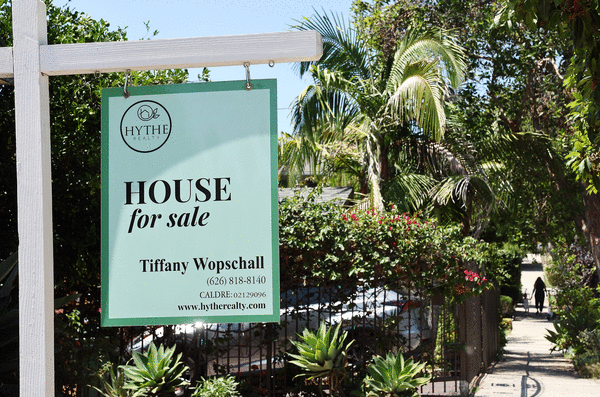
The housing industry is tied in a knot. Sales are dropping, but prices remain high. First time buyers can’t gather the down payment, much less afford the monthly mortgage, because of 30-year rates that remain around 6.7%. Homeowners who locked in rates around 3% during the pandemic can’t afford to move, so they don’t list their homes, contributing to the scarcity of supply.
The problem is only going to get worse, as the cost of building materials continues to rise: Think tariffs, energy to transport materials, and scarcity of labor. The trends are all going the wrong way.
Frank Holmes, CEO of U.S. Global Investors (www.USFunds.com) did the homework in a new report containing some scary housing market statistics. Here is a portion of what he found:
“U.S. home sales fell 4.1% in July to their lowest level in almost two years. New single-family home sales dropped 10.5% to an annualized 607,000 units, the weakest since January. ... Redfin counted over 966,000 buyers in the market in July, the lowest number on record, against nearly 1.5 million sellers. That’s nearly half a million more people trying to sell than buy.”
The affordability problem
Holmes concludes that affordability is a key issue. “And yet the median U.S. sales price just hit $407,730, a record for any July. The FHFA House Price Index has prices up a little over 2% year-over-year. A family earning the median income of $106,800 now needs 34% of it just to cover the mortgage on a median-priced new home.”
He cites the lag in growth of real disposable income: “Real disposable income growth has trailed real spending for 24 consecutive months, the longest run since the 1960s. ... Meanwhile, the savings rate has slid to 2.7%, near the lowest level in history, and HELOC balances — or home equity lines of credit — just posted their 17th straight quarterly increase, to $459 billion. That’s the highest amount since the end of 2017.
When people start borrowing against their house to afford groceries, that’s worth paying attention to.”
Rent vs. buy
“Renting now beats buying in all 50 of the largest U.S. metros, with the average buy-vs.-rent gap at $858 per month,” says Holmes.
According to Zillow, a household saving 10% of median income now needs 8.5 years to reach a 20% down payment. They need a further 6.2 years before owning pulls ahead of renting.”
Another key ingredient is availability. Builders are cutting back on supply, reluctant to spec build homes that buyers can’t afford. Notes Holmes: “Prices aren’t coming down because, simply put, supply is getting choked off faster than demand is falling.
“Single-family housing starts dropped 10% in July to an annualized 808,000 units, the lowest since November 2022 and down 15.7% from a year ago. Builder sentiment has been stuck at 35 on the NAHB/Wells Fargo Housing Market Index for more than two years running, with 50 marking the line between optimism and pessimism....
“Thirty-five percent of builders cut prices in August, by an average of 6%, and 63% are leaning on incentives to move product. ... This tells me they can’t build any cheaper, so they’ve decided to build less.”
It’s no wonder the stocks of homebuilders have tanked in recent months, while the domestic metals and mining companies have seen their stocks soar. Prices are up, tariffs impact imports, and profitability of the mining companies has increased, while homebuilders have been squeezed.
What to do?
This clear-cut analysis of the housing situation in America is lurking under the surface of the current political season. While the inflation numbers may appear to be tame (though not tame enough for the Fed), the issue of housing affordability is seeding a widespread discontent among voters of both parties.
Housing wealth is locked in for seniors, who face high monthly payments if they downsize from the family home. First-time buyers can’t save for the down payment amid rising costs for groceries and gas. And homebuilders can’t afford to build for less in an era of rising inputs on everything from lumber to labor.
Home ownership has always been considered one of the foundations of American democracy, giving people a stake in society. In fact, President Herbert Hoover in 1931 argued at a White House conference that widespread home ownership strengthened citizenship, liberty and democratic self-government. Too bad he didn’t act in time to save all the homes lost in the ensuing depression.
Once again, home ownership is in peril, although it isn’t yet making headlines. Politicians of both parties will pay the price. And that’s The Savage Truth.
©2026 Terry Savage. Distributed by Tribune Content Agency, LLC.









Comments