Trump's deal to 'run' Venezuela after Maduro's capture sidelines Machado, focuses on oil
Published in News & Features
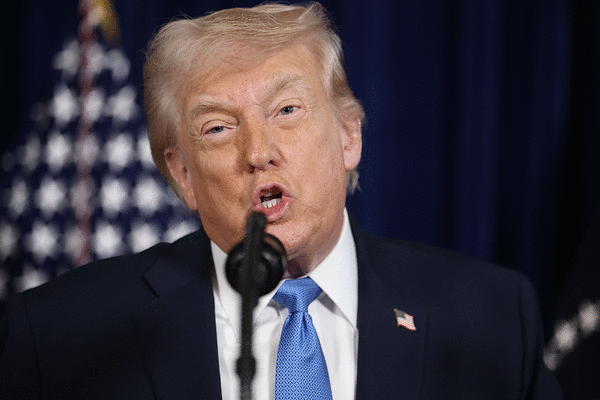
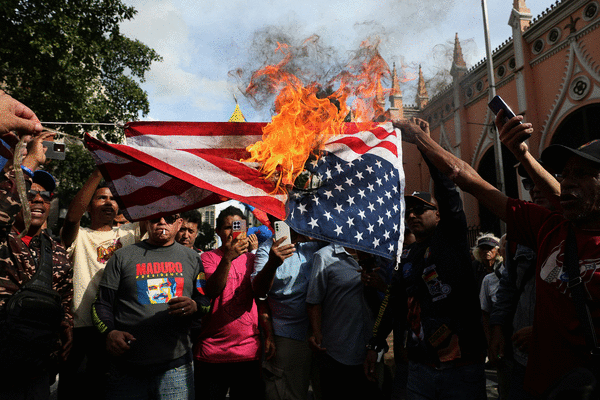
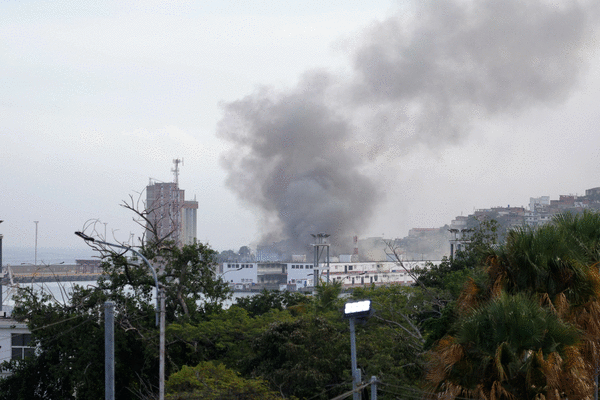
Following the capture of Venezuelan strongman Nicolás Maduro by U.S. forces on Saturday, President Donald Trump said the United States will effectively “run” Venezuela until a political transition takes place — an assertion that appears to rest on an understanding with figures inside the ruling socialist regime and that sidelines opposition leader María Corina Machado.
Those remarks, however, were quickly called into question by senior officials in Caracas. Vice President Delcy Rodríguez described Maduro’s capture as a kidnapping, demanding his release, and said Venezuela would not become “anyone’s colony,” directly challenging Trump’s portrayal of events.
At a press conference, Trump spoke as though Venezuela’s prolonged political and economic crisis was nearing an end under an arrangement overseen by Washington.
“We are going to run the country until such time as we can see a proper and judicious transition,” Trump said. “We can’t take a chance that someone else takes over Venezuela who doesn’t have the good of the Venezuelan people in mind.”
Throughout the briefing, Trump and Secretary of State Marco Rubio suggested that Washington had reached an understanding with remaining leaders of Venezuela’s socialist government over how the country would be governed following Maduro’s capture.
Trump outlined what appeared to be a framework involving Rodríguez that would grant the United States a central role in the development of Venezuela’s oil sector. As described, the arrangement appears to bypass Machado, the Nobel Peace Prize laureate who has served as the most visible face of the anti-Maduro movement.
“I think it’d be very tough for her to be the leader,” Trump said, referring to Machado. “She doesn’t have the support within or the respect within the country.”
Trump acknowledged that his administration has not held talks with Machado, who was awarded the Nobel Prize for her advocacy of what the committee described as a “just and peaceful transition from dictatorship to democracy.”
Within hours, the premise emerging from Washington about its role in the future of Venezuela was challenged by Rodríguez, who said on national television that the Venezuelan people “will never again be slaves … we will never again be a colony of any empire, whatever its nature.”
“We learned this from Commander Chávez. We are ready to defend Venezuela,” she said, announcing the creation of the National Defense Council. “We are willing to have relations based on respect. That is the only thing we will accept after our beloved nation has been attacked and militarily assaulted.”
Trump said details of the agreement for the U.S. to run Venezuela were ironed out in a phone call between Rubio and Rodriguez. “She’s essentially willing to do what we think is necessary to make Venezuela great again,” Trump said of the conversation.
Rodríguez, a close ally of the deposed strongman, was sworn in as Venezuela’s new president Saturday afternoon, just hours after Maduro and his wife, Cilia Flores, were captured and flown by helicopter to the USS Iwo Jima, a U.S. Navy assault ship operating as part of a larger flotilla in the Caribbean. From there, the Venezuelan strongman will be taken to New York to face drug trafficking charges.
Trump added that U.S. forces intend to remain in Venezuela until a transition is secured and warned that further military action remains an option.
“We’re there now and we’re going to stay until such time as a proper transition can take place,” he said. “We are ready to stage a second and much larger attack if we need to do so.
“We’re not afraid of boots on the ground,” he said. He later clarified that the U.S. will have a “presence in Venezuela as it pertains to oil.”
Trump said he will be “designating” U.S. officials to work along Venezuelans to “rebuild the oil infrastructure,” an effort he said would be paid by the oil companies “directly,” though they would be later “reimbursed.”
He mentioned several ways in which the money from Venezuelan oil would be used.
“We’re going to be taking out a tremendous amount of wealth out of the ground, and that wealth is going to the people of Venezuela and people from outside of Venezuela that used to be in Venezuela, and it goes also to the United States of America in the form of reimbursement for the damages caused us by that country,” he said.
Early on Saturday, Trump had hinted the administration would continue focusing on regime change in Venezuela in a call with Fox News, warning Maduro’s allies that “if they stay loyal, their future is really bad.”
“We can’t take a chance and let somebody else run and take over from where he left off, so we are making that decision now,” he said. “We want to do liberty for the people.”
But he fell short of supporting the idea of Machado, the opposition leader, running the country, noting, “they have a vice president, as you know.”
Earlier on Saturday, Machado had told Venezuelans that “freedom day” had arrived and to stay put for an announcement. She has not replied to Trump’s comments.
Some Latin American observers said they were surprised by Trump’s dismissal of Machado, especially because she led a successful campaign that ended up with the documented victory of the opposition candidate, Edmundo Gonzalez, in the presidential elections in July last year.
Trump’s comments on Machado and Rodriguez’s involvement have also been interpreted as a sign that a democratic transition might not be the end goal of the Trump administration in Venezuela.
“Delcy Rodriguez and her brother Jorge Rodriguez has been part of the regime for nearly 20 years so it is a continuation of Chavismo. Chavismo without Maduro continues to be Chavismo,” said Iria Puyosa, senior research fellow at the Atlantic Council.
New details of the raid
U.S. special operations forces captured Maduro and his wife in a covert nighttime raid in Caracas after cutting power across much of the capital, Trump said, describing an operation that unfolded in near-total darkness and faced armed resistance.
Maduro, who along with his wife faces charges in the U.S. of running a large drug cartel out of the presidency in Caracas, arrived Saturday afternoon at Stewart Air National Guard Base in New York, CNN reported.
Previously in an interview with Fox News, Trump said the target was a heavily fortified residence where Maduro was believed to be sheltering — a structure he described as “more like a fortress than a house,” with steel doors, reinforced corridors and a sealed inner safe room designed to withstand an assault.
U.S. forces were prepared to breach that inner room using heavy cutting equipment, Trump said, but the operation moved faster than expected.
“He didn’t make it to that area,” Trump said, referring to Maduro. “We were prepared.”
Trump acknowledged that at least one U.S. helicopter was struck during the operation and that some American troops may have been injured. He said he did not yet have a final casualty report but believed no U.S. personnel were killed.
Trump said the raid followed multiple failed attempts to persuade Maduro to step aside peacefully. He said he personally spoke with the Venezuelan leader and offered what he described as “off-ramps” that would have allowed him to surrender power without military action.
“I told him, you have to give up,” Trump said. “It was close. But in the end, he didn’t.”
Trump framed the decision to proceed with the operation as part of a broader effort to combat drug trafficking, which he blamed in part on Venezuela’s leadership.
Questions from Congress
Maduro’s capture has been praised by those who wanted to see the strongman out of power, but it has raised a flurry of questions about future U.S. actions and what could come next for Venezuelans.
Trump is also facing questions from Congress about what comes next and the legality of Saturday’s attack.
“The American people and Congress deserve transparency and real, concrete answers about what is happening in our own hemisphere,” U.S. Sen. Jeanne Shaheen, a New Hampshire Democrat and ranking member of the Senate Foreign Relations Committee, said in a statement.
“We need to hear directly from the President on why his varying justifications to date warrant dragging America into an armed conflict without a clear end,” she added. “We need to know how President Trump will prevent Maduro’s lieutenants and criminal gangs from filling the power vacuum that his unilateral action is likely to create. And the Administration should explain how it intends to prevent Venezuela from collapsing into further instability.”
U.S. Rep Gregory Meeks, D-N.Y., the ranking member of the House Foreign Affairs Committee, shared similar concerns.
“Let’s be clear. Nicolás Maduro is an illegitimate leader. But using the U.S. military to attempt regime change in a sovereign foreign nation, without approval from Congress, without a defined objective or plan for the day after, and without support from our allies, risks entangling the United States in an open-ended conflict in Venezuela that could destabilize the entire region,” he said.
“This action is also a violation of international law and further undermines America’s global standing.”
©2026 Miami Herald. Visit miamiherald.com. Distributed by Tribune Content Agency, LLC.



Comments