Space Force won't launch Vulcan rockets until booster problem solved
Published in News & Features
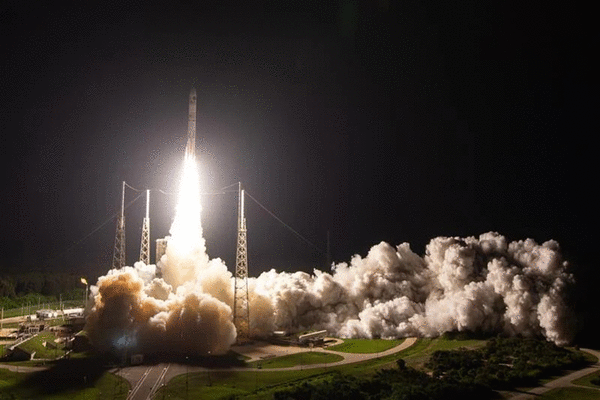
United Launch Alliance was hoping to ramp up its new Vulcan rocket launches this year, but won’t be launching any national security missions until it solves a recurring issue of booster nozzles burning off the rocket on launch.
While the Vulcan’s main first stage was able to course correct and get its Space Force payload to space on the Feb. 12 launch, one of the solid rocket boosters provided by Northrop Grumman saw an anomaly similar to what is suffered on the rocket’s second ever launch. On both flights, the nozzles on one of the boosters became engulfed in flames and broke off during liftoff.
Space Force Col. Eric Zarybnisky said last week that it will be months before they would consider using Vulcan again.
“The investigation is a meticulous, data-driven process, that enables us to identify the cause of the anomaly and necessary corrective actions,” he said. “Until the anomaly is resolved, the U.S. Space Force will not launch national security space missions aboard the Vulcan launch vehicle.”
Vulcan, a successor to ULA’s Atlas V and Delta IV class of rockets, originally was targeting a debut as early as 2019, but faced a series of delays due to COVID, the development of brand new engines from supplier Blue Origin and an explosion on a test pad.
It finally took flight in January 2024 with a second launch later that year, both of which were required before the rocket gained national security certification from the Space Force. But that second flight suffered a solid rocket booster losing its nozzle during liftoff.
That incident ended up delaying certification to April 2025 after the company’s former CEO Tory Bruno, who has since left the company for a job at Blue Origin, said at the time the booster problem was due to a manufacturing defect that had been corrected.
Vulcan was able to perform its first national security launch in August 2025 without issue, but then saw the nozzle problem again on its fourth-ever launch.
“Mission success, right? That was the No. 1 priority. But anytime there’s an anomaly, my team is going to be actively engaged with the contractors to make sure we understand what happened and we correct that issue,” Zarybnisky said. “So we’re still in the initial phases of that investigation. We’ll continue to work with United Launch Alliance and their suppliers to make sure we’ve got the right level of insight and we understand where that investigation is headed.”
He said the review would be a monthslong process as they work through the exact technical issue that happened on the recent launch as well as the corrective actions needed to make sure it doesn’t happen again.
“I definitely don’t want to say that this is just an everyday thing that we’re just going to go do. It is still rocket science, day in and day out,” he said. “So we will go do our due diligence and make sure we understand what happened there and what corrective actions we need to take.”
For ULA, a shared venture between Boeing and Lockheed Martin that was formed in 2006, that could mean they won’t get back to national security launches until the latter half of this year. It took more than six months for the Space Force to give ULA its certification after the last anomaly.
The company has a backlog in the 25 missions for the Department of Defense that were assigned to Vulcan, with several having already missed their original target launch date.
It has dozens more planned for Vulcan for commercial flights, but ULA has not said if it will move forward with any of those missions before solving the anomaly. It also has several remaining Atlas V rockets it can launch in the meantime, but it’s unlikely it will get near its goal of hitting 20 launches this year.
Some of the DOD missions will be looking at delays of nearly four years from original targets when they were awarded.
That could mean the Space Force shifts some of the awarded missions from ULA to SpaceX, something it has already done a few times for GPS satellite missions, although those have been trades with ULA promised the ability to fly some missions that had been awarded to SpaceX down the road.
“I’m going to look for every flexibility I have to make sure that I can deliver war fighter capability as quickly as possible,” Zarybnisky said. “I’ve got a number of tools in my toolkit to do that. But until this anomaly is solved, we will not be launching national security space launch missions (on Vulcan).”
_____
©2026 Orlando Sentinel. Visit orlandosentinel.com. Distributed by Tribune Content Agency, LLC.






Comments