Machado says she'll return to Venezuela soon, despite warning from Delcy Rodríguez
Published in News & Features
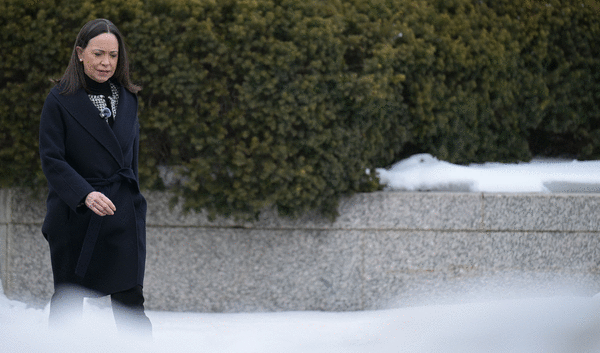
Opposition leader and Nobel Peace Prize laureate María Corina Machado said she plans to return to Venezuela “in a few weeks” to help steer what she described as an “orderly, sustainable and unstoppable transition to democracy,” despite a sharp warning from interim Chavista President Delcy Rodríguez.
In a video message released from the United States on Sunday, Machado said her return would focus on forging a “broad national agreement” to guarantee governability and prepare for “a new and massive electoral victory.”
“For all of this, I will return to Venezuela in a few weeks. I want to do so just as hundreds and thousands of Venezuelan exiles around the world wish to,” she said.
Machado left Venezuela last December to travel to Norway to receive the Nobel Peace Prize medal after spending a year in hiding to avoid arrest by the regime. Authorities had issued a warrant amid an intensifying crackdown on opposition leaders.
Her announcement comes during a fragile political transition following the Jan. 3 capture and removal of Nicolás Maduro in a U.S. operation that Washington described as the culmination of a prolonged investigation. Machado portrayed the episode as a decisive turning point.
“For years we said that this regime would only relinquish power when confronted with real force and a credible threat,” she said. “First we had to defeat them spiritually, then politically, then electorally and finally militarily. We said it would happen — and it did.”
She reiterated the opposition’s claim that Maduro had been “overwhelmingly defeated” in the July 28, 2024, presidential election by opposition candidate Edmundo González Urrutia. Maduro’s allies rejected those claims and maintained control of state institutions.
Machado credited President Donald Trump with playing a decisive role in Maduro’s arrest, saying he “brought Nicolás Maduro before international justice.” She thanked the U.S. government, members of Congress and U.S. service members “who risked their lives for Venezuela’s freedom and for the national security of their country and the security of all the Americas.”
During her stay in the United States, Machado said she met with Trump, Secretary of State Marco Rubio, senior State Department officials, 17 U.S. senators and 27 members of Congress. She also held meetings with representatives of 51 diplomatic missions, the Organization of American States, the Inter-American Commission on Human Rights, human rights groups, and business leaders in the financial, energy and technology sectors.
“To all of them I have conveyed the enormous potential Venezuela has — a bright future for that democratic Venezuela,” she said, outlining plans to restore the rule of law, rebuild public services, and provide legal and personal security to attract investment and encourage the return of millions of Venezuelans who have emigrated.
Venezuela has experienced one of the world’s largest displacement crises in recent years, with more than 8 million people fleeing the country amid economic collapse and political repression.
Machado announced her plans despite Rodríguez having signaled that she could face legal consequences if she returns.
In comments released ahead of a full interview with NBC News published last month, Rodríguez was asked whether Machado would receive security guarantees after months in hiding.
“With respect to her life, we do not understand why there is so much commotion,” Rodríguez said. “As for her return to the country, she will have to answer before Venezuela. Why did she call for a military intervention? Why did she call for sanctions against Venezuela? And why did she celebrate the actions that took place at the beginning of January?”
Rodríguez was referring to Machado’s support for international pressure on Maduro’s government and for the Jan. 3 U.S. operation that resulted in the capture of Maduro and his wife, Cilia Flores.
Machado has long defended sanctions and external pressure as necessary to confront what she describes as a repressive regime. In her address Sunday, she accused officials who remain in positions of authority of seeking to “buy time so that nothing changes.”
After Maduro’s capture, Trump publicly backed Rodríguez’s interim government, saying it was operating with his administration’s support and meeting Washington’s conditions, including granting access to Venezuela’s oil sector.
The arrangement has raised questions about the balance of power within the transitional framework and the degree of U.S. influence over political and economic decisions in Caracas.
In her address, Machado outlined a three-part road map: strengthening opposition unity forged during primary elections and grassroots mobilization; consolidating a broad national agreement to ensure governability during the transition, and preparing for new elections.
“We will arrive to embrace one another, to work together, to guarantee an orderly, sustainable, and unstoppable transition to democracy,” she said. “Freedom is approaching.”
_____
©2026 Miami Herald. Visit miamiherald.com. Distributed by Tribune Content Agency, LLC.




Comments