Federal agents lied about why they shot a Venezuelan man in Minneapolis. Their story quickly fell apart
Published in News & Features
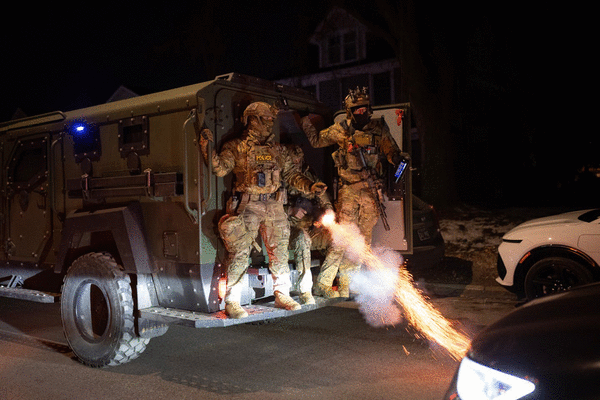
Hours after an ICE agent shot and wounded a Venezuelan immigrant in north Minneapolis in January, the Department of Homeland Security spun a narrative that the victim had it coming.
He and two other men “ambushed and attacked” the federal officer with a snow shovel and broom handle, the agency claimed on social media, prompting the agent to fire in self-defense.
The next morning, DHS Secretary Kristi Noem doubled down, denouncing the incident as an act of “attempted murder” on law enforcement. Her agency published mugshots of all three men arrested in connection with the alleged assault, casting them as “violent criminals.”
None of it was true.
Yet two Venezuelan nationals, Julio Cesar Sosa-Celis and Alfredo Alejandro Aljorna, were charged with assaulting a federal officer.
A third, Gabriel Alejandro Hernandez-Ledezma, was quickly shipped to Texas — despite taking no part in the encounter. He watched it all unfold from a first-floor window inside the duplex.
Hernandez-Ledezma remained in custody for weeks without charges, transferred to three different Texas facilities in what his lawyers called “a crude attempt to avoid judicial review.”
The Jan. 14 shooting sparked chaotic protests and an hourlong standoff with federal authorities at the suspects’ shared north Minneapolis duplex, where agents shattered an upstairs window and deployed tear gas inside a residence filled with women and young children.
The government’s official story would unravel in court — refuted by video surveillance, crime scene photos and witness statements.
Nearly a month after the shooting, Minnesota’s top federal prosecutor, Daniel Rosen, asked a judge to dismiss criminal charges against Sosa-Celis and Aljorna once it became clear that the federal agents involved lied during sworn testimony. Those unnamed officers were suspended pending an internal investigation, which could result in their termination or criminal prosecution.
The case was one of the many falsehoods touted by the Trump administration about the people detained, arrested and killed by federal agents during Operation Metro Surge. It also marked the only time that federal authorities admitted wrongdoing.
The DHS did not respond to a list of questions for this story.
None of the four adults living upstairs in the north Minneapolis duplex where the standoff occurred had current legal status to be in the United States. The men entered the country without authorization in May 2023, seeking temporary protected status. The women, both now 19, each came separately as unaccompanied minors.
In January, as the largest immigration crackdown in American history engulfed their adopted city, the families feared leaving the house.
Sosa-Celis, 24, and Aljorna, 26, worked as Door Dash delivery drivers to support their partners and toddler sons.
During the federal operation, that job put them at risk. So friends and neighbors dropped food and toys at their doorstep. The kids stayed home.
But on that particular evening, Aljorna decided to make a delivery. While on Interstate 94, an unmarked vehicle carrying two U.S. Immigration and Customs Enforcement officers attempted to pull him over, mistaking Aljorna for another target.
A chase ensued, ending when Aljorna crashed his car into a light pole on the 600 block of N. 24th Avenue. What happened just after he exited the vehicle and the nature of the subsequent scuffle have been contested ever since.
DHS officials insisted they were pursuing the same man that an agent then shot. That wasn’t true — a fact later acknowledged in sworn affidavits.
They also claimed two men rushed from a nearby residence and, alongside the original arrest target, attacked the officer “with weapons” as he lay on the ground. That’s when the agent fired, allegedly in fear for his life.
But an FBI special agent later testified that video surveillance footage from the street did not corroborate that account.
The state Bureau of Criminal Apprehension is investigating the incident, but the agency has been barred from interviewing the federal agents involved and has not been granted access to evidence collected by the FBI.
Witnesses always maintained that the ICE agent fired after the men fled into the house, striking Sosa-Celis in the thigh. Evidence later proved that a bullet pierced the door, undermining the officer’s self-defense claim.
Videos filmed in the aftermath of the shooting depict the terrified occupants huddled in the dark as they attempt to explain what happened to relatives and a 911 operator.
In a 23-minute call to her mother, Sosa-Celis’ partner, Indriany Syrisnoy Mendoza Camacho, wails while clutching her 3-year-old son on the floor. Soon after, federal agents shatter a second-story window and shoot tear gas inside the house.
“They’re going to get in,” she says in Spanish during a call translated for the Minnesota Star Tribune. “Mom! Mom! They’re going to kill us.”
Ji Hae Kim, an attorney who was on the line with family members, said she didn’t need to know Spanish to recognize the fear in their voices. At the time, residents believed agents were firing live rounds inside the building.
Kim instructed them to get away from the windows and “stay down,” emphasizing that they should not resist or throw anything back.
“I would have never in a million years thought that I would be telling a group of completely innocent, nonviolent human beings … how to not get shot in their own home by our government,” said Kim, a corporate attorney who provides pro bono immigrant aid. “This is not normal.”
After about an hour, ICE agents broke down the door, stormed the house and put the families into waiting vans. Camacho carried her young son outside, hoping to pass him to a friend who was waiting in the crowd and who is an American citizen. But federal authorities did not permit the exchange, her mother said.
Both Camacho’s son and Aljorna’s 18-month-old were relinquished to friends the next day under legal documents called a Delegation of Parental Authority (DOPA). They immediately returned the children to their respective grandmothers, who share an apartment in the Twin Cities.
None of the occupants or their relatives were allowed back into the duplex, now an active crime scene, so the children could not retrieve any belongings.
In the days that followed, Camacho’s little boy asked his teacher to deliver some toys — a dinosaur, Play Doh and a Lightning McQueen car.
His grandmother had another request: a baby bottle. The 18-month-old had not yet mastered drinking from an open cup, and the family did not feel safe leaving their apartment to go buy a bottle.
Tricia Armstrong, a speech therapist who began working with the older boy last spring, dropped off the groceries and a few extras.
“They’re a wonderful family,” she said, lambasting the DHS’ attempt to paint them as “evil criminals” in their statements about the shooting. “The way it’s spun makes it seem like (Sosa-Celis) is one of these dangerous, murdering rapist gang members from Venezuela.”
In reality, he has no criminal record beyond driving infractions.
“It’s cruelty on top of cruelty on top of cruelty.”
Within 48 hours, Camacho and Valentina De Los Angeles Tiapa Moreno, Aljorna’s partner, were flown to a detention facility more than 1,000 miles away in El Paso, Texas. Neither has a criminal record nor was accused of any new crime.
Yet federal agents put them on a plane while shackled from the waist, hands and legs. For nearly two weeks, Camacho lived in a large holding pen with approximately 70 other women. She slept on a top bunk where water dripped from the ceiling onto her bed, she said, and was served spoiled food.
“The smell was really peculiar,” Camacho said through an interpreter last month during an interview from the St. Paul federal courthouse following her release. “So we just didn’t eat.”
During her daughter’s incarceration, Yamelis Camacho tried to be honest with her grandson every time he cried for his mother. “She’s in a place where she can’t leave,” Yamelis recalled telling him.
The two men, Sosa-Celis and Aljorna, were held at Sherburne County jail while awaiting criminal proceedings in federal court. They called whenever they could to talk with the boys.
Attorneys eventually won freedom for Camacho and Moreno after federal judges ruled their continued detention unlawful.
Days later, their partners were also released, and the close-knit families were reunited under one small roof. All four are temporarily barred from any potential deportation proceedings until the conclusion of the investigation.
In a phone interview from her home, Camacho’s mother told the Minnesota Star Tribune that she feels so much pain from the ordeal, and she wants the world to understand who ICE is actually targeting.
“I understand this is their job, but the way they’re doing it is not OK,” she said through a translator. “We’re not all bad people. We are good people. We work really hard.”
Hernandez-Ledezma, 28, lived on the bottom floor of the north Minneapolis duplex with his 60-year-old uncle, a pregnant cousin, her partner, and their four kids. His cousin was late into her third trimester when federal officers fired tear gas inside their building.
Agents broke down their door and whisked him away, court records show, without producing a warrant.
DHS officials posted his mugshot the next day, accusing him of a crime he did not commit. No charges were ever filed — and no government official corrected the record.
In a court filing, his lawyers argued that his arrest and quick transfer to Texas served another, more ominous purpose: to shut him up.
As a key witness in the BCA’s use of force investigation, his testimony “undermines the federal government’s narrative of what occurred, in order to prevent contrary information from coming to light.”
“Gabriel’s life has been turned upside down by ICE’s actions in Minnesota,” said Jeanette Boerner, director of Hennepin County’s Adult Representation Services, the attorneys representing Hernandez-Ledezma. She hailed the District Court order finding her client’s detention unlawful as vindication against an unjust arrest and the “deliberate smearing of his name,” but she said it does not give him back the weeks he spent locked up.
“We look forward to further investigation into this matter and hope that those responsible face consequences.”
Kim, the attorney who assisted the family that night, said their story is indicative of the widespread flaws in how immigration law is enforced, along with the enduring trauma it causes.
“What is going on shouldn’t be a political issue,” Kim said in a recent interview. You can believe that America needs tighter controls at its borders and a different immigration policy, she added, while acknowledging that the tactics being used are not humane.
“It’s (about) treating people with dignity in this entire process. We are not doing that right now.”
_____
(Sarah Nelson of the Minnesota Star Tribune contributed to this report.)
_____
©2026 The Minnesota Star Tribune. Visit startribune.com. Distributed by Tribune Content Agency, LLC





Comments