Pentagon seeks $200 billion for campaign against Iran
Published in News & Features
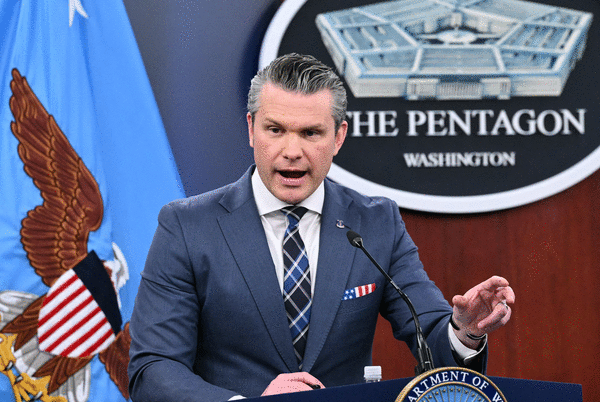
WASHINGTON — The Pentagon has asked for an additional $200 billion from Congress to pay for the war against Iran, a person familiar with the matter said, as Defense Secretary Pete Hegseth argued that the campaign was ahead of schedule and disputed that the U.S. was getting embroiled in a quagmire.
The person, who asked not to be identified discussing private deliberations, said that the request has been sent to the White House for review and President Donald Trump has yet to sign off. Asked about the figure on Thursday, Hegseth didn’t deny it but said the number could move.
“It takes money to kill bad guys,” Hegseth told a press conference. “We’re going back to Congress and our folks there to ensure that we’re properly funded.”
If approved by Congress, a $200 billion supplemental spending bill would be the largest since a COVID relief bill in 2020, according to the Congressional Budget Office. The Washington Post was first to report the figure.
The sum is far larger than the estimated $65 billion the U.S. has spent in security assistance to Ukraine since 2022 and suggests that the administration sees a long campaign ahead against Iran. Democrats criticized the plan and Republicans were noncommittal.
Senate Armed Services Chairman Roger Wicker declined to comment on the figure, saying he hasn’t received any details from the administration. Several other Republican senators sidestepped questions, with Eric Schmitt of Missouri calling the figure “conjecture.”
“At this point, a supplemental has not been submitted, so I’m going to wait and see what’s actually submitted,” Senator Ted Cruz of Texas said. “I will assess it on the merits after they submit a request for supplemental.”
Asking for such a huge sum could be a liability for Trump, who has long criticized his predecessors for getting the U.S. into so-called “forever wars” in Iraq and Afghanistan, and campaigned on the idea that he started no new conflicts in his first term. In his second term, he’s launched strikes against Yemen, Nigeria, Syria and Somalia along with the raid that captured Venezuelan President Nicolas Maduro and successive strikes on Iran.
Trump has repeatedly said he wants to boost military spending, arguing last year that he wants to increase the annual defense budget by $500 billion to $1.5 trillion. That’s run counter to his push, especially early in his administration, to deploy Elon Musk’s Department of Government Efficiency to cut costs across the government.
U.S. officials told lawmakers that the first six days of the war with Iran cost more than $11.3 billion. The Senate’s top Democrat, Chuck Schumer of New York, said the size of the anticipated request reflects the intensity of the operations.
“If Trump wants $200 billion, it means he believes we will be at war for a very, very long time,” Schumer said on X. “That’s the last thing Americans want.”
Hegseth brushed aside criticism of the operation at Thursday’s press conference. He said the U.S. campaign was proceeding as planned and attacked the media for what he said was unfair skepticism about Trump’s approach.
“The media here — not all of it, but much of it — wants you to think, just 19 days into this conflict, that we’re somehow spinning toward an endless abyss or a forever war or quagmire,” Hegseth said. “Nothing could be further from the truth.”
Hegseth said the U.S. was “winning decisively” — destroying Iran’s ballistic missile arsenal, its navy and submarines. He declined to answer a question about a specific time frame, but said the U.S. is “on plan” with a “clear set of objectives” and would end the conflict at a time of “the president’s choosing, ultimately.”
_____
(With assistance from María Paula Mijares Torres and Alicia Diaz.)
_____
©2026 Bloomberg L.P. Visit bloomberg.com. Distributed by Tribune Content Agency, LLC.






Comments