Tijuana takes steps to tackle police extortion of visitors amid mounting concerns
Published in News & Features

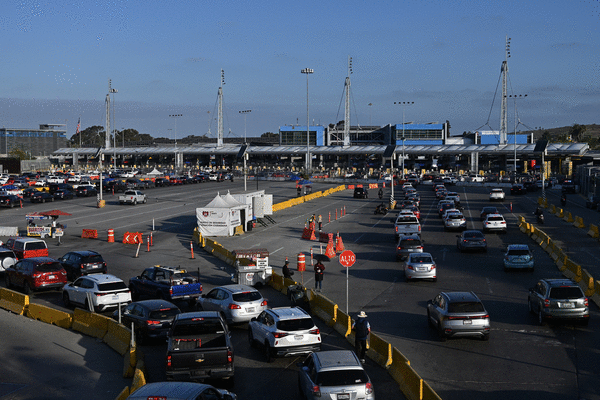


The couple from Fallbrook was returning from a dentist appointment in Tijuana when they were pulled over by a Tijuana traffic officer. What unfolded next made them swear to never drive across the border again.
The husband and wife were trying to enter the SENTRI lane to cross back into San Diego. As traffic moved through a busy Tijuana intersection, an officer waved them through so they wouldn’t block it. So they moved and, in doing so, apparently drove against a red light.
The officer then pulled them over. The reason? Running a red light.
They had two options, the officer told them: Pay him now, or have their truck towed. Confused and unfamiliar with both the language and the rules, the couple chose to pay $700. That’s more than triple the maximum fine for running a red light, $210.
What the officer did not make clear, they alleged, was that they had the option to appear before a city judge immediately and pay the fine at the police station that same day.
“Well, the first thing we decided, we’re never going to drive here again,” said the husband, 79, who asked not to be identified for fear of repercussions. That interaction happened months ago. While they still cross into Mexico from time to time, they instead take the trolley to the border and cross on foot. “It was like the end of an era for us,” he said.
Local leaders say they have been hearing similar stories of alleged police extortion in recent months from visitors to the large border city, many of them who drive vehicles with California license plates.
“If people have a negative experience, they won’t come back,” warned Atzimba Villegas, president of the Baja California Health Tourism Association. “One negative comment can affect us all,” she added.
In response to this long-standing issue, Tijuana government officials have taken action in an attempt to strengthen police accountability, including launching an app for reporting incidents, equipping police with body cameras, and even exploring the possibility of changing city rules involving foreign license plates.
While such incidents are not new, several have gotten public attention over the past year.
In December, a video circulated on social media showing an officer from the Tijuana Mobility Secretariat — an agency that regularly assists with traffic near ports of entry — informing a woman at the SENTRI line that she had committed a $200 traffic violation and that her vehicle could be towed as a result.
As the woman was about to pull over, the officer suggested that she pay the fine on the spot so that she could leave. She told him she only had $20, which he hurriedly accepted, the video shows.
Tijuana Mayor Ismael Burgueño said at the time that the officer was immediately fired. “I will not tolerate any act of corruption by a public official,” he said in a video posted on his social media. The mayor said that the officer was not authorized to request any payment and urged the public to report such cases.
Months earlier, Tijuana police had suspended two officers for allegedly extorting two Los Angeles tourists. According to a Telemundo San Diego report, the officers intended to ticket the tourists for driving with tinted windows but instead asked for money to let them go.
In late March, ahead of Holy Week — one of the busiest vacation periods in Mexico — police in Playas de Rosarito, a beach town about 30 minutes from the U.S.-Mexico border, launched an anti-bribery campaign.
“If you are asked for money, do not allow yourself to be intimidated: reporting it is your right,” read a flyer in English handed out by police officers in Rosarito, as seen in a video posted by officials on Facebook.
Apps and body cameras
Just over a week ago, the city of Tijuana began equipping its police officers with an initial round of 400 body cameras in an effort to prevent “any form of extortion or corruption,” Burgueño said. While that will equip just a fraction of the roughly 2,400-person police force, the city is prioritizing officers who work in tourist-heavy zones and near the ports of entry.
Use of the body cameras is now mandatory per amended city regulations, and officers who fail to comply may face sanctions, the mayor said.
Olivaldo Paz, president of the Tijuana chapter of the National Chamber of Commerce, who has reported cases of alleged police extortion to the media, said that equipping police officers with body cameras would “absolutely help.” He just hopes that officers actually turn them on.
Officials are also turning to mobile apps, as they have done before with other public safety concerns.
In late March, Tijuana officials introduced an English-language app known as the Emergency Button, or Botón de Emergencia. The app is designed to “promote a safer, more reliable, and more efficient experience during their stay in the city,” officials said in a news release.
The app allows tourists and U.S. citizens living in Tijuana to report police extortion, car crashes and thefts. It also provides information about local traffic rules.
Once the emergency button is pressed, a notification is sent to the Tijuana Control and Command Center, and assistance is provided via chat. The app uses GPS to pinpoint the location of the incident, allowing the city’s nearby surveillance cameras to be quickly directed toward the scene.
This creates “another channel for oversight and transparency,” said José Alejandro Avilés, head of Tijuana’s Secretariat of Security and Citizen Protection. During a news conference at the U.S. Consulate General in Tijuana, he explained that “the cameras will focus on the interaction, and we will monitor how the interaction protocol unfolds.”
The app builds on an existing emergency button that allows locals to file reports. To date, it has been downloaded more than 60,000 times, officials said. The Botón de Emergencia app is available on Google Play and the Apple App Store.
Tijuana has previously tested using mobile apps in addition to the state’s 911 system for emergency situations. The city developed the Purple Button, or Botón Morado, app, which women use to report emergencies.
“This app will provide another tool for citizens who may need assistance,” said Christopher Teal, U.S. consul general in Tijuana. “The great thing about it is that it offers bilingual information to help many people who perhaps don’t speak Spanish well or fully understand the rules here in Tijuana and Baja California.”
Tickets must be paid ‘immediately’
Tijuana has the busiest land border crossing in the Western Hemisphere, with some 130,000 people crossing per day. Baja California’s medical tourism industry alone draws nearly 4.5 million visitors each year.
Many visitors and U.S.-citizen residents alike drive California-licensed vehicles. That could make them more vulnerable to extortion.
Tijuana’s traffic regulations, available to read through the Emergency Button app, state that vehicles with foreign or out-of-state license plates must pay any traffic violation fine “immediately.”
Under the law, vehicles with foreign license plates may otherwise be impounded by police.
Those who commit a traffic infraction are permitted under the law to drive to a nearby police station and appear right away before a city judge there. Drivers can explain their case and pay the fine set by the judge.
The regulations also stipulate that tickets could be paid on the spot to the police officer who issued them, as long as the officer has the necessary portable equipment to accept only card payments. In March, Burgueño told the media that although the option is allowed by law, they were still working on its implementation. At that time, officials were also exploring the possibility of allowing payments through the emergency app for tourists in the future.
The laws requiring prompt payment were implemented years ago because some drivers with foreign plates were failing to pay their fines, officials said.
However, some city officials have said that they have heard the concerns and are considering adjusting certain rules.
Tijuana Councilmember Ranier Falcón, who chairs the Public Safety and Civil Protection Committee, said that they have received input from the public, nonprofit organizations and chambers of commerce. He said the next step would be to have conversations with several local officials.
The council member said they have also detected cases in which the credit card terminal at a police station cannot process a ticket payment for some reason. This requires drivers to go to the nearest station, which wastes a lot of time for both drivers and officers.
“The current regulations, unfortunately, do not provide the necessary framework to curb extortion or, also, bribery,” Falcón said.
One suggestion they have considered is to issue tickets to drivers with California license plates and give them time to pay. However, they would impose other sanctions if the drivers failed to do so.
The Fallbrook couple said they were glad to hear about the local government’s efforts to address the issue, including the use of body cameras and the app.
“Both of those are great steps,” the husband said.
But it’s still not enough to get them back behind the wheel.
©2026 The San Diego Union-Tribune. Visit sandiegouniontribune.com. Distributed by Tribune Content Agency, LLC.






Comments