'Striking' purple waves spotted at California shore. What is causing the color change?
Published in News & Features
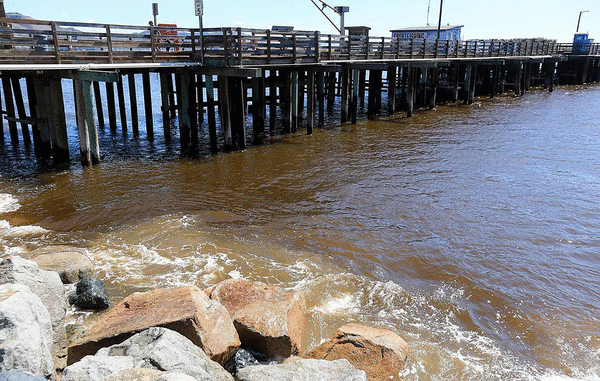
SACRAMENTO, Calif. — “Striking” purple waves are crashing onto the Northern California coastline, according to an online news feed.
“(It’s) not something you see every day, a purple wave in Point Reyes” in Marin County, The West Marin Feed wrote in a Sunday, May 3, on X.
According to experts, the violet-colored waves aren’t the result of someone pouring dye into the water.
Instead, the color change is linked to a natural phenomenon that’s common in the spring and summer.
Here’s what to know:
What is causing California waves to turn purple?
Red- or purple-hued waves are the result of phytoplankton — “microscopic, single-celled plants that occur naturally in our coastal waters,” the California Sea Grant said.
These tiny, plant-like creatures use photosynthesis to turn sunlight into energy.
“When conditions are right, phytoplankton populations can grow explosively, a phenomenon known as a bloom,” NASA said.
Although phytoplankton serve as food for fish, whales and other animals, they can also be deadly, according to NASA.
“Certain species of phytoplankton produce powerful biotoxins, making them responsible for so-called ‘red tides,’ or harmful algal blooms,” NASA said. “These toxic blooms can kill marine life and people who eat contaminated seafood.”
Why do red tides look red?
According to the California Sea Grant, the phytoplankton cells that cause red tides contain “pigments for capturing sunlight needed for cell nourishment, growth and reproduction.”
“These pigments can give off a reddish color when millions of cells are concentrated in each gallon of seawater along our coast,” said the California Sea Grant, a partnership between the National Oceanic and Atmospheric Administration, the state of California universities across the Golden State.
“Individual phytoplankton are tiny, but when they bloom by the billions, the high concentrations of chlorophyll and other light-catching pigments change the way the surface reflects light,” NASA explained.
Not all red tides are actually red.
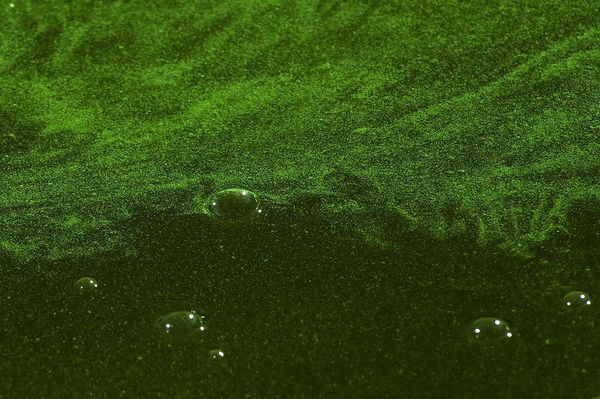
Phytoplankton blooms can also make water appear purple, burgundy, brown, green or even yellow, experts say.
“If you were to look at just one of these cells under a microscope it might actually have a golden-brown color,” the California Sea Grant said.
When do red tides occur?
In California, the majority of red tides occur between early spring and late summer, according to the California Sea Grant.
That’s when “sunlight increases and the relentless mixing of the water by winter storms subsides,” NASA explained, adding that vigorous wave member in the winter may bring “nutrients up from deeper waters into the sunlit layers at the surface.”
Phytoplankton blooms can be found along the California coast, from Humboldt Bay in Eureka to the Channel Islands off the coast of Santa Barbara to Scripps Pier in La Jolla, according to NASA and the Southern California Coastal Ocean Observing System.
What are jellyfish-like animals in the waves?
According to The West Marin Feed, juvenile salps were found in the purple waves in Point Reyes.
Although they’re often mistaken for jellyfish, these barrel-shaped, gelatinous zooplankton don’t have tentacles, according to the Nippon Foundation Nereus Program in Vancouver, British Columbia.
“Unlike jellyfish, they also have complex nervous and digestive systems with a brain, heart and intestines,” the global partnership of scientific institutes said, and feed “through a mesh by pumping water through their bodies.”
According to the Catalina Island Marine Institute, salps are energy-efficient organisms who eat and swim at the same time.
Salps’ favorite snack is phytoplankton, according to the nonprofit outdoor science school.
“Salps can devour entire blooms by rapidly cloning themselves and forming huge chains,” the Catalina Island Marine Institute said.
Are algae blooms are dangerous to humans?
Algal blooms can harm people, animals or the environment, according to the Centers for Disease Control and Prevention.
Cyanobacteria can be found in fresh water, while dinoflagellates and diatoms live in saltwater environments such as oceans and brackish waters, the CDC said.
“Serious symptoms are most often caused by eating seafood containing harmful algal bloom toxins,” the CDC said.
“Going in water with a harmful algal bloom or breathing in sea spray may cause more mild symptoms” such as coughing, sneezing, shortness of breath, a sore throat, eye irritation or a rash, the federal health agency said.
If you swim in waters affected by a toxic algae bloom, the CDC said you should remove all contaminated clothing and accessories and wash your body with soap and water for at least 10 minutes.
If you think you got sick from the algal blooms, call a healthcare provider or contact your local Poison Center at 800-222-1222.
Can my pet get sick from swimming in toxic algae?
“Animals can be poisoned by swimming in or swallowing water with a harmful algal bloom,” the CDC said, as well as eating algae, fish or shellfish in affected waters.
Animals can get seriously sick or die within hours to days of contact with harmful algal blooms or their toxins,” the CDC said.
If your pet swims in the toxic blooms, wash them off immediately with clean water and call a veterinarian if they show any of these signs:
— Loss of energy
— Loss of appetite
— Vomiting
— Stumbling or falling
— Foaming at the mouth
— Diarrhea
— Convulsions
— Excessive drooling
— Tremors and seizures
— Any unexplained sickness
_____
©2026 The Sacramento Bee. Visit sacbee.com. Distributed by Tribune Content Agency, LLC.






Comments