Minnesota officials grant emergency pardon in effort to block Laotian refugee's deportation
Published in News & Features
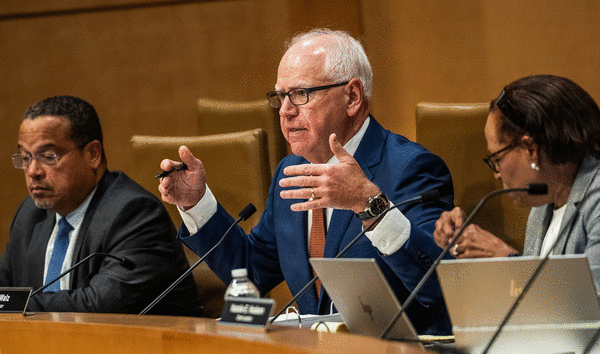
MINNEAPOLIS — Minnesota officials offered a rare, last-minute pardon to a Laotian refugee in the hopes of halting his deportation after he was swept up in the federal government’s unprecedented immigration crackdown.
The man, Ricky Chandee, was detained by immigration officials in January and remains in detention in Louisiana. He faces deportation to Laos decades after his family was uprooted by the “Secret War,” the U.S. anti-communism campaign that took place during the Vietnam War.
Chandee was a year old when his family arrived and doesn’t speak Lao. His attorney has said he wouldn’t automatically be accepted as a citizen in Laos. He had already submitted an application for a pardon before President Donald Trump’s administration deployed thousands of immigration agents to Minnesota in the largest immigration crackdown in history, known as Operation Metro Surge.
Citing Chandee’s looming deportation, Gov. Tim Walz called an emergency meeting of the Minnesota Board of Pardons on Monday. The state’s Clemency Review Commission, which screens pardon applications before they reach the board, had already recommended his pardon.
Members of the board — which also includes Attorney General Keith Ellison and Supreme Court Chief Justice Natalie Hudson — voted unanimously to pardon Chandee, saying he had built a record of serving his community and working for the city of Minneapolis in the decades since he pleaded guilty to second-degree assault.
Chandee pleaded guilty after he and a friend went to Windom, Minn., for a county fair. Following an altercation, Chandee shot two local 18-year-olds in the legs. He was sentenced to three years in prison where he earned an engineering certificate.
“This is someone (who) made an error, paid his time, did his time, 33 years ago, has now established himself as an upstanding member of the community,” Walz said.
He said he hoped the federal government would “follow the law” and stop his deportation.
“Their reasoning for a removal of Mr. Chandee was solely based on this (conviction) that no longer exists,” he said.
Chandee’s attorney, Linus Chan, said he was grateful officials decided “that he should not have to leave and be separated from his family and not have to go back to a place that he hasn’t been since he was a toddler.”
Chan noted the “journey is not over” and said the “government has indicated that they still intend to try and remove him.” While the pardon means Chandee’s conviction no longer exists, that information would need to make it in front of a federal court or the Board of Immigration Appeals before Chandee’s removal order is vacated.
“But we are extraordinarily grateful for the efforts of the Minnesota governor, attorney general and chief justice,” Chan said, “and the grace that they showed him and his family.”
Chandee is one of dozens of Laotians who fled after the Vietnam War and settled in Minnesota but never received American citizenship because of felony charges. Laos doesn’t have an agreement with the U.S. to allow people to be deported there, but the Trump administration has pressured the country to issue travel documents to deportees.
Ellison noted Chandee had gone decades with no additional criminal offense. While the pardon was considered on an emergency basis “because of actions of the federal government,” Ellison said he would have voted the same way if Chandee’s pardon application came up at the board’s next regular meeting.
“This pardon will spare his family from tremendous hardship,” Ellison said, “which would result if he were to be deported.”
Hudson also acknowledged the seriousness of the crime, but said Chandee’s letters of recommendation demonstrated how far he had come.
“He’s doing all the things that we would hope individuals would do,” Hudson said, “to reintegrate back into our community as upstanding, law-abiding individuals.”
Earlier this year, Twin Cities auto shop owner Fong Khang was pardoned for eight criminal convictions, only to be apprehended by ICE the following day and told he was going to be deported to Laos. He was eventually released back home after his lawyer argued that the pardon extinguished any grounds for deportation, and federal officials agreed.
_____
(Susan Du and Deena Winter of the Minnesota Star Tribune contributed to this story.)
_____
©2026 The Minnesota Star Tribune. Visit startribune.com. Distributed by Tribune Content Agency, LLC





Comments