Iran weighs response to US plan to end war as China urges peace
Published in News & Features
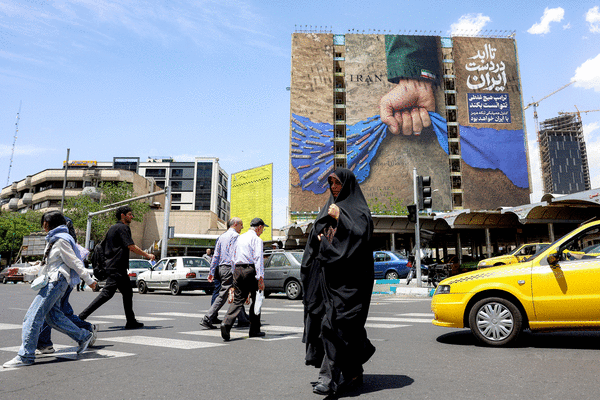
Iran is evaluating a new proposal from the U.S. to end their almost 10-week war, according to a person familiar with the matter, as China added its voice to global pressure to wrap up the conflict.
Washington’s one-page memorandum of understanding will, if Iran accepts it, lead to the gradual reopening of the Strait of Hormuz and lifting of the American blockade on Iranian ports, according to the person, who asked not to be identified discussing sensitive information. Detailed negotiations on Iran’s nuclear program will come later in the process, the person said, adding that nothing has yet been agreed.
Oil prices plunged more than 10% on the news to below $100 a barrel for the first time since late April, before paring declines. Global stocks and bonds rallied in anticipation of a potential deal.
Iran is expected to send a response via mediator Pakistan in the next two days, the person said. However, the plan “contains excessive and unrealistic proposals which have been strongly rejected by our country’s authorities in recent days,” the semi-official Iranian Students’ News Agency reported, without saying where it got the information.
U.S. President Donald Trump on numerous occasions throughout the conflict has indicated that a deal is near, though none has materialized. On Wednesday, he acknowledged to the New York Post that it might be “too soon” to think about face-to-face talks to lock up such an agreement.
At a meeting in Beijing, China’s Foreign Minister Wang Yi urged Iranian counterpart Abbas Araghchi to keep negotiating, saying “a resumption of hostilities is inadvisable.” Araghchi said China has made its own four-point proposal, according to ISNA, without giving further details.
China maintains close economic and diplomatic ties with Iran, absorbing some 90% of its oil exports, but has stayed largely in the background since the U.S. and Israel began strikes on the Islamic Republic in late February. President Xi Jinping is due to meet Trump in Beijing on May 14-15, with the U.S. leader acknowledging on Tuesday that the conflict would be on the agenda.
Trump told PBS News that the U.S. would offer sanctions relief to Iran if the deal is secured, which could render unnecessary any potential U.S. penalties on Chinese banks buying Iranian oil.
“If we make this deal, we’ll be lightening up on Iran with sanctions, et cetera, so we won’t have to worry about this,” Trump said.
The U.S. will end its military campaign and lift its blockade of Hormuz “assuming Iran agrees to give what has been agreed to, which is, perhaps, a big assumption,” Trump posted on social media on Wednesday, without giving details of the proposal. “If they don’t agree, the bombing starts.”
The new peace plan includes provisions for the removal of sanctions on Iran and a moratorium on the country’s uranium enrichment program, according to the person familiar with the situation. All conditions can be reversed if a wider nuclear deal can’t be reached, they said. Axios first reported on the proposal earlier Wednesday.
News of the potential breakthrough comes as pressure mounts on Trump to end the war, both domestically and internationally. The shuttering of Hormuz has blocked a key transit point for global energy supplies, triggering a surge in U.S. gasoline prices to above $4.50 a gallon for the first time since July 2022. That’s piled pressure on the Republican Party ahead of Midterm elections this November.
The U.S. and Iran last came close to an agreement on April 17, when Araghchi said Tehran would open Hormuz in line with broader efforts to secure peace. Trump opted not to lift the U.S. blockade in return, paving the way for the current impasse.
Trump on Tuesday suspended a military initiative to guide stranded ships though Hormuz after only one day of operations. The plan resulted in clashes with Iran and missiles fired at the United Arab Emirates, forcing Washington to insist an almost month-long ceasefire remains in place.
In Israel, the prospective deal caused concern, with Prime Minister Benjamin Netanyahu’s government wanting Iran totally defeated and its nuclear, missile and proxy militia programs dismantled.
“We must continue with full force — either until all conditions are fully met, or until the regime is broken,” Energy Minister Eli Cohen told Army Radio when early reports of a deal surfaced.
Netanyahu is holding talks with U.S. officials to better understand the situation, CNN reported, citing an Israeli source it didn’t identify.
©2026 Bloomberg L.P. Visit bloomberg.com. Distributed by Tribune Content Agency, LLC.






Comments