Police overtime spirals as O'Hara fights for second term as Minneapolis chief
Published in News & Features
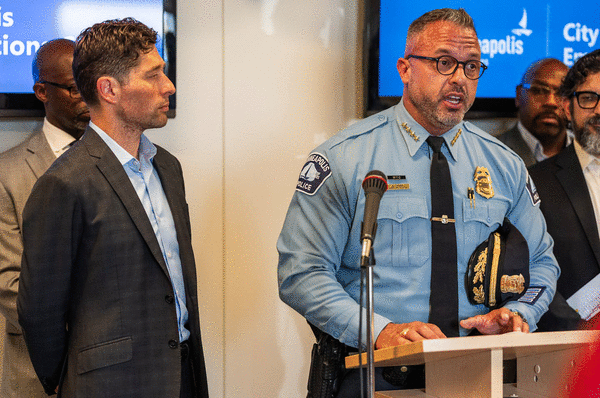
MINNEAPOLIS — The Minneapolis Police Department is on pace to blow its budget by over $23 million this year — well beyond the extra overtime racked up during the federal immigration crackdown.
Mayor Jacob Frey on Thursday nominated Police Chief Brian O’Hara to serve another four-year term, but the department’s troublesome financial forecast, which emerged days prior, is almost certain to play a major role as a skeptical City Council decides whether he should keep his job. For months, a number of council members have browbeaten O’Hara for exceeding his budget last year.
This year, the department is projected to exceed its budget by even more than the last, in part because of overtime and other spending during Operation Metro Surge, the massive federal immigration crackdown that left two protesters dead.
The forecast that the department would exceed its 2026 budget by $23.4 million surfaced during a City Council committee meeting earlier this week, before Frey nominated O’Hara. The department’s total budget this year is nearly $226 million.
O’Hara attributes the overspending to the cost of replenishing police ranks, which were depleted after the 2020 police killing of George Floyd. Last year, the department hired 162 people, but many didn’t immediately hit the streets — they were in training at the police academy or working as community service officers and cadets. As a result, the department continued to log heavy overtime. And because there are fewer vacancies, there’s less unspent money to shift around to cover the cost of overtime, as had been done in previous years.
This year, that trend continues, and on top of that, overtime shot up during the Trump administration’s immigration enforcement operation in January through mid-February. The department extended shifts, canceled days off and called in officers for emergencies.
The department spent over $6 million on overtime in January alone, eclipsing the $2.3 million budgeted for all of 2026.
O’Hara told the budget committee that Operation Metro Surge was one of the most complex, sustained operations the department has endured. He said police were in a heightened state of readiness for weeks and sought help from the State Patrol and National Guard.
“It was just a constant state of emergency,” he said, vowing to try to cut overtime by one-third for the remainder of the year.
O’Hara may have a tough time getting confirmed by the City Council.
Last month, the council rejected public safety commissioner Todd Barnette’s nomination by one vote, in part because of police overspending, and at the recent budget committee meeting, the issue was front and center, foreshadowing a key facet of the coming debate over O’Hara’s nomination, which will include at least one public hearing.
Some council members focused on overtime and standby pay.
One officer worked nearly eight hours of overtime every day for 32 days, according to data compiled by the MPD. When Council President Elliott Payne questioned that, Deputy Chief of Patrol Mark Klukow said the officer is an outlier who “manages to stay within the boundaries but is working as many hours as he possibly can.” Most of those hours were not related to the surge but were responding to 911 calls, he said.
When Payne said working that many hours doesn’t seem healthy, Klukow said the employee is spiking his pay as he approaches retirement. Minnesota police pensions are calculated based on the average of their five highest-earning years, including overtime, which means big paychecks now lead to larger retirement checks later.
“I did it last year,” Klukow told the committee. “It’s the end of your career, you’re attempting to do as much work as you can to reconcile your retirement for the rest of your life. You somehow buffalo that as much as you can. That’s the honest answer. Most of our older folks are doing something similar to that.”
Police data shows a dozen officers worked about 14 hours of “standby” per day during the surge — meaning they were paid a quarter to half their regular hourly rate to be on standby and ready to report for duty within an hour.
Council member Soren Stevenson questioned how that was possible, given police rules limiting how much officers can work. Klukow said when the city is in trouble, exceptions are made. For example, after shootings during the surge, it was all hands on deck as the city teetered on edge.
Council member Aisha Chughtai noted 118 officers each worked between 250 and 475 hours of standby over 32 days from early January to early February, with each earning between $8,000 and $20,000 in 32 days.
“That’s astronomical. That’s insane,” she said. “Just to be ready to work, you receive $20,000 over the course of one month, not for actual work done. That is mind-boggling.”
Klukow later said in an interview those figures aren’t surprising to him because the officers were logging heavy standby as police leaders tried to avoid a repeat of 2020, when protests turned violent and buildings went up in flames.
Since 911 calls didn’t go “through the roof” during the surge as expected, Klukow said officers working overtime were put on “strike teams” ready to respond to problems, stationed at vigils, memorials and protests, and sent into neighborhoods in chaos to help respond to 911 calls.
Some officers protected infrastructure and helped monitor video of demonstrations, he said. And a good number were stationed, two at a time, in hotels under threat, real or perceived, Klukow said. Some hotels where federal agents were believed to be staying were targeted by protesters and vandalized.
“We didn’t like the idea of personnel coming in and not being of service to the community in some way,” Klukow said.
Overtime spending on police has become a regular problem for Minneapolis in recent years.
The city has shelled out millions in overtime since 2020, when hundreds of officers began leaving. Staffing dropped from about 900 cops in 2019 to a low of 550, leaving Minneapolis with one of the nation’s lowest ratios of officers to residents.
O’Hara has worked to replenish the ranks with a recruitment campaign and big pay increases. The city now has 642 police officers, and Frey said this week he hopes to reach the city charter-mandated 733 next year and surpass 800 by the time he leaves office.
The city’s acting budget director, Jayne Discenza, told the budget committee there’s a tipping point where hiring more people makes more sense than spending so much on overtime.
_____
©2026 The Minnesota Star Tribune. Visit startribune.com. Distributed by Tribune Content Agency, LLC






Comments