Analysis: Trump punts thorniest Iran challenges in push to reopen Hormuz
Published in News & Features
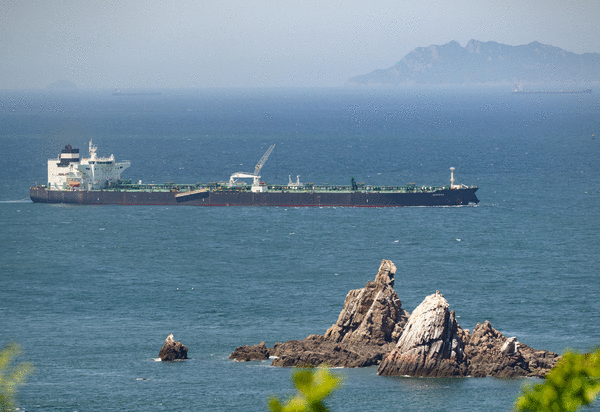
WASHINGTON — President Donald Trump has changed his approach as he tries to end the war against Iran: reopen the Strait of Hormuz at all costs and leave thorny negotiations on Tehran’s nuclear and ballistic missile programs until later.
That strategy has seen the ceasefire between the U.S. and Iran tested as the two sides traded fire in recent days after Trump ordered U.S. warships to provide cover for merchant vessels transiting the strait, and then abruptly shelved “Project Freedom” on Tuesday. Iran also targeted oil facilities in the nearby United Arab Emirates.
While Trump has repeatedly said eliminating Iran’s nuclear program is the main justification for the conflict in the Middle East, the vital waterway for oil and gas flows has emerged as a far more pressing facet of the conflict — and a key source of leverage for Tehran as diplomacy continues.
“The Trump administration just desperately wants out of this war, and the sole objective that they now really have is establishing some navigation within the strait,” said David Tannenbaum, a director at Blackstone Compliance Services, a consulting company focused on sanctions. “I’m even wondering if Iran’s nuclear program is actually on the table.”
The administration said it is.
“President Trump has all the cards as negotiations continue, and he wisely keeps all options on the table to ensure that Iran can never possess a nuclear weapon,” White House spokeswoman Olivia Wales told Bloomberg.
With global energy prices soaring, U.S. officials said this week the war against Iran is formally over with the ceasefire in place and talks ongoing, despite the repeated clashes. Secretary of State Marco Rubio told reporters this week the U.S. wants to push back negotiations to free up Hormuz.
“What the president would prefer is a deal,” Rubio told reporters at the White House. “He would prefer to sit down, work out a memorandum of understanding for future negotiations that touches on all the key topics that have to be addressed. A full opening of the Straits so the world can get back to normal.”
But events of recent days have shown how much events in the region can spin out of Trump’s control. On Tuesday evening when he paused “Project Freedom,” Trump said the two sides were close to a deal. He was basing that on a one-page memo to the Islamic Republic that aimed to reopen the strait but delay much trickier negotiations, and later demanded that Iran deliver an answer to its diplomatic offer on Friday.
On Thursday evening, the U.S. said Navy ships moving in the strait were attacked by Iranian drones and missiles, prompting fresh U.S. salvos at launch sites on Iranian soil. And on Friday, Navy F/A-18 Super Hornets fired on and disabled two more Iranian-flagged commercial vessels — after hitting another vessel on Thursday — as part of the blockade designed to pressure Tehran into caving and reopening the strait.
While the stakes this time are higher, Trump’s approach has parallels with other conflicts he’s attempted to resolve, according to former U.S. officials and critics.
One risk now is Trump’s team — facing pressure over U.S. gas prices ahead of the midterm elections — pursues a deal similar to the one in Gaza. That won plaudits for ending a war between Israel and Hamas but put off difficult issues including the militant group’s disarmament — which still hasn’t been resolved seven months later.
“President Trump does not follow through,” said Aslı Aydıntaşbaş, an expert on the Middle East at the Brookings Institution. “His foreign policy has been upside down: declare victory and hope it all works out. But in most places it hasn’t.”
Trump’s special envoy Steve Witkoff and son-in-law Jared Kushner secured a Gaza truce but were quickly deployed elsewhere while progress in Gaza stalled. The two men were eventually dispatched for talks with Iran, which ended with a surprise U.S. bombing campaign alongside Israel.
As a result, Iran’s leaders are wary of discussions with the U.S., and have shown little sign of yielding on Iran’s nuclear program or accepting a moratorium on enriching uranium, both top U.S. demands.
In fact, they’ve doubled down on controlling Hormuz: collecting tolls and insisting at the United Nations they have a right over the waterway lapping at their coastline, unlike the distant U.S. Tehran on Wednesday laid out new protocols for ships in the waterway.
Supporters of Trump’s war point to Iran’s decimated navy and air force as evidence the conflict has weakened Washington’s geopolitical foe. Yet the current U.S. diplomatic overture skips previous priorities such as Iran’s missiles and support for proxy groups, and prioritizes the strait — which was functioning normally before the war.
“Iran has established a chokehold over the global economy,” said Michael Carpenter, a former White House official in the Biden administration now at the International Institute of Strategic Studies. “The U.S. is now scrambling just to restore the status quo ante by reopening the strait.”
©2026 Bloomberg L.P. Visit bloomberg.com. Distributed by Tribune Content Agency, LLC.





Comments