Her heart stopped after giving birth. Now, she's warning others about blood clots during pregnancy
Published in News & Features
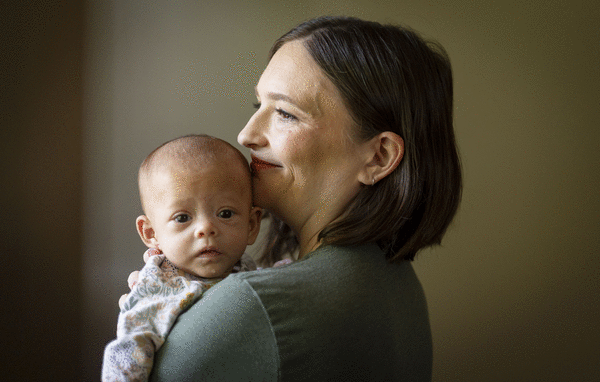
The last thing Chelsea Cheveria remembers after the birth of her daughter was greeting her new baby girl.
“I said, ‘Hi, oh, that’s my baby,’” Cheveria, 38, recalled. She kissed the tiny newborn, and her husband told her, “You did it.”
Then everything went dark. Without warning, Cheveria’s heart stopped as she lay atop the operating table where minutes earlier doctors had delivered her baby Zairah through a cesarean section.
Workers rushed her husband Scott Cheveria out of the room, and doctors and nurses began performing CPR on the Logan Square mom. A medical worker urged Scott Cheveria to pray, he said.
“We were all smiles and everything was going well,” said Scott Cheveria, 39, remembering that day. “And then the tables turned and everything became a nightmare.”
Now, 12 weeks later, the family is home and, miraculously, healthy after what doctors describe as a rare but life-threatening pregnancy complication.
Chelsea Cheveria had developed a blood clot that traveled through her heart and to her lungs, known as a pulmonary embolism. The clot obstructed the flow of blood out of her heart, causing her blood pressure to plummet and cardiac arrest.
Though only about one in 1,000 pregnant women develop pulmonary embolisms, it’s one of the most common causes of pregnancy-related death in the U.S.
Though blood clots can happen during pregnancy, for someone to go into cardiac arrest because of one “is quite rare,” said Dr. Daniel Schimmel, director of the Pulmonary Embolism Response Team at the Northwestern Medicine Bluhm Cardiovascular Institute. Schimmel said he’s only seen what happened to Chelsea Cheveria occur one other time in the last decade at Northwestern Medicine Prentice Women’s Hospital, where about 11,000 babies are delivered each year.
Chelsea Cheveria credits the doctors at Prentice and Northwestern Memorial Hospital with saving her life that day through quick thinking and teamwork.
“Childbirth, even in 2026, is dangerous,” said Chelsea Cheveria, while nursing Zairah in her Logan Square home on a recent day. Blood clots in pregnancy are “not talked about enough,” Cheveria said. “The threat is so real.”
From selfies to CPR
Leading up to Zairah’s birth, Chelsea Cheveria thought she knew what to expect.
The birth of her first child, Annayiah, four years earlier had gone smoothly, so she tried to duplicate the experience. She used the same midwife, decided to again deliver at Prentice and had the same doctor perform another scheduled C-section. She had a C-section with her first child because of a prior health condition.
Chelsea Cheveria and her husband took a selfie before they headed into the operating room. She joked around with her doctor before the C-section.
Just a short time later, that same physician was among those performing CPR on Chelsea Cheveria as she lay unconscious on the operating table.
Through CPR and blood pressure medication, they were able to get Chelsea Cheveria’s heart pumping again.
An echocardiogram performed at her bedside showed the reason behind the cardiac arrest: the blood clot.
Doctors knew they had to give her blood thinning medication and remove the clot, but, first, they had a problem to solve — she had just had surgery and delivered a baby, which both caused bleeding. A blood thinner could make the bleeding dangerously worse.
“You’re walking a very, very fine line between thinning the blood but not too much, and controlling the bleeding while you’re doing that,” said Dr. Keith Benzuly, an interventional cardiologist at Northwestern Memorial Hospital.
To address that issue, an interventional radiologist plugged a small artery to her uterus to prevent excessive bleeding. Benzuly was then able to give her blood thinners and perform another procedure to remove the clot. He inserted a catheter into a vein in her leg and then snaked it up through her heart and into her lungs to grab the clot.
“It took a great team working really swiftly and efficiently to get her through this,” Benzuly said. He called it “one of the great moments of my career.”
‘The darkest moments of my life’
Once the clot was removed, all that doctors and Chelsea Cheveria’s family could do was wait.
Doctors told Scott Cheveria that the next couple of days would be critical, Scott Cheveria said.
Scott Cheveria still wasn’t sure when or if she’d wake up. He tried to stay positive, but he couldn’t help but think about how he would answer his 4-year-old daughter’s questions about what happened to her mom.
He called it “some of the darkest moments of my life.”
“Everything just flashed, like what is life going to be like after this, and why is this happening,” said Scott Cheveria, who owns a construction company with Chelsea’s dad. “I had so many questions with no answers.”
But then, less than a day after her heart stopped, Chelsea Cheveria began to wake. She had no idea what had transpired, but looked around and realized she wasn’t in a maternity ward.
She was bruised and in pain — her ribs were broken during CPR — but she was going to be OK.
She remembers her husband crying tears of joy as he explained what had happened.
At first, she couldn’t talk because she was on a ventilator. She typed “baby?” into her husband’s phone, and her husband reassured her that Zairah was safe and healthy in the nursery.
From that point on, Chelsea Cheveria was determined to recover as quickly as possible. Once the ventilator was removed, she asked for a breast pump so she could start collecting milk for Zairah. She was moved out of Northwestern Memorial’s intensive care unit and back to Prentice, where she was able to spend more time with her daughter.
Less than a week after she went into cardiac arrest, she was able to go home — back to the house in Logan Square where she grew up, a home that she now shares with her parents, her husband and two children.
She was grateful for the medical team’s work, but she was tired of being poked and prodded.
“I worked really hard to get home,” Chelsea Cheveria said with a laugh.
Recognizing signs of blood clots during pregnancy
Once home, Chelsea Cheveria spent the first week mostly resting and recovering. She had a lot of help. Her sister, husband, mother-in-law and parents were all on hand.
“It was hard,” Chelsea Cheveria said. “It took a lot of hands. It took almost my entire village.”
But she was determined to get back on her feet. She was eager to resume preschool drop-offs and return to her normal life.
Now, about 12 weeks after the scare, she feels like she’s just about there.
Chelsea Cheveria’s doctors say it’s highly unusual to go into cardiac arrest because of a pulmonary embolism after giving birth. Still, they say it’s important for pregnant women to be aware of the signs that they may have a blood clot.
Women are five times more likely to experience a dangerous blood clot during pregnancy, and cesarean sections nearly double that risk, according to the Centers for Disease Control and Prevention.
Famously, tennis star Serena Williams experienced blood clots in her lungs shortly after giving birth to her daughter, she told Vogue in 2018. Black women are three times more likely than white women to die from a pregnancy-related cause, according to the CDC.
Pregnant women should seek medical attention if they experience sudden shortness of breath, new chest pain and/or swelling in the legs, especially if the swelling is in just one leg, Schimmel said. If caught early, blood clots can be treated with blood-thinning medication taken at home, after a brief period of observation in the hospital.
Chelsea Cheveria also encourages women to make sure they have doctors they trust before they deliver. Chelsea Cheveria and her husband credit the medical team that cared for her after Zairah’s birth with her survival.
On a recent day at home, Chelsea Cheveria paused for a moment to watch Zairah and Annayiah in bed together. Annayiah was singing to her baby sister, and Zairah was cooing in response.
“That’s surreal to me that I may not have been here for that,” Chelsea Cheveria said. “My girls may not have had a mom. It makes me take a step back and calmly put my boundaries up and slow my life down and really focus on my kids.”
_____
©2026 Chicago Tribune. Visit chicagotribune.com. Distributed by Tribune Content Agency, LLC.






Comments