Often-maligned 'mommy brain' isn't a bad thing, emerging research suggests
Published in News & Features
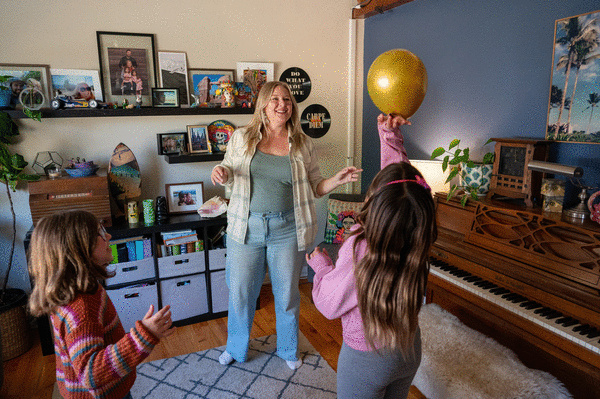
Pre-kids, Sarah Freeman had a reputation as the brave one in her friend group because she didn’t hesitate to try things like bungee jumping. She hated being tied down by plans, even to the point of refusing to make restaurant reservations. And she assumed when she did have children, her world would shrink.
So it was a bit difficult for some friends to square the person they knew before with the Wheat Ridge mom who’d become much more cautious, planned her day around snack times and took joy in watching caterpillars with her daughters Lula, 9, and Maisie, 7.
“Now bravery looks like letting my girls go a branch higher on a tree,” she said. Parenting “really will change you, but in the best way.”
Emerging science suggests Freeman and other mothers who feel like they’ve become different people after having children might be on to something.
Researchers are still learning the exact changes that take place in a typical mother’s brain and determining what their function might be, but clearly something big is happening, since computers can learn to distinguish the brains of women who recently became mothers from those without children, said Darby Saxbe, a professor of psychology at University of Southern California and the author of “DAD BRAIN: The New Science of Fatherhood and How it Shapes Men’s Lives.”
Much remains unknown about what exactly is happening in the brain, but changes are visible in areas devoted to attention, empathy and the “default mode network” that runs when people aren’t focused on any particular task, said Dr. Aviva Olsavsky, an associate professor at University of Colorado School of Medicine. The default mode change might suggest differences in identity, though science can’t prove or disprove the subjective experience of feeling like a new person after becoming a parent, she said.
The clearest finding is a reduction in gray matter in areas of the brain linked to empathy, understanding other people’s perspectives and social bonds, Saxbe said. While a reduction in gray matter might sound frightening, it reflects that the brain is becoming more efficient at a particular skill, she said.
“That suggests it’s helping women become more responsive and bonded,” she said. “All of that practice (in the brain) is helping you develop more efficient connections.”
While all the physical and hormonal changes of pregnancy likely play a role, new fathers also undergo brain changes, though theirs appear to start after the child is born, rather than during pregnancy, Saxbe said. Parents who have more noticeable brain changes tend to report a closer relationship and more positive emotions from their infants, she said. Though scientists don’t know whether the brain changes cause increased interest in the baby, or if people who are motivated to spend more time with their babies develop greater brain changes through learning to care for them.
Mothers show a consistent pattern of changes linked to the brain’s emotional circuitry, while fathers’ brains seem to be working on their ability to pick up and interpret cues from other people, Olsavsky said. In gay couples, the dad who is the primary caregiver had an in-between pattern, with elements typically seen in heterosexual mothers and fathers, she said.
“Parenting is a skill” and it makes sense that the brain changes through practice, she said.
The idea that the brain’s emotional circuitry changes after becoming a mother rang true for Carol Wilsey, of Denver, who was a self-described “ice queen” before having her daughter Brett, 28. After the birth, she found herself crying in front of people for the first time in her adult life, and hormonal fluctuations weren’t the whole story.
“Becoming a parent really broke my heart open,” she said.
It was embarrassing, and sometimes still is, but she has come to see staying in touch with her feelings as a positive overall.
“The joy pieces have been amplified as well. Probably anger, too,” she said.
Most of the research has involved either cisgender heterosexual couples or gay couples, leaving significant blind spots about the experiences of adoptive mothers, lesbian couples and transgender or nonbinary people who can give birth.
Longer-term studies in mothers found the brain has partially, but not fully, returned to its pre-pregnancy state seven years after a birth, Saxbe said. The brain also appears to change with a second child, but following a slightly different pattern, she said.
The brain also prunes its gray matter in early childhood and adolescence, though in those cases, the volume doesn’t partially rebound as it does following the postpartum period, Olsavsky said.
“When we get into these sensitive periods of development, there are increased efficiencies,” she said.
Those changes also come with drawbacks. Saxbe’s study with fathers found those with greater changes reported worse sleep and more depression, underscoring that new parents need financial and social support in those difficult first months, including paid leave.
“We think of the transition to parenthood as the birth of a baby, but it’s also the birth of a new set of parents,” she said.
Jessica McGhee, of Aurora, experienced one of the most extreme brain changes.
“After my son was born, I couldn’t sleep, physically couldn’t sleep,” she said. “I’d sleep maybe an hour and wake up with something like a panic attack.”
The emergency room she visited initially dismissed her symptoms as anxiety and normal postpartum sleep deprivation. They admitted her on the third or fourth visit, when she was starting to get confused and disoriented. A psychiatrist who treats postpartum patients diagnosed her with postpartum psychosis, a label that terrified her because of the stories she’d heard of women who’d harmed their babies.
Her doctor prescribed lithium and at least four hours of uninterrupted sleep each night to bring the symptoms under control. Fortunately, she had family members who could help with the night shift.
Two years later, her son Aidan is thriving and McGhee has her mental health under control, though she now has a diagnosis of bipolar disorder that she treats with lithium. Her psychiatrist estimated about half of women with postpartum psychosis ultimately develop bipolar disorder and need long-term treatment, she said.
While her bond with Aidan hasn’t suffered, McGhee struggled in the early months with the fear that she might not be able to safely care for him, even after her psychiatrist reassured her that women with appropriate treatment for postpartum psychosis aren’t dangerous.
“It’’s very destabilizing, to have your sense of self shaken,” she said.
Much of the discussion of the postpartum period is focused on moms’ vulnerability to new mental health problems, which is important to know about and points to the need to support new parents financially and socially, Olsavsky said. But, like the also challenging period of adolescence, it typically ends with a brain that has successfully mastered new skills and roles, she said.
“People experience vulnerability … but it’s an incredible learning process,” she said.
Those skills sometimes cross over into mothers’ other roles. Having multiple children is a crash course in bringing together stakeholders to reach consensus, said Dani Coleman, of Louisville. She has 18-year-old twins, Adi and Mae, and a 14-year-old named Vivian. As soon as they learned to voice preferences, they tended to want different things, maybe as a way of asserting their independence, she said.
“From the time they’re toddlers in the bathtub, one would want to splash and the other doesn’t want to get splashed. So you have to figure out, OK, turn your backs, you can splash the wall,” she said.
Coleman noticed the same skills came through at work. In recent years, she has tended to be the one in the meeting who summarizes what everyone said and finds areas of common ground.
“I never was the person who would take the lead,” she said. “Being a parent, you’re the adult in the room.”
Mothers still deal with negative perceptions about their abilities, including the idea that “mommy brain” makes them less intelligent or capable, Olsavsky said.
Some poorly designed studies found declines in cognitive performance among new mothers, but didn’t consider that other people who are sleep-deprived and in demanding new roles also would not do as well as on tests, she said. Performance generally returns to someone’s pre-pregnancy baseline a few months after the birth, when they are getting more sleep and have a better understanding of the baby’s needs.
Ultimately, whatever the science says, becoming a mom brings a profound reordering of life, said Freeman, the Wheat Ridge woman with two daughters. She formed new communities with other parents around their schools and activities, and loves the shift from searching for herself to leading her kids as they figure out who they are. And the girls’ perspectives on the world can be funny, like when her younger daughter asked for “raw toast” for breakfast instead of bread.
“My thinking has changed so much from a ‘me’ mindset to a ‘them’ mindset,” she said. “It’s such an honor and such an adventure.”
_____
©2026 MediaNews Group, Inc. Visit at denverpost.com. Distributed by Tribune Content Agency, LLC.






Comments