US-Iran standoff lengthens as Trump reiterates war threats
Published in News & Features
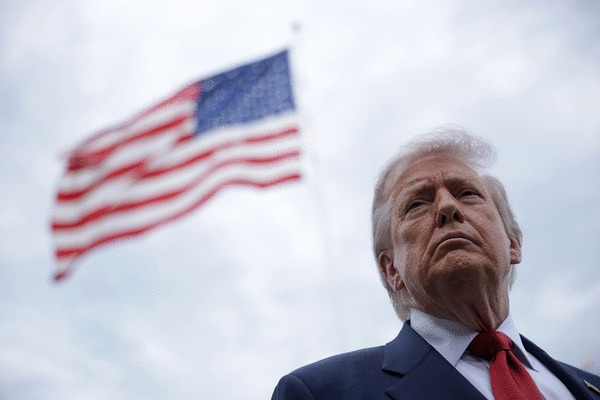
U.S. President Donald Trump repeated his military threats against Iran ahead of a visit to China, the Islamic Republic’s largest oil customer and a key diplomatic partner.
Iran will either “make a good deal” with the U.S. or face devastation, Trump said on Tuesday. The war on Iran, which has sent energy prices soaring because of Tehran’s effective closure of the Strait of Hormuz, will be high on the agenda of the talks between Trump and Chinese President Xi Jinping.
“Number one, we’re going to have a long talk about it,” Trump said before his trip. “I think you’re going to see that good things are going to happen.”
The war will likely constrain Trump’s hand in discussions with China over trade, and his administration’s called on Beijing to help get Iran to reopen the strait.
A ceasefire between the U.S. and Iran has lasted over a month but is fragile, with Trump describing it this week as being on “massive life support.”
Tehran continues to resist U.S. demands to reopen Hormuz and says it will only do that if Washington ends a naval blockade on Iranian ports. It’s also insisting that the U.S. unfreezes billions of dollars of Iranian assets and lifts sanctions. Iran’s stance comes despite signs that oil shipments from Kharg Island, its main export terminal, may be coming to a standstill because of the blockade, a development that would add to pressure on the economy.
For all that the U.S.-Israeli bombardment until the ceasefire battered Iran’s military, it seemingly still has plenty of firepower. New U.S. intelligence assessments show Iran has operational access to 30 of its 33 missile sites along the Hormuz strait and has retained roughly 70% of its prewar missile stockpile, according to a New York Times report citing classified information.
“The U.S. and Iran remain too far apart for a deal,” wrote Bloomberg Economics’ Dina Esfandiary and Becca Wasser. “If neither side is willing to make concessions, then a lasting peace deal will remain elusive, sporadic increases in intensity and protracted war the most likely scenario.”
Oil prices dropped on Wednesday by roughly 1%, with Brent trading at slightly above $107 a barrel. They’re still up more than 5% this week.
The impact on the energy market of the closure of the strait, which normally handles one fifth of world’s supplies of oil and liquefied natural gas, is deepening. On Wednesday, the International Energy Agency said oil inventories are falling at a record pace and will continue to drop for months.
U.S. lawmakers on Tuesday pressed Pentagon chiefs for details on the mounting costs of the war. Defense Secretary Pete Hegseth declined to give a breakdown as he faced questions in Congress during a hearing on the administration’s unprecedented $1.5 trillion defense spending request for next year. Jules Hurst, the Pentagon’s acting comptroller, said the war’s estimated price tag has risen closer to $29 billion. That’s up from a $25 billion estimate that had been criticized by some U.S. lawmakers as unrealistically low.
Here’s more related to the war:
•The United Arab Emirates retaliated against Iranian attacks on its territory earlier in the war, according to people familiar with the matter, coordinating with Israel as the two countries deepen security ties. Saudi Arabia also conducted some retaliatory strikes in March, Reuters reported.
•Iran won’t join another round of talks with the U.S. unless five confidence-building preconditions are met, including sanctions relief and release of frozen funds, the Fars news agency reported.
•Saudi Arabia’s Crown Prince Mohammed bin Salman spoke with UAE President Sheikh Mohammed bin Zayed about bolstering security and stability in the region, the state-run Saudi Press Agency reported. The call came with tensions between the two countries high, underlined by the UAE’s decision to leave OPEC.
•The U.S. said it’s releasing additional barrels of oil from its strategic reserves to help tame surging fuel prices.
•The main natural gas plant supplying the fuel in the UAE — which was damaged by Iranian strikes — will only return to full capacity next year. The Habshan facility is operating at about 60% capacity and aims to reach 80% by the end of this year, Adnoc Gas Plc said.
©2026 Bloomberg L.P. Visit bloomberg.com. Distributed by Tribune Content Agency, LLC.






Comments