North Carolina among the most economically segregated schools in the US, report says
Published in News & Features
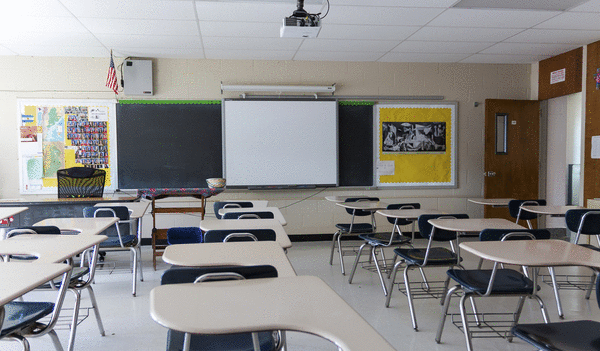
A new national report ranks North Carolina as having among the most economically segregated public schools in the nation.
The “States of Segregation” report released on Monday ranked North Carolina seventh in the nation for economic segregation in schools and 33rd for racial segregation in schools. The report found that segregation has increased nationally over the past few decades to the point where schools are as segregated today as they were in the 1970s.
The report comes 72 years after the U.S. Supreme Court ruled in the Brown v. Board of Education that state-sanctioned racially segregated schools are unconstitutional.
“We remain a very, very segregated nation, 72 years now, after Brown v. Board,” Ann Owens, a sociology professor at UCLA and co-director of the Segregation Tracking Project, said at a virtual press conference Monday.
The report was done with 2023-24 school year data by Brown’s Promise and The Segregation Tracking Project, a collaboration of UCLA and Stanford University. Brown’s Promise was created by the Southern Education Foundation.
Schools becoming more segregated
The new findings are in line with a 2024 report from N.C. State researchers that found North Carolina’s public schools were more racially segregated than they were in the 1980s.
Even though Brown v. Board was in 1954, large-scale integration didn’t happen until the 1970s. One of the reasons for the 1976 merger of the Wake County and Raleigh City school systems was to desegregate the districts.
The late 1980s saw North Carolina school districts actively integrating schools. Districts such as Charlotte-Mecklenburg were still under federal court desegregation orders. Wake County was still making race-based assignments before later switching to socioeconomic-based assignments.
In 2007, the U.S. Supreme Court sharply scaled back the ability of schools to use race to assign students.
Schools have largely scaled back diversity efforts. Wake, for instance, focuses more on encouraging families to diversity schools by attending magnet schools rather than by using busing.
School districts have had to deal with increased competition for students from charter schools and now from expanded private school vouchers.
In addition, the Trump administration has focused on eliminating diversity, equity and inclusion (DEI) efforts in schools.
“This administration just made it clear that it’s not going to be helpful when they make a campaign out of eliminating diversity,” Congressman Bobby Scott, a Virginia Democrat, said at the press conference. “It’s kind of hard to think they’re going to do much about school integration.”
Economic segregation in North Carolina schools
As part of the report, researchers looked at the degree of segregation between students who qualify for a free or reduced price lunch. The report found the poverty rate in the average poor North Carolina student’s school was 30 percentage points higher than the poverty rate in a non-poor student’s school.
The report found that the majority of the economic segregation in North Carolina’s public schools occurred within school districts as opposed to between districts.
Overall, the report found that only the District of Columbia, New Jersey, Nevada, Illinois, Massachusetts and Connecticut had more economically segregated schools than North Carolina.
“This data clearly maps the nation’s school segregation problem and represents both a moment of reckoning and a window of opportunity,” Ary Amerikaner, co-founder of Brown’s Promise, said in a news release. “Segregated schools are the result of deliberate policy decisions.
“North Carolina’s policymakers have a responsibility to address this problem with proven, practical policy solutions.”
_____
©2026 Raleigh News & Observer. Visit newsobserver.com. Distributed by Tribune Content Agency, LLC.






Comments