More racist texts from ex-Mass State Police trooper Michael Proctor unveiled in murder case
Published in News & Features
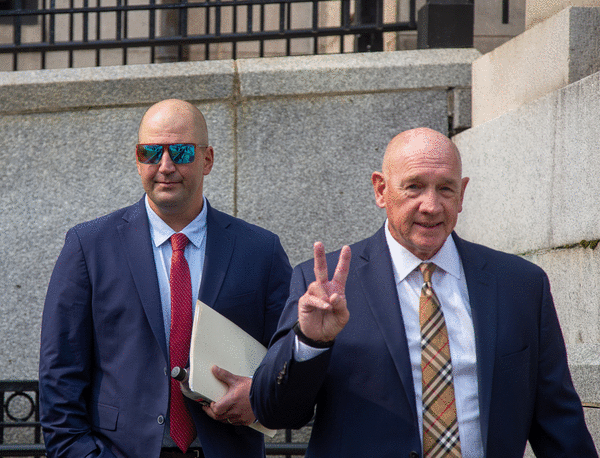
BOSTON — More N-word-laden messages and racist photos on former Mass State Police trooper Michael Proctor’s personal cellphone have been made public.
The new messages, included in a motion to dismiss a murder case Proctor investigated, mention violence against Black people, the belief that they commit more crime and Proctor’s desire to not be around them.
“I was planning on tying a (N-word) up and dragging him from my bumper through the streets of Randolph,” Proctor sent in one of the dozens of messages included in the filing.
Lawyers for Myles King, a Black man accused of the 2021 murder of Marquis Simmons, argued that the messages prove that their client did not get a fair investigation.
“King moves to dismiss the charges against him on the basis that the lead investigator of his case held views so fundamentally racist and opposed to him as a black man that the entire investigation was tainted by the lead investigator’s bias,” his attorneys Rosemary and Nicole Scapicchio wrote in their motion, which was only recently unsealed. “No action save dismissal will be enough to clear that taint.”
King’s case is one of several that has been impacted by Proctor’s texts. The Norfolk District Attorney’s Office has said they are notifying defendants investigated by Proctor in all open and closed cases.
Proctor was fired by the Mass State Police after crude messages he sent about Karen Read while he was investigating her for the death of her late boyfriend Boston Police Officer John O’Keefe became public. After Read was acquitted last summer, she’s filed civil suits alleging misconduct by Proctor and the State Police which included other racist, sexist, and antisemitic messages Proctor sent.
The messages quoted in the motion to dismiss are from 2013 to 2023. In them, Proctor and his friends, including former Canton Police Officer Sean Goode, repeatedly use racial slurs to refer to Black people.
“2 park rangers stabbed in Boston Common… has to be the work of a (N-word),” Proctor wrote in one message.
In another, he said that he enjoyed a visit to a Newton movie theater and wouldn’t watch movies anywhere else, in part because the theater didn’t have any Black people, who he again referred to by a slur.
In these texts, slurs and racist texts are thrown into conversations about Nirvana, Dunkin Donuts orders and high school sports.
“Let’s get some horses and white sheets and burn a cross in the arboretum,” Proctor wrote in one text, seeming to refer to the Ku Klux Klan.
At one point, he writes to a friend that “we could use them (N-words) as dart boards.”
The friend replies, “I would love that. Perfect world.”
Then another person in the chat chimes in, “God can hear you two.”
In addition to the messages, the motion included photos from Proctor’s phone with racist jokes and overtones, like a picture of a Black child in a cage and an image of a jail captioned, “Why don’t black people get sunburnt? Because prisons are indoors.”
“These are only snippets of the derogatory language and offensive photographs that Proctor and his associates used,” King’s lawyers wrote in their motion.
They noted that Proctor was the lead investigator of King’s case and “had a hand in almost every aspect of the investigation.”
“As such, this entire investigation is flawed,” they wrote.
The lawyers referred to the investigation as a “modern-day lynching” and questioned how someone with explicitly racist views like Proctor could have investigated King, a Black man, fairly.
“This was not a search for truth,” they wrote.
Attached to the motion is a paper titled, “Biased and Biasing: The Hidden Bias Cascade and Bias Snow Ball Effects.”
The attorneys mentioned that Proctor was sending some of the messages amidst the investigation into King, giving the example of an exchange where a friend texted Proctor that, “Going from Cam Newton to Mac Jones is like driving through Mattapan Square and entering Milton.”
Proctor replied, “That’s great… accurate.”
They also argued that Proctor relied more heavily on evidence he received from white witnesses in the case and asked that an evidentiary hearing be held to dive deeper into Proctor’s potential misconduct.
Prosecutors plan to present evidence, referred to in the motion as the “fruits of Proctor’s racist investigation,” without calling the former investigator to the stand.
The defense argued that because the Commonwealth will not call Proctor as a witness, even if King calls him, Proctor can claim Fifth Amendment protections, making it so “the Commonwealth will have effectively immunized its own racist lead investigator from any meaningful cross-examination.”
They asked that if the case against King isn’t dismissed because of prejudice, it should be dismissed to discourage future misconduct, writing, “The message currently being sent is that it is acceptable to be a police officer and to hold beliefs that black people are animals responsible for all crime.”
King had been released on bail last year but is back in jail after being arrested by federal law enforcement for allegedly dealing drugs during pretrial release.
_____
©2026 MediaNews Group, Inc. Visit at bostonherald.com. Distributed by Tribune Content Agency, LLC.



Comments