California, Santa Clara County ask court to stop construction of ICE facility near Gilroy
Published in News & Features
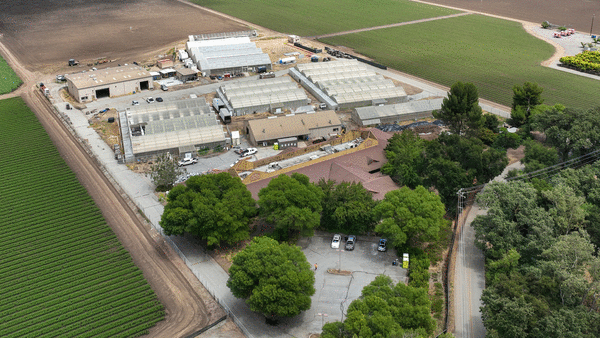
SAN JOSE, Calif. — California, joined by Santa Clara County, is asking the U.S. District Court in San Jose to block work on an Immigration and Customs Enforcement facility outside of Gilroy in a legal motion filed Wednesday.
The court’s decision will determine whether work on the ICE facility can continue as the lawsuit against the facility, filed earlier this month, moves forward.
“This attempt to construct an ICE facility without complying with the applicable laws is dangerous for the environment and for our people. California refuses to stand idly by,” said Attorney General Rob Bonta in a statement. “Today, we’re asking the court to pause this development and ensure the interests of our communities are properly protected. The law isn’t written in disappearing ink, and it’s time for the Trump Administration to take a step back and read it clearly.”
Reporting by this news organization showed that work is already underway on a planned ICE facility on Santa Clara County land just east of Highway 101 and north of Highway 152. The facility appears to be designed to hold up to 150 people, according to county officials, and has led to widespread concern throughout many in nearby Gilroy, which is majority Latino. Federal officials have declined to officially acknowledge the project, which was revealed through news reports based on federal property-procurement documents.
The motion follows a lawsuit against the Trump administration filed earlier this month that alleges that the facility would violate federal environmental laws because the government failed to produce an environmental assessment or impact statement before entering the lease and starting construction. It also claims the project would run afoul of federal immigration law because it is planned for land zoned exclusively for agricultural use, near habitat for several endangered and threatened species.
The preliminary injunction filed Wednesday asks the court to stop work on the facility for as long as the lawsuit goes through court, arguing that the project is likely dangerous for human health and the environment and violates the law that governs cooperation between federal and local government. The motion alleges that the construction could cause “irreparable harm” to the surrounding environment, including by potentially releasing hazardous waste into the environment, and that work began without consulting state and local governments.
“This motion demonstrates that, with public health and the environment at stake, the federal government chose secrecy over transparency and speed over deliberation,” said Santa Clara County Counsel Tony LoPresti in a statement. “We’re confident the court will hold the federal government accountable to the clear legal requirements that apply to this project — requirements that the federal government has so far completely ignored.”
Vikram D. Amar, a constitutional law professor at the University of California, Davis, notes that unlike many other attempts to push back against the Trump administration, the case relies on federal law. In other cases, states have attempted to create laws to regulate federal action, as with California’s ban on ICE agents wearing masks. “Those kinds of laws are much harder to uphold or sustain because in general, states and cities aren’t allowed to regulate the federal government,” said Amar.
This case largely skirts around thorny issues regarding whether a state might have jurisdiction over a federal project, instead alleging that the federal government is breaking its own rules.
Whether the court decides to stop the construction or not will depend on the details of the case, suggests Amar. Even so, since the motion is “piggybacking on the already existing lawsuit,” the court’s decision on whether or not to grant the injunction could offer hints as to how strong the case is.
“What the court typically does in these cases is it makes a prediction about who’s likely to ultimately win on the merits,” said Amar, though he adds that even then “we don’t know for sure who’s going to win or lose …That’s why we have years worth of litigation.”
(Ethan Baron contributed to this report.)
©2026 MediaNews Group, Inc. Visit at mercurynews.com. Distributed by Tribune Content Agency, LLC.






Comments