Venezuela quake crisis to test legitimacy of Rodriguez regime
Published in News & Features
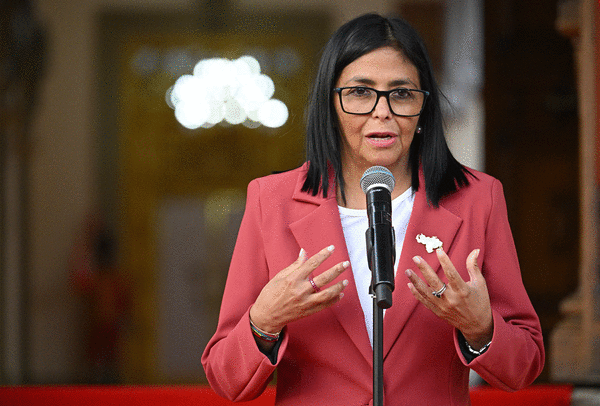
The earthquakes that struck Venezuela Wednesday have become the first major political test for acting President Delcy Rodríguez, with the disaster quickly evolving into a contest over competence.
By Friday morning, the official death toll had risen to nearly 600, and authorities reported 3,000 injured people. More than 200 aftershocks had occurred.
As Rodríguez’s administration races to rescue victims, restore infrastructure and secure international assistance, the opposition is mounting its own support operation. That includes organizing the humanitarian response, creating rival platforms to locate missing people and coordinate aid.
The competing efforts underscore how disaster relief is a key battleground for legitimacy in post-Maduro Venezuela.
How Rodríguez handles the crisis is likely to shape the future of her administration after the U.S. operation that removed strongman Nicolás Maduro from power in January. An effective response might help build support behind her, while a faltering one stands to deepen public frustration and strengthen opposition led by María Corina Machado.
For Rodríguez, “the emergency is simultaneously a risk and an opportunity,” Venezuelan political analyst Benigno Alarcón said in a report. If the response is rapid and transparent, “the interim government can recover performance legitimacy. If it is opaque, militarized, exclusionary or corrupt, social cost, international pressure and the probability of fractures will increase.”
Unlike elections or negotiations, natural disasters offer governments an immediate opportunity to demonstrate state capacity — or expose its limits.
History offers a mixed record for Rodríguez. In December 1999, Hugo Chávez faced the devastating Vargas tragedy, when torrential rains and mudslides killed tens of thousands in what is now La Guaira state. While the disaster cemented Chávez’s image as a hands-on leader, his government rejected offers of military assistance from the U.S., turning relief into another front in Venezuela’s confrontation with Washington.
Rodríguez has taken a markedly different approach. Her government has publicly welcomed offers of assistance from countries across the political spectrum, including the U.S. and allies of Donald Trump like Chile, Ecuador, Paraguay and El Salvador, signaling a more pragmatic approach to international cooperation.
The decision also reflects the scale of the challenge. The twin earthquakes — the strongest to hit Venezuela in decades — prompted the U.S. Geological Survey to issue its highest-level PAGER alert, warning of potentially catastrophic human and economic losses.
Equally, when catastrophic floods and landslides killed dozens and destroyed thousands of homes in Las Tejerías in 2022, Maduro broke years of relative isolation to make repeated visits to the disaster zone, promising government help. Yet at the time it was widely viewed as an effort to rebuild his standing ahead of the 2024 presidential election after nearly a decade of economic collapse and political turmoil.
Some initial personal experiences hint at the political dangers of not getting the response right, especially at a time when the Venezuelan opposition continues to command broad backing despite Machado remaining in exile.
Marianao Vallenilla, a 35-year-old university professor in Caracas, said she had seen no authorities in the Chacao neighborhood where she lives: no police, no firefighters. Residents in her building were instead organizing privately to hire engineers to check if its structure was safe.
“We haven’t heard anything about what we should do,” Vallenilla said via WhatsApp audio message. People outside Venezuela are likely to know more about what is happening than those inside the country, she added.
Jonny Montoya, 62, was with his panicked 84-year-old mother in El Rosal, an upscale business district in eastern Caracas, when the quakes hit. He expects little from Rodríguez’s leadership in the crisis, calling her government “a criminal gang that has done worse than an earthquake” and saying if the international community sends aid, the state “will steal it.”
It will in his view be hard for the government to mount a proper response after decades of institutional deterioration under the ruling socialist party. “The firefighters don’t have gasoline, they don’t have any tools to solve the problem,” he said.
A doctor at Hospital Miguel Pérez Carreño shared photos of eight handwritten pages listing injured patients, saying the hospital was overwhelmed. She circulated the names in hopes that families could locate missing relatives. Venezuela’s hospitals have been depleted by years of crisis, with shortages of medicine and basic medical supplies.
The competition between the interim authorities and the opposition is already playing out online. Rodríguez’s administration has repurposed VenApp — the mobile application previously used to encourage citizens to report suspected government critics — into an emergency platform for reporting missing people and damaged infrastructure.
The opposition, meanwhile, launched a parallel platform to reconnect families searching for missing relatives and coordinate volunteers, creating rival humanitarian networks as both sides compete to demonstrate they can mobilize aid faster and more effectively.
The opposition platform provides an alternative for those who view the government app with suspicion. It currently lists more than 58,000 as missing, with about 8,100 found. By Thursday at midday, the government was only reporting 157 people unaccounted for.
The opposition’s figures appear more consistent with expectations for a disaster of this scale. The U.S. Geological Survey said “high casualties and extensive damage” were likely following an earthquake of this magnitude, with an estimated death toll exceeding 10,000.
In a single WhatsApp group dedicated to missing persons in La Guaira state, more than 700 members were sharing photos and information, with new reports of missing people appearing every few minutes. Many of those being searched for are pilots, flight attendants and other aviation personnel, who commonly live in La Guaira because it is home to the country’s main international airport, Maiquetia, which has been closed since Wednesday night due to damage.
Machado remains in exile after leaving Venezuela late last year to receive the Nobel Peace Prize in Oslo, forcing her to coordinate relief largely through volunteers and online networks rather than in person. She has urged supporters to organize assistance through campaign accounts on social media while the opposition’s website has become a clearinghouse for reports of missing people and damaged infrastructure.
“In this very dark, very difficult hour, we stand together — you are not alone,” Machado told supporters in a video posted on her social media accounts. “Very, very soon, we will embrace one another in Venezuela.”
Machado’s team also launched “Operation Everyone with Venezuela,” an initiative to mobilize humanitarian aid for affected families through a network of aid stations for donations including food, drinkable water, clothing and medical supplies.
The effort got underway early Thursday evening, when campaign volunteers began sorting and distributing supplies in La Guaira, according to a video posted on Machado’s campaign social media account.
Still, Montaya, who lives in Catia, a lower-income district of Caracas once considered a government stronghold, said he had yet to see any tangible relief efforts from either the Rodríguez government or the opposition.
“If Rodríguez’s legitimacy rested on her ability to attract foreign investment and restart Venezuela’s shattered economy, the devastation caused by the earthquakes has made it a steep uphill battle,” Tiziano Breda of conflict monitor ACLED said by email.
©2026 Bloomberg L.P. Visit bloomberg.com. Distributed by Tribune Content Agency, LLC.

Comments