US, Iran plan to halt attacking each other ahead of talks
Published in News & Features
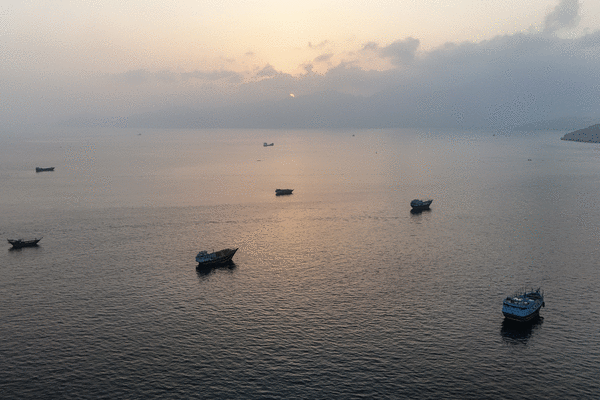
The U.S. and Iran have agreed to stop attacking each other before peace talks resume this week over the Strait of Hormuz and other issues to end the war, Axios reported. It is a sign of de-escalation after several days of tit-for-tat attacks that tested a fragile truce.
The back-and-forth assaults over the key waterway for oil and gas trade began Thursday with the Islamic Republic striking a container ship, prompting Washington to hit Iran the following day. The U.S. struck again overnight Saturday, after Tehran attacked a vessel carrying Qatari oil. Both sides blamed the other for breaching the ceasefire.
The violence ratcheted up tensions in the wake of this month’s interim U.S.-Iran peace deal and risks slowing progress toward restoring traffic through the vital strait to prewar levels. Talks over the details of the interim deal were expected to resume this week in Doha.
U.S. officials told Axios that Washington and Tehran had agreed to stand down on strikes and that vessels could move freely as talks continue. The talks, previously technical discussions about the future of Iran’s nuclear program, will now concentrate on opening the strait, Axios reported, through which a fifth of the world’s oil and gas flow.
The White House didn’t immediately respond to a request for comment.
Trading blows
In the latest barrage on Sunday, Iran’s Islamic Revolutionary Guard Corps said it launched missiles and drones at the Ali Al Salem Air Base in Kuwait and the 5th Fleet naval base in Salman Port, Bahrain.
Kuwait said it intercepted two missiles and there was no material damage or injuries. Bahrain reported a residential building had been hit, but said there were no fatalities.
The U.S. said on Saturday it struck Iranian military sites.
“There may come a point when we are no longer able to be reasonable, and will be forced to militarily complete the job that we very successfully started,” President Donald Trump said Saturday in a post on Truth Social after the latest strikes on Iran.
On Sunday morning, as tensions continued to mount, Trump drove around Washington, DC, inspecting the sites of current and future renovation projects he is unilaterally taking on, including the algae-filled Reflecting Pool.
The Joint Maritime Information Center on Saturday raised the security threat in the Strait of Hormuz to “substantial” after a tanker was struck, and published a warning area for potential mines spanning much of the usual transit route. It also said the Omani route recommended by Western navies had been expanded to allow ships to transit in both directions simultaneously.
Several vessels were crossing early Sunday using both the designated Omani and Iranian routes.
Tehran has repeatedly targeted Gulf states that host American military bases and thousands of troops since the U.S. and Israel launched the war on Feb. 28.
Separately, Israel said it destroyed a Hezbollah underground infrastructure in southern Lebanon. It had agreed with Lebanon to a ceasefire, but Hezbollah, which the U.S. has deemed a terror group and is Israel’s target in Lebanon, said the ceasefire was “void.” Iran has made Israel’s war with the Iran-supported Hezbollah a part of the interim deal, even though Israel was not a party to the agreement.
The IRGC said on Sunday that based on an agreement now known as the Islamabad Memorandum of Understanding, “traffic control arrangements in the Strait of Hormuz are with Iran, and from now on, violating ships will be dealt with more strongly than before,” Press TV reported in a post on X.
The two sides continue to tussle over key provisions, including whether Iran will impose tolls or other costs on ships seeking to sail through Hormuz and a ceasefire between Israel and Lebanon. Oman told European officials that vessels may ultimately have to be charged some fees, Bloomberg reported earlier.
Iranian Foreign Minister Abbas Araghchi visited neighboring Iraq on Sunday and said he discussed the U.S. accord with officials in Baghdad.
Iran is solely responsible for the restoration of Hormuz traffic and any interference risks escalation, he said in a televised press conference alongside his Iraqi counterpart.
Trump’s decision to attack demonstrates that he’s willing to use military force to maintain freedom of navigation in the strait.
Iran’s strikes, however, have shown it will seek to maintain control of the waterway, which has been largely shut since just after the war began.
The Hormuz strait, through which a fifth of the world’s crude and liquefied natural gas once transited, has become Tehran’s greatest point of leverage after its near-closure roiled the global economy.
_____
(With assistance from Alex Longley and Tim Smith.)
_____
©2026 Bloomberg L.P. Visit bloomberg.com. Distributed by Tribune Content Agency, LLC.





Comments