Ex-Gov. Hogan calls Maryland GOP gubernatorial nominees 'unelectable,' won't back Cox
Published in News & Features
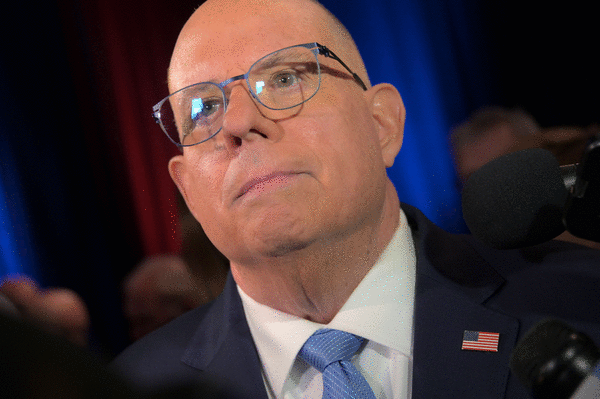
BALTIMORE — Former Maryland Gov. Larry Hogan did not commit to supporting Republican gubernatorial candidate Dan Cox, whom he also declined to endorse in 2022, renewing questions about whether Maryland Republicans can win statewide without the coalition Hogan built.
In a Sunday Fox 5 interview, Hogan said Maryland Republicans are “nominating unelectable people in the primaries.”
“I’m going to have to make a tough decision about what I do in November,” Hogan said.
Hogan’s comment renewed a long-running debate in Maryland politics: whether the coalition Hogan built — powered by Republicans, independents and some Democrats — still exists and could elect another Republican statewide.
Cox, who secured the GOP nomination last week after defeating businessman Ed Hale, told The Baltimore Sun on Monday that he is seeking Hogan’s endorsement and hopes to build a team similar to the one Hogan assembled during his two terms as governor.
“We intend to win, and I’m asking for [Hogan’s] support,” Cox said, adding that the former governor has already been gracious. “We have a lot of Governor Hogan’s supporters who helped him get elected that are now coming on board to help me, and we’re very grateful for that kindness.”
Hogan did not respond to requests for comment.
Cox said he is attempting to carry forward what he described as Hogan’s “economic message,” centered on affordability concerns such as electric bills, car registration fees, taxes and the cost of living.
“When you look at the message that Maryland wants, it wants common sense leadership,” Cox said. “Governor Hogan’s economic policies for families were what I defended every day in the state House, and I’m proud of that.”
But political scientists said replicating Hogan’s coalition may prove difficult.
Niambi Carter, a professor at the University of Maryland School of Public Policy, said Hogan’s success rested on more than an economic message. He built a political identity that distinguished him from national Republicans and appealed to moderate voters in a heavily Democratic state, she said.
Carter pointed to Hogan’s handling of the COVID-19 pandemic and his willingness to break with national Republican leaders as examples of what made him successful in a heavily Democratic state like Maryland. “When you’re trying to be Larry Hogan, you have to be more considerate of your state than you do your party,” she said.
Although Cox has centered his campaign on affordability, Carter said voters may be skeptical that he would govern as a moderate.
“I don’t think that people can trust what Cox says he’s going to do when we look at the kind of relationships that he has cultivated,” she said.
Cox was closely aligned with President Donald Trump during his last bid for governor, which drew sharp criticism from Hogan, who called him “a conspiracy theory-believing QAnon whack-job.”
Richard Vatz, a conservative political rhetoric professor at Towson University, said Hogan’s refusal to endorse Cox reflects broader changes within the Maryland Republican Party since he was first elected governor in 2014. “Hogan wants the Republican Party of 10 years ago,” Vatz said. “That brand in Maryland is really gone.”
Many Republican voters and activists have moved further to the right, Vatz said, arguing that it has become more difficult for candidates to attract the independents and moderate Democrats who helped elect Hogan twice.
John Dedie, a political science professor at the Community College of Baltimore County, said that divisions within the party, coupled with a lack of competitive Republican races in some parts of the state, could dampen GOP turnout in November. “There is no competitive reason for Republicans in some of these counties to come out and vote,” he said, pointing to races in Howard and Baltimore Counties with few Republican prospects motivating voters.
Analysts also questioned whether Cox will be able to raise the money needed to mount a competitive statewide campaign after his unsuccessful 2022 gubernatorial run.
“You donate when you think there’s a chance of winning,” Dedie said. “I don’t see where his bundlers and supporters are going to come up with the multimillion dollars you need.”
Carter said Maryland Republicans could again become competitive statewide, but only if they nominate candidates capable of appealing beyond the party’s conservative base. “If Republicans are serious, they’ve got to find a moderate Republican,” she said.
_____
©2026 The Baltimore Sun. Visit at baltimoresun.com. Distributed by Tribune Content Agency, LLC.




Comments