450 wild horses face a roundup in Eastern Sierra as feds proceed with contested plan
Published in News & Features
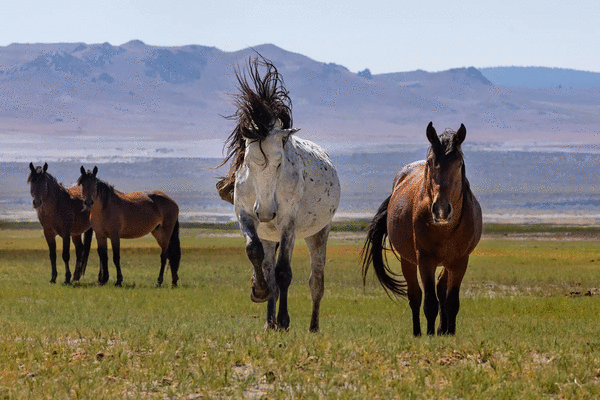
LOS ANGELES — Federal officials have set a date to round up and relocate 450 wild horses they say are damaging Mono Lake’s famed limestone tufas and posing a threat to drivers. The move is hailed by environmentalists but heartbreaking for tribes and horse lovers who have fought to stop it.
On July 8, the Inyo National Forest will begin rounding up horses from the Montgomery Pass herd roaming beyond the roughly 200,000 acres designated for them along the California-Nevada border, according to a recent news release.
Contractors will use helicopters and other vehicles to drive the horses into a large catch pen with holding corrals. Officials say the use of helicopters is humane and carried out with measures to protect the horses, whereas many animal welfare advocates claim it can lead to injury and even death. A federal bill introduced last year seeks to ban the practice.
They will be taken in trailers to a corral in Modoc National Forest and readied for adoption.
The operation is planned for one to two weeks, but may finish sooner.
The announcement comes more than a year after the U.S. Forest Service and Bureau of Land Management approved a plan to remove hundreds of horses that had wandered beyond their designated territory. In 1971, there were 50 horses within the area. As of 2024, a federal census found there were roughly 700 — more than three times what officials say the land can support — with most of them outside the territory.
In August 2025, a documentary filmmaker, primary care physician and wildlife ecologist sued the government over the plan, claiming it was reneging on its duty to protect the horses under the Wild Free-Roaming Horses and Burros Act.
That 1971 law declared wild horses and burros “living symbols of the historic and pioneer spirit of the West” and made it illegal to harass, capture or kill them on public land. But the Forest Service and BLM, which became responsible for managing them, can remove “excess animals” to preserve the health of the range.
The lawsuit delayed the roundup, also known as a gather, but in February a U.S. magistrate judge ruled in favor of the government, paving the way for it to move forward.
Cherie Tobin, the physician among the plaintiffs, said they plan to appeal as well as ask the court to halt the gather. Among other things, she said they will argue that federal officials improperly redrew the territory boundaries, shrinking it and depriving the horses of year-round water sources.
The Forest Service, in written comments, said it has never redrawn the boundary.
In October 2022, Tobin, who lives near Pasadena, visited the Eastern Sierra town of Lee Vining to learn landscape photography and ended up hearing about — and photographing — the herd. She kept coming back, spending more than 360 hours with them, all told.
News of the coming gather, she said, is “frightening.”
“I know the different horses and their babies, and I’ve watched the babies grow up; I’ve given them names,” she added. “So to hear this, and then to have it sprung on us with only two weeks to prepare, that’s just so cruel.”
Tobin’s group isn’t the only one opposed and the issues she raises are only some of the points of contention. Those seeking to stop the roundup reject almost all of the federal agencies’ claims, including the size of the herd and the notion that the horses cause ecological damage.
Representatives from two local tribes draw a parallel between the gather and past efforts to expel their people from their ancestral lands, and say the horses are intertwined with their culture.
“They wanted to get rid of the Native American people for being feral and wild, and now they want the wild horses gone because they’re feral and wild — and free,” said Rana Saulque, vice chairwoman for the Utu Utu Gwaitu Paiute Tribe.
Ronda Kauk of the Mono Lake Kootzaduka’a Tribe recalled a dream in which people were rounded up by helicopters. “Some people would say it was a vision,” she said.
Saulque and Kauk are part of an Indigenous-led coalition that has sought to help manage the horses that they call “family,” proposing to run a pack station and orchestrate equine therapy.
They say the Forest Service has not responded to their requests and feel they’ve been sidelined in discussions over the future of the herd. On Monday, Saulque’s tribe, its chairman and Kauk filed a lawsuit in federal court to stop the roundup.
A Forest Service spokesperson said the agency believes it has met its obligation to consult with local tribes, as required by the law, treaties and agency policy. The agency denied receiving requests from any tribe about managing the horses, but said it’s open to such conversations.
“The Inyo National Forest works with multiple Tribes in the Eastern Sierra, and while each Tribe engages at different levels — and holds differing views on wild horses — we have maintained open and active communication throughout this process,” wrote the spokesperson, who was not addressing the recent suit.
For others, including retired state employees speaking in their individual capacities, the planned operation is long overdue.
Steve Heimlich spent roughly 40 years working at a California Department of Fish and Wildlife hatchery, frequently venturing into the Eastern High Sierra before he retired a decade ago. The Mono City resident recalls seeing a few dozen horses on the east side of the White Mountains in the early days. Over time, he said, they pushed west and their number increased. By 2021, they reached South Tufa, where tourists congregate to gaze at the rock formations. In the spring of 2023, as epic winter snows melted, horse carcasses emerged along the shores of South Tufa and nearby Navy Beach.
On the remote east side of Mono Lake, he said, the animals gobbled down grass, roots and all, depriving certain birds of the worms that live in the vegetation — their sustenance. He said they displace antelope and other species too. “It’s upsetting the biological balance,” he said.
Although he supports the relocation effort, he questions its long-term effectiveness. Wild horse populations can increase as much as 20% a year, a rate some experts say is greater than the capacity to remove horses.
“I’m not in favor of shooting some of these beautiful animals, but euthanizing them might be the only thing that works,” Heimlich said. (The 1971 law allows healthy horses to be euthanized for management purposes, but Congress forbids it through the annual budget process.) Others believe the best solution is darting the horses with birth control, a method used elsewhere in the U.S.
Dave Marquart, part of a team that monitored the wetlands rimming Mono Lake for 36 years, said he witnessed the transition “from some of the most thriving, pristine wetlands in the state to just being trampled.”
As a former interpretive naturalist for the Mono Lake Tufa State Natural Reserve, he even led a field trip for the Forest Service, BLM and State Parks to highlight the ecological damage. Asked why nothing was done until now, he speculated that it’s such a “big issue” — emotionally charged and logistically challenging — that the agencies didn’t want to touch it.
He sees the gather as a win for everyone: “The horses get moved, and adopted, and the wetlands get an opportunity to rebound — hopefully.”
©2026 Los Angeles Times. Visit at latimes.com. Distributed by Tribune Content Agency, LLC.






Comments