Detroit carmakers mostly miss out on demand boom for hybrids
Published in News & Features
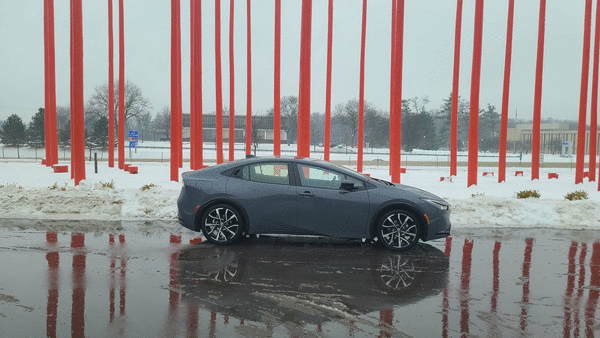
Fuel-sipping hybrids have become some of the hottest vehicles on the lot this year as gas prices hover near $4 a gallon.
The problem for Detroit’s automakers is that they don’t have many to offer.
Hybrid sales likely rose more than 9% during the first half of the year, compared with a roughly 3% decline in overall U.S. auto sales, according forecasts by researcher Cox Automotive. Deliveries have jumped more than 80% since 2023, with hybrids accounting for a record 14% share of the market through the first quarter.
The trend has put a spotlight on the haves and have-nots in the segment. Asian automakers dominate the hybrid market in the U.S., with Japan’s Honda Motor Co. and Toyota Motor Corp. accounting for seven of the 10 best-selling hybrid models this year, according to Cox.
Just a single model from a U.S. automaker — Ford Motor Co.’s Maverick pickup — cracked the top 10. With fewer hybrids by comparison, Detroit’s carmakers risk missing out on the sales bonanza in the near term.
Hyundai Motor Co. on Wednesday reported record second-quarter sales that were helped by a 71% rise in hybrid deliveries, led by gas-electric versions of high-volume models including the Sonata sedan and Santa Fe and Tucson SUVs, the South Korean automaker said Wednesday.
The company plans to increase production of gas-electric vehicles in the U.S. in response to the strong demand, said Randy Parker, chief executive officer of Hyundai’s North America business.
“Hybrids are definitely our growth engine right now,” Parker told reporters.
Hyundai’s sibling Kia saw sales of hybrid models jump 187% in June, contributing to a 3% gain in second-quarter deliveries.
Hybrids combine an internal combustion engine with an electric motor, boosting fuel-efficiency compared with models powered solely by gasoline. They’re also less expensive than battery-electric vehicles and can be refueled at the pump, unlike EVs that drivers often charge at home.
“These are the strongest sellers that we have across the line, regardless of the model,” said Brian Benstock, vice president of Paragon Honda in Queens, New York. “If we have a hybrid in it, that is what customers are asking for first.”
Toyota and Honda are expected to report higher U.S. sales as most carmakers announce second-quarter deliveries on Wednesday.
General Motors Co. by contrast only offers a low-volume hybrid version of Chevrolet Corvette sports car. GM has stuck with a strategy of selling EVs rather than hybrids, while relying on its pricey trucks and SUVs to keep profits and cash flow up.
A GM spokesman declined to comment on the company’s hybrid strategy.
Ford, the top U.S. carmaker in hybrid sales, plans to deploy additional gas-electrics across its lineup in the coming years. But for now, the company is producing just three hybrid models after it canceled a pair of SUVs late last year to make room for a new $30,000 electric pickup that it plans to build in Kentucky.
One of the discontinued hybrids, the Escape compact SUV, had sold in large numbers for more than two decades. Its departure from the popular segment has contributed to a 22% decline in Ford’s hybrid sales through May.
Stellantis NV currently sells a single hybrid in the U.S. — the new 2026 Jeep Cherokee. The company discontinued plug-in hybrid versions of models including the Chrysler Pacifica minivan and Jeep Wrangler SUV earlier this year.
Antonio Filosa, the automaker’s chief executive officer, has said the company plans to add more gas-electric options, and will introduce an extended-range version of the Jeep Grand Wagoneer and Ram pickup truck later this year. Extended-range vehicles can be plugged in like a conventional EV, but have an on-board gas generator to boost range.
“If you’ve got a hybrid to sell, it’s going to do alright,” said Ed Kim, president of consultancy AutoPacific. “It also means the automakers that don’t have hybrids, they’re the ones that stand to lose out.”
Demand for hybrids has become a bright spot in an overall U.S. auto market that’s expected to show little growth or possibly shrink this year. New cars that sell for just shy of $50,000 on average and rising gasoline prices have pushed shoppers to prioritize affordability.
Seasonally adjusted sales likely rose to an annualized rate 16.5 million vehicles in June, helping push second-quarter deliveries a slight gain compared with the prior-year period, according to forecaster JD Power.
Cox Automotive forecasts full-year sales of about 15.8 million vehicles, down 2.9% from 2025.
Analysts see hybrids’ popularity as more than a passing trend. U.S. hybrid market share is set to more than double over the next five years to account for more than a quarter of the market, according to a report by John Murphy, founder of advisory firm Murphy Automotive Partners.
“Automakers are building real scale into this segment,” said Stephanie Valdez Streaty, director of industry insights at Cox. “It’s becoming a core volume strategy, and consumer demand is keeping pace.”
Detroit’s biggest pickups continue to sell, but companies are offering deals to bring in buyers. Dealer Jim Hardick said his Chevrolet and Ram stores near Fort Worth, Texas, had a good quarter after both companies got more aggressive with 0% financing offers to help sell full-size pickups.
“Our truck business has started pick up again,” he said. “It’s helped us.”
Hardick’s Kia stores don’t need help. They’re having a strong month thanks to the brand’s hybrids and lower-priced models.
“It’s a good time to be a Kia dealer,” said Hardick, managing partner of the Moritz Dealerships group in Fort Worth. “Their prices are in the right spot and they have hybrids, and they’re selling well.”
(With assistance from Keith Naughton and Chester Dawson.)
©2026 Bloomberg L.P. Visit bloomberg.com. Distributed by Tribune Content Agency, LLC.






Comments