Trump heads to NATO as tensions simmer with Europe
Published in News & Features
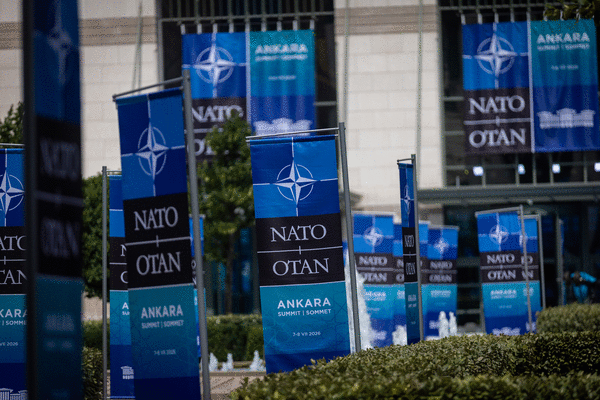
WASHINGTON — The leaders of Europe are bracing for another turbulent summit with President Donald Trump this week as NATO members gather for their annual meeting in the Turkish capital.
European diplomats view Trump’s decision to attend as a positive sign of his continued commitment to the alliance. But the president’s grievances with several European governments over their refusal to join the U.S. war with Iran have cast a pall over a summit already strained by Trump’s wavering support for the continent.
The secretary-general of the trans-Atlantic alliance, Mark Rutte, told reporters Monday that Trump had aired his resentments in a recent phone call. But Rutte countered with a mix of flattery and countervailing facts that has thus far kept Trump engaged.
While Trump has accused European leaders of denying U.S. forces access to allied bases for takeoffs and refueling during the war, Rutte noted that about 5,000 sorties supporting Operation Epic Fury launched from European airfields. And last Friday, France and Britain committed to a joint military mission with Oman to support freedom of navigation in the Strait of Hormuz — “an extremely important development,” Rutte said.
At last year’s summit, held in The Hague, Netherlands, all NATO member states — with the exception of Spain — agreed to spend 5% of their GDP on defense by 2035, marking a significant increase in historic spending goals for modern Europe. The pledge is divided into two categories, with 3.5% of spending allocated to core military requirements, and the rest committed to a broad set of security-related investments.
Trump’s tough love on the alliance “is, I think, bringing NATO closer together,” the secretary-general told reporters.
“You could argue that he is the first president of the U.S. since Eisenhower who was able to come to this situation where the Europeans and the Canadians will spend the same as the Americans” on security, Rutte said. “This equalization was a wish for 50, 60 years, and now it’s happening — I think in large part due to his leadership.”
In a video message posted on social media Monday, Trump’s ambassador to NATO, Matthew Whitaker, said the summit this week would serve as a “report card” to determine whether countries were beginning to fulfill their commitments from last year.
He offered a note of optimism and suggested the president’s goal is to enhance, rather than undermine, the alliance.
“The United States will be here, but we also need our allies to be here. We cannot do it alone, and the American taxpayer should no longer bear the burden,” Whitaker said.
A White House schedule for Trump’s trip lists bilateral meetings with Rutte and the leaders of Turkey, Syria and Ukraine, in between alliance-wide meals and conferences.
Ukraine will remain at the top of the agenda, Trump told reporters Monday, expressing hope that the war could soon come to an end after four brutal years of fighting.
Russia’s invasion of Ukraine has caused the greatest loss of life in Europe since World War II, resulting in more than 1 million casualties, including an estimated 600,000 dead. Since Russian President Vladimir Putin launched his full-scale invasion in 2022, following his covert invasions of Ukraine’s Crimean peninsula and eastern regions in 2014, Russian forces have captured roughly 12% of Ukraine’s territory.
The war has settled into a deadly stalemate since a 2023 Ukrainian counteroffensive failed to break Russian defensive lines. While Russian forces have occasionally advanced, they have only managed to hold marginal gains along the front, at tremendous cost.
In recent weeks, however, expanded Ukrainian drone and missile capabilities have shifted the dynamic, striking military production sites deep inside Russia and targets near Moscow, bringing the war more directly into the Russian public consciousness and raising questions in the Russian capital whether the war effort is sustainable.
Ukraine’s boldness has impressed the Trump administration, Alexander Stubb, the president of Finland, told the Financial Times this week.
“I think he does feel pressure,” Trump said of Putin, addressing reporters in the Oval Office before departing for Turkey on Monday.
The president referred to an ongoing U.S. effort to end the war, a goal that has remained elusive for Trump since returning to office.
“I think we’re getting much closer than people realize,” he said. “President Putin wants it to end, I will tell you that. Very strongly. Had a good call. And President Zelenskyy actually wants it to end now.”
“We’re going to be going to NATO, and we’re going to be talking about it,” Trump added. “And I think we’re going to get it ended. It’s been terrible.”
©2026 Los Angeles Times. Visit at latimes.com. Distributed by Tribune Content Agency, LLC.






Comments