Netanyahu's main challenger is ex-general who lost son in Gaza war
Published in News & Features
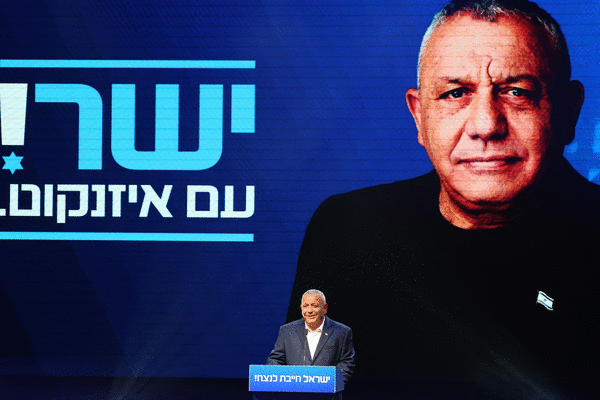
Gadi Eisenkot, a former head of Israel’s armed forces, has emerged as the main challenger to Benjamin Netanyahu in upcoming elections that could end the premiership of the country’s longest-serving leader.
Polls indicate that Eisenkot’s new party Yashar — Hebrew for straightforward or honest — will get slightly more seats than Netanyahu’s Likud in the Oct. 27 vote, which would give him the right to try and form a coalition government. Stocky and somber, untested in domestic politics and a stranger to foreign-policy circles, the 66-year-old ex-general represents a stark contrast to the articulate and telegenic Netanyahu, in style if not so much in policy.
The ballot will double as a verdict on Netanyahu, 76, whose most recent term has been punctuated by near constant war, corruption cases, constitutional feuding and the growing isolation of Israel on the global stage.
Eisenkot is “almost the antithesis of what Netanyahu represents,” said Amotz Asa-El, research fellow at the Shalom Hartman Institute in Jerusalem. “After a whole era in which Israel was, for better or worse, led by a politician who embodied charisma, people are happy now to veer from charisma to anti-charisma.”
Eisenkot, who commanded the Israel Defense Forces for four years through 2019, lost a son, Gal, and two nephews during the war against Hamas in Gaza. That’s given him a gravitas with many Israelis, as well as a degree of protection from rivals’ sniping, as he vows to repair a nation weary of conflict in the Palestinian territory, Lebanon and Syria, as well as with Iran.
Running for office, Eisenkot told public broadcaster Kan, is “mainly searching for meaning amid this heavy price, so that we will be worthy of it, as a family and as a country.”
A poll aired on Channel 12 TV on Monday found that 43% of Israelis see Eisenkot as the best candidate for prime minister, compared with 34% for Netanyahu.
Son of immigrants
In contrast to the Tel Aviv-born and U.S.-educated Netanyahu, Eisenkot is the son of poor Moroccan immigrants who grew up in the remote working-class port of Eilat. He rose through the infantry ranks to eventually become military chief, although his time as a general was not free of controversy.
In 2008, he was the architect of the Dahiya doctrine, named after the Beirut neighborhood where Hezbollah had its headquarters. It involves destroying civilian infrastructure and forcing local populations to leave so Israel can better target its Iran-backed militant opponents.
Israeli forces have been widely criticized by international governments and rights groups for using this strategy in Gaza, where tens of thousands of civilians died in the recent war. In Lebanon, more than a million people have been displaced this year by Israel’s airstrikes and occupation of the south of the country.
Israel insists groups like Hezbollah and Hamas use civilian neighborhoods as bases and weapon storage sites, making the doctrine a military necessity.
Eisenkot’s background qualified him to join Netanyahu’s war Cabinet during the early months of the Gaza war, but he now says he would shun any coalition with the prime minister.
“I’m a million percent determined to clear out the worst government this country has had since its founding — to replace it,” Eisenkot, with rare vehemence, told a rooftop gathering of supporters in the town of Kfar Sava, north of Tel Aviv, earlier this month.
“I’m not trying to pass myself off as something I’m not, but rather to present things the way I understand them, and then let you decide.”
On matters of Israeli national security, like the threat from Iran, he spoke of its seriousness in matter-of-fact terms shorn of Netanyahu’s rhetorical flourishes. He’s committed to universal military conscription, even though that’s anathema to ultra-Orthodox Jewish parties whose constituents are granted exceptions.
He’s less forthright when questioned about the economy, education or youth crime, deferring to the ideas of veteran lawmakers or civil-service professionals on his party roster.
The website of Eisenkot’s Yashar party lays out an economic platform that’s hard to distinguish from Netanyahu’s promises of free-market reforms and infrastructure investments.
US relationship
Some Israeli commentators have questioned whether a Prime Minister Eisenkot, lacking Netanyahu’s command of English and mileage in Washington, could win over the administration of U.S. President Donald Trump — especially at a time of ruptures in the alliance between the countries. Eisenkot, a graduate of the U.S. Army War College, dismisses that concern.
“The Americans would be business-minded with him,” said Asa-El. “The question at that point would be not how he speaks, but what he says. In that regard, he would be perfectly fine in a setting like the White House.”
A poll on Israel’s Channel 13 TV last week suggested Yashar could win 23 of parliament’s 120 seats, putting it in the lead, with Likud getting 22. But even if such an upset plays out in the election, Eisenkot will face tough horse-trading to form a stable new coalition.
His commitment to conscription means he’s unlikely to partner with ultra-Orthodox Jewish parties. Eisenkot wants the far-right minister for police, Itamar Ben-Gvir, out of politics, and opposes the aggressive West Bank settlement strategy pursued by ultranationalist Finance Minister Bezalel Smotrich. Like all Israeli politicians however, he opposes the formation of a Palestinian state.
That leaves center-left or secularist politicians. Two of these, former Prime Ministers Naftali Bennett and Yair Lapid, formed a joint slate in April without inviting or consulting Eisenkot — a move that caught him off guard, he told Channel 12.
Eisenkot has provided grist for rightist attack ads by not ruling out cooperation with parties that cater to Israel’s Arabs, a minority increasingly sidelined during the war in Gaza. If they’re willing to accept non-military national service there’s a basis for engagement, he said in Kfar Sava.
Eisenkot’s Moroccan descent could be a draw among fellow Mizrachim — or ‘Middle Easterners’ — who make up about half of Israel’s majority Jews but have never produced a prime minister. It may also give him an advantage in relations with Arab neighbors that see the Netanyahu government as belligerent and expansionist.
Nahum Barnea, senior columnist for the top-selling newspaper Yedioth Ahronoth, warned that Eisenkot’s current front runner status may be shaken by the hard knocks of political compromise.
“The love that he is currently being showered with will soon turn into a sea of doubts,” he wrote. “The voters will expect answers. He will come under attack from inside the bloc, from left and from right.”
—With assistance from Gina Turner.
©2026 Bloomberg L.P. Visit bloomberg.com. Distributed by Tribune Content Agency, LLC.






Comments