Illinois shatters air quality record, EPA data shows, as dangerous wildfire smoke envelops region
Published in News & Features
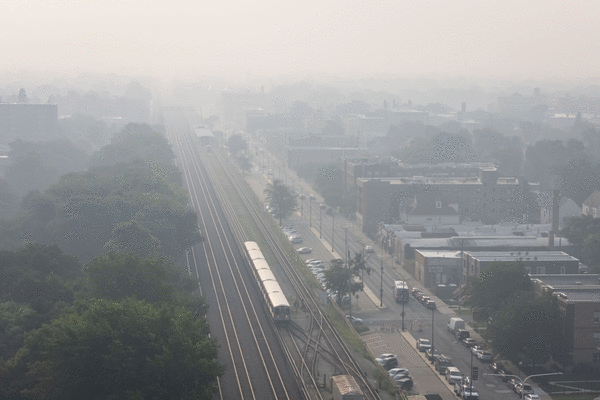
CHICAGO — Thick haze settled over northern Illinois on Thursday morning as dangerous levels of wildfire smoke from Canada and Minnesota rolled into the area, and it might get worse tonight, according to the National Weather Service.
Concentrations of the pollutant PM2.5 in the Chicago area by midafternoon had reached an index of 400 on a scale that tops out at 500, according to AirNow, a website that combines data from county, state and federal air quality agencies nationwide.
Air quality was even worse in the North Shore suburbs, where Wilmette and Winnetka registered above 700. Cook County’s previous record for PM2.5 was less than a third of that on June 27, 2023, according to data from the U.S. Environmental Protection Agency
Levels between 200 and 300 are “very unhealthy,” and anything above 300 is “hazardous.” When the forecast is hazardous, everyone should stay indoors and reduce activity levels.
According to Swiss air quality company IQAir, as of 9 a.m. Chicago was the third-most-polluted major city in the world, behind Detroit and Minneapolis.
Fine particles known as PM2.5, which can be emitted by factories, power plants, diesel and gasoline vehicles, residential fireplaces and wildfires, are the main driver behind Thursday’s elevated air quality. PM2.5 can harm human health and sometimes be deadly. Initially, fine particulate matter may cause a burning sensation in the eyes and nose. But because of its small size, it can settle deep in the lungs and cross into the bloodstream.
Ricky Castro, meteorologist for the National Weather Service, said the haziest conditions could develop Thursday night. The forecast for Friday is uncertain, he added.
Humboldt Park was eerily quiet Thursday afternoon as smoke blanketed the sprawling greenspace. The playgrounds, usually crowded with children, sat empty.
Across the street, toddlers at Roots Early Learning Center played quietly indoors, separated from the hazy air by a floor-to-ceiling wall of glass. Several children were absent, said owner Azra Hodzic, including a young girl with severe asthma.
“Today’s the first day that, due to the air quality, we didn’t go outside,” said Hodzic. “We take all the precautions we can since we have little kids.”
Hodzic kept a close eye on air quality updates Thursday morning before telling parents the children would forgo their usual trip to the park. For many outdoor workers, however, avoiding the smoke wasn’t an option.
“I don’t even think staying home crossed our minds,” said Ramon Toledo, a lineman for the city of Chicago, who spent the afternoon lifting heavy drain covers along Kedzie Avenue. “Nobody brought it up.”
With more than a decade on the job, Toledo said working through smoky conditions has become part of the routine. As his two coworkers adjusted bundles of brightly colored wires inside a traffic signal control box, none of the three men wore masks.
“It’s not bad unless you’re in the sun,” said Toledo, 46. “That’s where it hits you, that’s when you get tired.”
Climate change effects
Illinois State Climatologist Trent Ford said air often moves in from Canada this time of year due to a high pressure system in the central U.S. This leads to air from central Canada getting pushed into the Great Lakes, along with wildfire smoke.
Ford said hazy conditions such as those Thursday and in 2023 aren’t necessarily a “new normal,” although wildfire smoke is something northern Illinois will likely deal with more often in coming summers.
In 2023, smoke from intense Canadian wildfires made Chicago the second-most-polluted major city in the country that year.
Ford said the primary reason for these conditions is climate change. First, human-caused climate change creates conditions where there’s more extreme variation in rain. Even in places like Minnesota where it’s raining more, Ford said, there’s short-lived droughts creating conditions suitable for wildfires.
Second and more importantly, higher temperatures create a drier atmosphere, he said. Large wildfires not only remove a source of climate-change mitigation by destroying trees; they can also actively make things worse by releasing carbon dioxide from trees into the atmosphere.
“We think of forests as a sink for that carbon for that to reduce the amount of carbon dioxide or hopefully limit warming,” Ford said. “But when we have these large wildfires, they are sort of reversing that process.”
According to Castro, wildfire smoke is exacerbating pollution issues already present in northern Illinois earlier this week. The Illinois Environmental Protection Agency issued an alert for ground-level ozone Tuesday. Ozone can cause coughing, damage airways and aggravate lung diseases, according to the U.S. Environmental Protection Agency.
Castro said the pollutant often accumulates more in hot summer conditions when it’s not as windy. Without wind, it’s more difficult for ozone to move away from the ground and out of an area.
“Winds are what really do cause dispersion of pollutants or emissions like ozone,” Castro said. “When you don’t have winds to serve things up, they tend to get trapped.”
Health impacts
Some people may experience more problems from the pollution, especially those with respiratory conditions, said Brian Urbaszewski, director of environmental health programs for the Respiratory Health Association, based in Chicago.
The pollution in the air Thursday is especially dangerous because it’s made up of PM2.5 — fine particles that are far smaller than even the width of a single strand of hair, Urbaszewski said. The hair and mucus in peoples’ noses and throats can filter out larger particles, but not necessarily tiny ones, he said.
“The problem with these really small particles is that they bypass those filters,” Urbaszewski said. “They get into the deepest portion of your lungs and from there they can get into your bloodstream and circulate throughout your body.”
When these particles are in the bloodstream, they can cause blood vessels to constrict, straining the heart, said Dr. Samer Martini, a cardiologist at Advocate Health Care in Elgin. This can increase risks of heart attacks, strokes and heart failure, he added.
Dr. Jack Zhao, a pulmonary critical care physician at Rush Copley Medical Center in Aurora, already had “quite a few people” come through the hospital’s emergency department by late Thursday morning with shortness of breath.
Anyone experiencing shortness of breath, chest pain or tightness, or dizziness should seek medical attention, Zhao said.
But even relatively healthy people should stay inside as much as possible and take other precautions, health experts said.
“If (people) have to go outside today and be outside for extended periods of time, it will be like smoking or standing next to a campfire,” Zhao said. “They may get eye or throat irritation.”
In addition to staying inside as much as possible, Urbaszewski advises people to recirculate the air in their vehicles, so that less outside air is sucked inside while driving. People should also use high-efficiency particulate air (HEPA) filters in their homes if they have them.
It’s also important, however, for people to balance the need to stay cool in the high heat with avoiding the pollution. If a person doesn’t have air conditioning, staying in their homes with all the windows shut on a very hot day could also be dangerous, he said.
People without air conditioning may want to leave their homes to go to places with air conditioning, such as a relative’s home, a workplace, a cooling center or senior center, Urbaszewski said.
“We don’t want to say that the smoke is more dangerous than creating a heat stroke situation,” Urbaszewski said.
Zhao also recommended people wear N95 masks when outside, especially those with other health conditions.
The conditions still posed a concern for Lachon Dunn, 60, who walked toward a bus stop wearing a bright blue surgical mask. Friends had called the West Side native that morning to warn her about the air quality, knowing she has a respiratory condition.
“I see what they’re talking about now that I’m out here,” said Dunn. “It feels stuffy, and I’m worried about my health.”
Around the corner, Hector Plaza shuffled down the sidewalk with one hand on his walker and the other gripping his dog’s leash. The 80-year-old said he didn’t know about the poor air quality until he stepped outside.
“I walked out this morning and looked around to see if anything was burning,” said Plaza. “This is what probably has me so sick.”
Plaza said chronic circulation problems in his legs require him to walk every day, even if only for a few minutes. And his Pomeranian, Bear, still needs to get outside.
“It feels bad, I can hardly breathe,” he said. “I should be inside, but I have to do a little bit of exercise.”
—Chicago Tribune’s Adriana Pérez contributed.
____
©2026 Chicago Tribune. Visit at chicagotribune.com. Distributed by Tribune Content Agency, LLC.





Comments