Maryland's campaign season leaves behind a mountain of waste
Published in News & Features
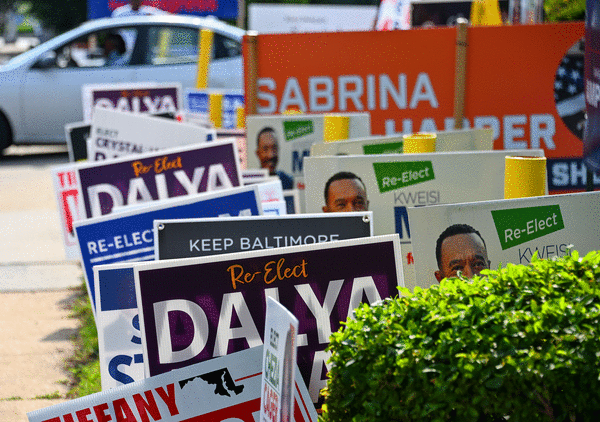
Every election season, Maryland political campaigns blanket voters with paper mailers, plastic yard signs and campaign literature. After the votes are counted, much of that material becomes trash — waste that few agencies track and almost no candidates campaign on reducing.
Some ends up in landfills or is burned at trash incinerators, while other campaign signs linger along roadsides for weeks after Election Day. Yet despite the volume of campaign materials produced each election cycle, Maryland does not track how much ultimately becomes waste.
Some Maryland campaigns say they’re trying to reduce waste by using recyclable materials and other environmentally conscious outreach methods. But political strategists and analysts say completely “green” campaigns remain unrealistic because reaching voters still depends heavily on printed mail, campaign signs and travel.
Campaigns generate waste in multiple ways, particularly through repeated campaign mailers sent in the weeks before Election Day, said John Dedie, a politics professor at the Community College of Baltimore County.
Once elections are over, campaign signs often remain along Maryland roadsides until they’re removed. Since April 2024, the Maryland State Highway Administration has been primarily responsible for removing campaign and advertising signs from state highways, sidewalks and clear zones. While some campaigns collect signs for reuse or recycling, others are discarded after Election Day.
How campaigns went green so far
Some Maryland environmental groups are encouraging campaigns to reduce their environmental footprint.
The Maryland League of Conservation Voters (MDCLV), a statewide environmental advocacy group, considers campaign sustainability as part of its endorsement process. In addition to evaluating lawmakers’ records on issues such as clean air and affordable energy, the organization encourages campaigns to use recyclable materials, mass transit and, in local races, prioritize face-to-face voter outreach over paper communications.
Shawn Drury, an MDCLV spokesperson, said he witnessed an increase in environmentally conscious campaigns, noting that “the most environmentally friendly campaigns are the ones that win.” MDCLV endorsed 98 candidates in the 2026 primary elections, including the governor, Comptroller Brooke Lierman and Attorney General Anthony Brown, and over 100 candidates from the Maryland General Assembly during the 2022 midterm elections.
When Baltimore City entrepreneur Bobby LaPin launched his state Senate campaign, one of his first questions for printing vendors wasn’t price — it was whether campaign signs could be recycled.
The businessman, who last month lost his challenge to sitting Senate President Bill Ferguson, said he wanted a green campaign, conscious of the waste generated by printing thousands of paper mailers and coroplast signs, which are plastic-covered, during election season. He added that the waste often ends up burned at a trash incinerator in Southwest Baltimore, which has been the city’s largest air polluter.
“A lot of people use the paper signs melded with plastic, which can’t be recycled because you can’t separate the plastic from the paper,” LaPin said, adding that he often bought signs with biodegradable paper and ink. But when he had to use coroplast signs, LaPin’s campaign donated them to local businesses and artists, who used them for flooring or as canvases for painting.
Gov. Wes Moore’s campaign has also prioritized eco-friendly campaign materials. Carter Elliott, Moore’s campaign spokesperson, said, “Many of the paper products used by the campaign are also made of already recycled materials.”
Still, not all Maryland campaigns are adopting an eco-friendly approach.
Jim Burton, a consultant who works with Maryland Republican candidates, said his strategy centers on crafting the most effective message and determining how best to communicate it. While environmentally friendly methods are admirable, Burton said, they’re also expensive and can strangle campaign budgets, particularly for candidates without financial muscle.
“Using recycled paper generally costs more money. Campaigns are about limited budget and limited time,” he said. “If five pieces of mail are going to cost $35,000, recycling paper would cost (way) more.”
In some cases, environmentally safe campaign methods aren’t possible. Joe Francaviglia, a former Maryland Democratic Party official, said campaigns can’t avoid burning gas because winning statewide races requires extensive travel.
“Public transit doesn’t get to most of Maryland. So, while public transit would be ideal, you (also) need to get to places to campaign because it’s important to talk to voters face to face,” Francaviglia said. “The number one focus of anyone running campaigns is to win, and you have to put your resources where you can win.”
_____
©2026 Baltimore Sun. Visit baltimoresun.com. Distributed by Tribune Content Agency, LLC.





Comments