US, Iran extend pause in strikes as Oman holds Hormuz talks
Published in News & Features
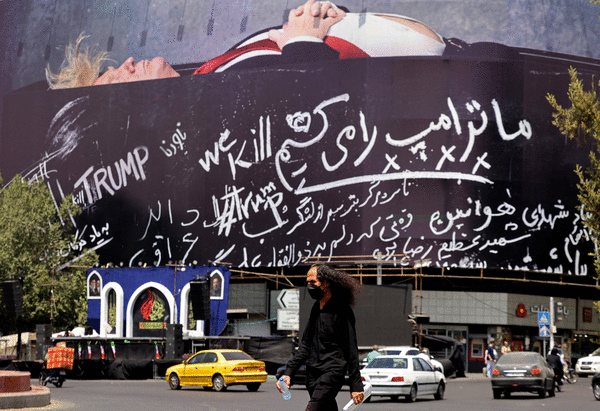
The U.S. paused an almost two-week run of strikes against Iran for a second night while the Islamic Republic signaled it was refraining from any retaliatory attacks and held talks with Oman over the Strait of Hormuz.
After 13 straight nights of strikes aimed at degrading Iran’s ability to attack commercial shipping, the U.S. has apparently held off since late Friday without explanation or announcement, raising questions about President Donald Trump’s next move. Iran’s army on Sunday said Tehran had halted its retaliation as a result.
“The U.S. may have devised other scenarios for the coming days, but the current situation is not what they desire,” spokesman Mohammad Akraminia told state TV. “If the Americans insist on continuing the war and airstrikes, the geography of the war will expand.”
The lull came as Iranian and Omani officials met over the weekend in a fresh attempt to resolve shipping through Hormuz, the global chokepoint at the heart of the conflict the U.S. and Israel began in late February.
U.S. equity-index futures rallied and Brent crude fell as much as 7.4% to below $90 a barrel before paring losses, as the halt eased concerns over potential disruptions to Middle East energy supplies.
Asked on NBC’s Meet the Press on Sunday whether Trump had decided against escalation, U.S. Ambassador to the United Nations Mike Waltz said he “wouldn’t go that far at all.”
“The president is keeping all options on the table,” Waltz said. “What the president is doing right now, as we’ve seen all along, is giving the talks some space.”
Waltz also said talks were “ongoing” at every level, from technical discussions to “the highest level” of the Iranian and U.S. leadership.
With traffic in Hormuz essentially paralyzed, skirmishes between Yemen’s Houthi militants and Saudi Arabia have also ratcheted up tensions linked to another one — the Bab el-Mandeb in the southern Red Sea.
The Iran-backed Houthis said they fired missiles and drones at facilities linked to oil giant Saudi Aramco in the port towns of Jizan and Yanbu on Saturday. There was no immediate confirmation from the Saudi government or Aramco.
Saudi authorities briefly issued emergency warnings, before saying the danger had passed. A Saudi-led coalition responded by striking Houthi military positions later Saturday, according to Yemen TV, a channel affiliated with the country’s internationally recognized government.
The escalation compounds an already severe squeeze on regional energy flows caused by the near-total stoppage of Hormuz traffic, which previously carried about a fifth of global crude supplies.
On Friday, the Saudi-led coalition struck the port from which the Houthis typically launch Red Sea attacks, after the group announced a blockade of the kingdom and attacked three Saudi-linked tankers. Any sustained disruption to Saudi Arabia’s Red Sea export route through Yanbu, which is carrying millions of barrels a day as an alternative, would likely push crude prices even higher.
Trump, who’s increasingly frustrated with Tehran for refusing to reopen Hormuz, said late Friday the U.S. is “locked and loaded” for major strikes on Iran. He added he had not made a decision on whether to go ahead, after telling Axios a few days ago he was mulling a “massive attack.”
The New York Times reported Trump and his advisers have decided to hold off on plans to escalate the U.S. strikes for now, in part over concerns that the war could drain the already-diminished stores of Patriot anti-missile interceptors and other air-defense weapons in the region.
Waltz on Sunday denied that, saying the U.S. military has everything it needs to conduct its campaign.
Axios also reported Sunday that Admiral Brad Cooper, the top U.S. commander overseeing the Middle East, recommended stopping strikes because they had reached the limit of their effectiveness, citing sources in the region. Cooper told White House and Pentagon officials that the strikes had degraded Iran’s ability to attack ships and that the U.S. had exhausted its list of targets.
Trump has consistently said “he prefers a diplomatic solution, but he continues to retain all options if Iran continues terrorist activities in the Strait of Hormuz or against allies,” White House spokesman Steven Cheung said in a statement. It would be “wise for Iran to work toward a negotiated deal.”
Iran and Oman’s deputy foreign ministers met in Tehran on Friday and Saturday to discuss maritime navigation in the Strait of Hormuz, Foreign Ministry spokesman Esmail Baghaei said on Telegram. The talks were “constructive” and “some progress was made,” though he gave no details, adding consultations were continuing and traffic through the strait remained unchanged.
Iran held talks with Oman in May about establishing a permanent toll system that would formalize its control of maritime traffic through the strait.
The apparent new Houthi aggression came despite a shaky truce between Saudi Arabia and Yemen, which has been in a civil war for 12 years. The Houthis survived a seven-year bombing campaign led by Saudi Arabia and the United Arab Emirates and still control territory containing most of Yemen’s population of more than 40 million people.
Iran is the group’s main backer, though it operates more autonomously than proxies such as Hezbollah in Lebanon.
_____
(With assistance from Tony Czuczka and Jon Herskovitz.)
_____
©2026 Bloomberg L.P. Visit bloomberg.com. Distributed by Tribune Content Agency, LLC.






Comments