Trump asks Supreme Court to scrap $83.3 million Carroll verdict
Published in News & Features
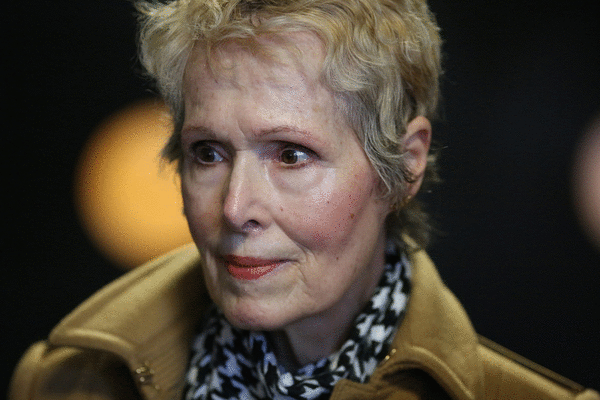
President Donald Trump asked the U.S. Supreme Court to hear his appeal of an $83.3 million jury verdict against him in E. Jean Carroll’s defamation suit, according to a copy of the petition reviewed by Bloomberg News.
Trump filed his petition with the Supreme Court on Tuesday, according to a person familiar with the matter who asked not to be identified as the filing isn’t yet visible on the court’s docket.
The move kicks off his latest clash with the former Elle magazine advice columnist who went public with her sexual abuse claims against Trump during his first term in office. The Tuesday filing comes one month after the justices dismissed his challenge to a separate $5 million verdict in Carroll’s related sexual abuse case.
Trump’s appeal hinges on whether he is protected by presidential immunity because his allegedly defamatory statements about Carroll were made when he denied her sexual-abuse claims during his first term in office.
“Because accusations bearing on the President’s fitness for office are unquestionably matters of public concern, Presidential statements responding to press questions about such accusations are plainly official,” according to the petition. “This court should say so.”
Trump, 80, is separately awaiting a decision from the justices on his request that they reconsider their choice to not hear his appeal of the $5 million verdict, which was formally paid out to the New York writer on July 13. Trump denies wrongdoing in both cases.
Carroll alleges that the president defamed her in 2019 by calling her a liar when she went public with her claim that Trump had assaulted her in 1996 in a Bergdorf Goodman dressing room. At issue were statements Trump issued accusing Carroll of lying and fabricating the assault for political purposes and to sell a book.
A New York jury issued the $83.3 million penalty in January 2024 following a trial in which Trump took the witness stand and then stormed out during closing arguments. The U.S. Second Circuit Court of Appeals upheld the verdict.
The defamation case differs from the other lawsuit Carroll won because it relates to statements that Trump made about Carroll while he was in office. Trump argues the Supreme Court’s landmark immunity ruling should have spared him from Carroll’s lawsuit because his remarks about her qualified as official duties in office.
Trump argues the appeals court wrongfully downplayed the strength of presidential immunity by concluding that Trump had forfeited his right to the defense by failing to raise it in his initial response to Carroll’s lawsuit.
Trump’s lawyer said in the Supreme Court petition that the verdict marks “the first case in our nation’s history in which a court has imposed damages liability on a president for his conduct in office.”
“Yet, in upholding the exorbitant $83.3 million defamation judgment here, the Second Circuit never even decided whether presidential immunity applies to President Trump’s allegedly defamatory statements — statements made from the White House, in response to press questions, denying allegations of personal misconduct directly questioning his fitness for office,” Trump’s lawyer said.
The Justice Department is expected to ask the Supreme Court to let it intervene in the appeal on Trump’s behalf. The department in May told the appeals court that it planned to ask the justices to substitute the government for Trump in the case, sparing the president from the litigation altogether.
Substituting the U.S. for Trump — allowed under the Westfall Act of 1988 — would result in the suit being dismissed because the U.S. can’t be sued for defamation. The request was previously denied by the district judge who oversaw the case as well as the appeals court.
The Westfall Act is a federal statute that protects government employees from lawsuits over actions that relate to their official duties. At issue in Carroll’s lawsuit is whether Trump qualified as a government employee as president and, if so, whether he was acting within his official duties when he made crude remarks about Carroll in denying her allegations.
Carroll’s other civil suit was filed under a temporary New York law that allowed victims of decades-old sexual assaults to file civil suits for damages against their alleged attackers. That case also included a claim of defamation over comments Trump made in 2022, as a private citizen.
_____
©2026 Bloomberg L.P. Visit bloomberg.com. Distributed by Tribune Content Agency, LLC.





Comments