Are disability services in Minnesota backsliding? Advocates fear being 'pawns in political games'
Published in News & Features
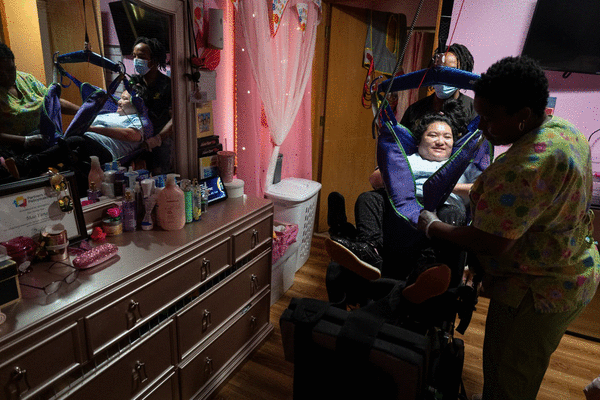
Minnesotans with disabilities and their families are used to a fight.
They are quick to describe decades of work pushing state officials, school districts, employers and others to allow them to live fuller lives that are more integrated into the community.
But many said the number of threats to that progress now feels overwhelming.
The ranks of people who need assistance is growing as the state ages. But there are not enough workers to provide care, and the state and federal government have cut funding for some services.
Fraudsters have preyed on people with disabilities, and the state — due in part to intense federal pressure — has cracked down in a way many advocates fear will leave people without needed aid.
Then there are new Medicaid requirements under President Donald Trump’s “Big, Beautiful Bill” that could lead some recipients to lose services. And people with disabilities said numerous other Trump administration actions and comments show a disregard for their lives.
To top it off, there is widespread discontent about an update to the state plan that is supposed to ensure Minnesotans with disabilities can live with freedom, choice and belonging.
”We’re not disposable. Our lives do have value. We shouldn’t be pawns in political games,“ said Mai Thor, a longtime disability justice activist in Minnesota. ”What’s happening right now is a really, really scary time for us."
Disability services have been at the center of the fraud firestorm in Minnesota. Stories have stacked up about providers abusing the system, billing for services they did not provide.
The alleged fraud — which prosecutors said could total billions in lost taxpayer dollars — has made national headlines, triggered federal investigations, fueled election politics and prompted state leaders to re-evaluate Minnesota’s approach to social services.
Minnesotans with disabilities said they are the biggest victims. Not only have fraudsters left people without crucial care, the state has stopped paying providers some people relied on and ended one service entirely as it sought to block fraud.
For Mao Yang, those moves set back her search for her own apartment. The 31-year-old, who has cerebral palsy, lives in a Cottage Grove group home with a few other people. She didn’t know about other housing options when she left her family’s home, and initially she was just happy to have the care. But as she got involved in disability rights advocacy, she wanted more freedom.
She was working with a Housing Stabilization Services provider to find her own place shortly before the state ended that service amid allegations of widespread fraud in the program.
She said services intended to help people not just survive, but thrive, are “being taken away, not due to anything that we did.”
“Society feels like we should already be grateful for what we have,” Yang said, but just because someone’s basic needs are met, “doesn’t mean that we’re getting necessarily the human connection, the time spent in the community. Our mental and emotional health is lacking ... It’s not even being thought about.”
Disability service leaders also fear the specter of fraud will cast a long shadow on hiring in the industry. Several people predicted fewer workers will want to go into the field, which was already struggling to hire for relatively low-paid jobs that can be physically and emotionally demanding.
John Connolly, the temporary commissioner of the Department of Human Services (DHS), said he knows the state’s work to bolster program integrity has been difficult and disruptive.
“Our effort here is to strengthen these services so that they remain available, because we know how essential they are to folks in the community and in our programs,” he said.
The federal government has withheld hundreds of millions in Medicaid funds to Minnesota over fraud, and threatened to pull more. How much Minnesota will lose — and how state leaders will handle potential losses — remains to be seen.
There is also uncertainty about the full impact of the “Big, Beautiful Bill,” which state officials describe as the biggest disinvestment in Medicaid’s history. It includes new work requirements for some adult Medicaid recipients and more frequent eligibility checks. However, many important work requirement details have been left for states to interpret, Minnesota Council on Disability Executive Director David Dively said.
“We have this kind of, ‘everything hanging in the balance’ feeling,” Dively said. “And I think that’s just really difficult for people.”
Beyond potential funding cuts and new administrative mandates, people with disabilities and advocates said messaging from the Trump administration — including the president’s use of the R-word about Gov. Tim Walz and others, and Health and Human Services Secretary Robert F. Kennedy Jr.’s comments that marginalized people with autism — erodes progress on how people with disabilities are treated.
They’re worried about a shift in oversight of special education to Kennedy’s department.
Connolly said state officials are also “very alarmed” by how the federal government’s focus on fraud is happening as the U.S. Department of Justice recently put out a memo concluding federal disability laws do not require states to serve people in the most integrated appropriate setting — a departure from how those laws have long been interpreted. The laws ban the unnecessary segregation of people with disabilities.
That DOJ memo doesn’t upset existing laws or court decisions, but it sends a signal from the federal government that has many people on edge. Connolly said he fears it may lead to a “weakening of these services."
Amy Hewitt, who leads the University of Minnesota’s Institute on Community Integration, called the Trump administration’s actions “an assault.”
“It just feels like the federal administration, from the time they took office, have been making policy decisions ... that clearly put disability services at risk of backsliding," Hewitt said.
But she said she has also been worried about what Democratic leaders in Minnesota are doing to disability services.
This spring, state legislators and Walz agreed to slice $150 million from human services in the budget and another $150 million in the next two-year budget.
DFL Sen. John Hoffman told colleagues the human services deal cut behind closed doors left him with a “heavy heart” over its provisions restricting services for some of Minnesota’s most vulnerable citizens.
“It is inauthentic to celebrate inclusion while reducing the very services that make inclusion possible,” he said.
Changes this year include new billing limits on chore services, which help people with tasks like home maintenance; assistive technology; family training and counseling; independent living skills support; and other services for people with disabilities and their families.
New cuts come on top of spending reductions for seniors and people with disabilities in 2025. Walz has pushed to significantly scale back spending on Minnesota’s Medicaid disability waivers over the past couple years, warning the costs are unsustainable.
Other state actions have people with disabilities worried they will lose housing choices and be forced into more restrictive settings.
Some social service providers care for adults with disabilities in the provider’s home, rather than a corporate group home. This year Minnesota switched how it pays those so-called family adult foster care providers in a way providers said significantly cuts their income and will force people to stop doing the work.
A group of providers is suing the DHS, contending the state has “pursued a deliberate campaign to sabotage” them and that it aims “to force vulnerable adults into more institutionalized settings preferred by DHS.”
The state’s “Waiver Reimagine” project also has some disability advocates worried. Medicaid waivers cover wide-ranging costs that support people in settings like their own apartment, family home or a group home, rather than large nursing facilities or hospitals.
People with waivers have long acknowledged deep flaws in the system, which DHS is trying to simplify. However, some people with disabilities and their families fear the state’s planned changes would lead to more institutionalization and have pushed to scrap or delay the new system’s launch.
Lisa Vala, a Plymouth mother of two adult daughters who get waiver services, vented her frustration and fears on Facebook.
“It will uproot people from homes they built over decades, force them into corporate settings they never chose, destroy caregivers, routines, relationships, autonomy,” she wrote. “People will lose services. People will lose homes. Some people will die. These are not slogans. These are predictions from families who have already spent years surviving systems that barely hear them.”
Concerns over the new waiver program prompted lawmakers this year to require DHS consult with a state office to ensure the waiver approach promotes community integration and doesn’t leave people without care. However, some advocates have recently expressed disappointment in that key office, called the state’s Olmstead Implementation Office.
The Olmstead decision — often described as the disability rights movement’s version of Brown v. Board of Education — is a 1999 Supreme Court ruling that ensures people with disabilities can get services in the community, not institutions, when appropriate.
Minnesota has an Olmstead plan to guide state agencies on everything from housing to employment to education, and the Olmstead office supports work on the plan.
Minnesota is updating the plan’s goals, but the proposed update has been widely criticized as inadequate and lacking enforcement to make sure goals actually happen. Among the loudest critics are people with disabilities, dubbed “inclusion consultants,” who were supposed to help shape the new goals.
“We fear that too many of the goals reflect what agencies can easily accomplish rather than the transformative change that disabled people in the state of Minnesota need,” the consultants wrote to the state this spring, warning “the heart of the Olmstead Plan has gotten lost.”
For example, one goal is to have two fewer students experience maltreatment by June 30, 2027. “This would effectively reach 0.001 percent of the disabled population,“ the consultants noted.
The state had to balance diverse perspectives and focus on areas where agencies have “authority, capacity and responsibility,” Housing Commissioner Jennifer Ho, who is also chair of the Olmstead Subcabinet, said in a statement. “We know the plan will not address every challenge facing Minnesotans with disabilities, but it represents a meaningful commitment by participating agencies,” Ho stated, noting federal changes bring new challenges for people with disabilities.
Ken Rodgers, one of the inclusion consultants and a former state Department of Transportation employee, said he is disappointed in the goals. However, he said having people with disabilities involved in the process opened state employees’ eyes and showed how the lack of coordination across state agencies and with counties is harming people.
Rodgers said consultants need a face-to-face with the next governor to share what they learned about how the state’s power structure is not working for people with disabilities. Several advocates said the next governor needs to take a stronger approach to ensure Minnesota complies with the Olmstead ruling, particularly given the recent DOJ memo.
The Olmstead decision is “the thing that got us out of the institutions and gave us our freedoms,” inclusion consultant Abraham Tieman said. “To see it go down the drain so quickly and so suddenly and not have anyone really know about it is a shame.”
_____
©2026 The Minnesota Star Tribune. Visit startribune.com. Distributed by Tribune Content Agency, LLC






Comments