As Alaska's soil thaws, Florida will flood more. But will it matter how much?
Published in News & Features
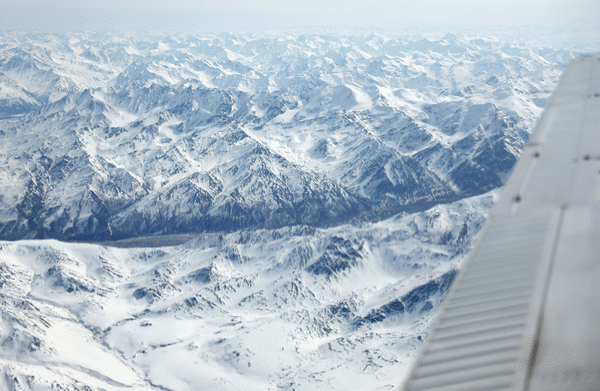
TOOLIK FIELD STATION, NORTH SLOPE, Alaska — Unlike most people, Rose Cory wasn’t drawn to northern Alaska for the vistas of the weather-scarred Brooks Range or the braided rivers winding through seemingly endless tundra. Rather, she was lured by what it contains on an atomic level: “It’s the carbon,” Cory said.
To Cory, an aquatic geochemist with a warm face and a bright voice, that fascination is obvious: Over thousands of years, the Arctic has stored carbon in soil that is frozen year-round. Known as permafrost, that soil is now thawing, and as it does, more and more of its long-trapped carbon is being released into the atmosphere.
The potential impact is enormous: While the carbon we’ve already released into the atmosphere as greenhouse gases, mostly by burning fossil fuels, is altering life on Earth, the frozen Arctic soil stores twice that amount.
“It unnerves me,” Cory said, sitting inside her lab at Toolik Field Station in the Arctic, just a few feet from a lake where ice was rapidly melting this June.
Even more unnerving than the sheer volume is how little the impact is understood and accounted for. So far, the models used to predict and plan for sea level rise, for instance, aren’t even taking it into account.
Geographically, South Florida couldn’t be farther within the U.S. But the uncertainty has real consequences.
Thresholds of sea level for which homes and roads in coastal communities like South Florida were engineered would be crossed faster than expected. “Your infrastructure may start to fail 10 years earlier than you thought it would,” said Ben Kirtman, dean of the University of Miami’s Rosenstiel School of Marine, Atmospheric, and Earth Science.
“It’s a big deal,” he said.
A microbial buffet beneath the ice
During the winter, temperatures here drop as low as -50 F. Snow, ice and complete darkness reign. But in summer, there’s no doubt how alive the Arctic truly is. Around the dozens of containers that make Toolik the U.S.’s largest research station in the Arctic, musk ox and caribou graze on dwarf birches and fragrant labrador tea, while Arctic ground squirrels pop out of their burrows to survey the tundra.
When any of these organisms die, tiny microbes start chewing them up. Carbon is turned into gas. That process happens anywhere in the world — including in the human gut, where microbes eat indigestible foods, and create a byproduct medical doctors might describe as flatulence. For a climate scientist, the intrigue lies in how much of that gas will end up warming the planet.
The CO2 a gassy reader might produce is of little concern to the overall climate; what’s coming out of the permafrost is. That’s not just because it spans an area double that of the US, but because the cold has suspended microbial decomposition over millennia, essentially creating an enormous freezer that kept being stocked, and stocked, and then stocked some more.
Just how much carbon is stocked was the first unknown. From the polar regions of Russia, Norway, Canada and Alaska, scientists took thousands of permafrost samples, measured the weight and burnt them at around 850 degrees Fahrenheit, then measured the weight of the rocks and minerals that didn’t burn. The difference (when correcting for water) was the mass of carbon.
By extrapolating, they arrived at a total number for the carbon stored in Arctic permafrost, which, decades after the effort began, was first acknowledged by the latest report of the Intergovernmental Panel on Climate Change (IPCC): Between 1,070 and 1,360 gigatonnes, more than 3,000 times the combined weight of every person on Earth.
“We’re very confident in those numbers,” Cory said. Yet that’s not enough.
‘Too conservative’
For more than 40 years, politicians and policymakers have been pressing scientists to tell them not just how a warmer climate will destroy life as we know it, but when.
Having to make those predictions has put scientists in an awkward spot, as the most important variable — just how much CO2 and other greenhouse gases we will emit — is impossible to predict. “Humans are the source of that uncertainty, and so that’s really hard to get your hands around,” Kirtman, who worked on the 2013 IPCC report, said.
Instead, they’ve picked different thresholds, where they play out what will happen if global temperatures rise above that level.
NOAA believes that the “intermediate high” scenario is the most likely to pass — provided humanity continues adopting green energy — which means the sea would be two feet higher by 2060 than it is today. That’s also the figure governments across South Florida rely on when adapting infrastructure like roads, or planning new ones.
But the projections we have, Cory said, are “absolutely too conservative.”
With a team of about 70, the Arctic Long Term Ecological Research (LTER), where Cory is a principal investigator, is part of the global effort to figure out just how much is “too conservative.”
How much, when
On the outside, the trailer that contains her lab reminds her of her childhood home in rural Montana, though the interior design came at a higher price tag: From office chairs to mass spectrometers that cost tens of thousands of dollars, every single piece of equipment had to be hauled some 12 hours by car over an unpaved road from Fairbanks, or flown in by helicopter.
Though it took decades to get a decent grasp of how much carbon is stored in the Arctic permafrost, that was the easy part, Cory said. To really be taken into account when it comes to modeling, researchers need to figure out how much is being released, and when.
Scientists have learned that as soon as summer temperatures thaw layers of the permafrost, its carbon turns into a bedazzling buffet for microbes.
How long that buffet is open before it freezes again over the winter determines how much carbon the microbes manage to chew up. The depth of thaw, which can vary from one day to the next, is another factor.
“See the slightly golden tint?” Cory said as she held a water-filled vial against the stark lab light. “That’s organic matter — carbon.” The timing of the snow and ice melt, plus rainfalls, determines whether a plot of thawing permafrost is waterlogged — and whether carbon isn’t just turned into CO2, but also methane, a greenhouse gas four times as potent.
For warming, it’s the difference of wrapping the planet not in cotton, but heavy wool.
How high to build?
In its simplest form, scientists can put a chunk of soil in a mason jar, measure how much gas is released over time, then extrapolate a total figure. For now, one of the best approximations we have, Cory said, is that thawing permafrost will add 0.3 degrees Celsius of warming, or 0.54 degrees Fahrenheit.
Global surface temperatures are now roughly 2 degrees Fahrenheit warmer than they were before humans started burning fossil fuels. As the oceans absorb much of this excess heat, warmer seawater expands and takes up more space, while melting glaciers and ice sheets add even more water. Sea levels rise. In South Florida, they are now about 8 inches higher than just three decades ago.
That increase has already led to more sunny day flooding, intensified rainfalls and hurricanes, reflected in higher and higher insurance premiums. In the Keys, ground floors are deemed uninhabitable.
And sea level rise is accelerating the more the planet warms, said Jayantha Obeysekera, head of Florida International University’s Sea Level Solutions Center. “Even in the mid-2010s, I’ve seen almost like a step jump, so I think this is going to continue,” he said.
Local governments here understand that they’re at the front lines of climate change, and have worked out how to adapt their infrastructure based on projections that sea levels will rise by 10 to 17 inches by 2040, and by 21 to 40 inches by 2070. The range reflects the uncertainties around factors like how fast the ice melts off the landmass of Antarctica, which is sped up by the warming permafrost, said Obeysekera.
“As you know, we’re very flat, so a few inches in sea level rise matter a lot,” Obeysekera said.
Including the effect of the thawing permafrost matters because it allows governments to better prepare. “It will give us more confidence in our planning numbers,” he said.
But until that happens, the key is to plan infrastructure that can easily be adapted, for example, by building a pump station that could house four pumps, even if only two are currently needed, or by creating foundations that would allow for roads to be elevated later on.
Overall, experts say that adaptation is way behind.
For example, experts estimate that some 2 million buildings in Florida will need to be lifted to avoid frequent flood damage, but so far, little has happened, and federal grants are being delayed.
About 80% of Florida’s GDP is generated on the coast, where four out of five Floridians live. Some are in an even more precarious situation than others, like North Bay Village, home to about 8,000 people who live on manmade islands.
How to adapt an entire community that is built at sea level, “is something that continues to stump my engineers,” said Rachel Streitfeld, the mayor of North Bay Village. In 2022, about 67% of North Bay Village voters approved a $60 million bond, mainly to raise roads, and any planning now assumes that by 2060, sea levels will have risen by two feet.
If scientists were to find that permafrost alone would shave a decade off that timeline, it’d make a difference. Two feet by 2050, “that’s only 25 years away,” Streitfeld said, highlighting that it’d give her a reason to propose a tax hike “to fast-track these projects.”
In the end, it might not be better projections, but seeing the devastating effects on the ground that will garner political will on a state or federal level, said Obeysekera. The 2023 flash floods in Fort Lauderdale alone came with a $1.1 billion price tag as 64,000 people were stranded at the closed airport, thousands of homes and cars were inundated, and streets and I-95 exits were impassible.
Once that happens more frequently, he said, “then the local government — and the state — they’ll come up with the funding.”
©2026 Miami Herald. Visit miamiherald.com. Distributed by Tribune Content Agency, LLC.






Comments