Federal judge holds government in civil contempt for not imaging immigration agents' personal phones
Published in News & Features
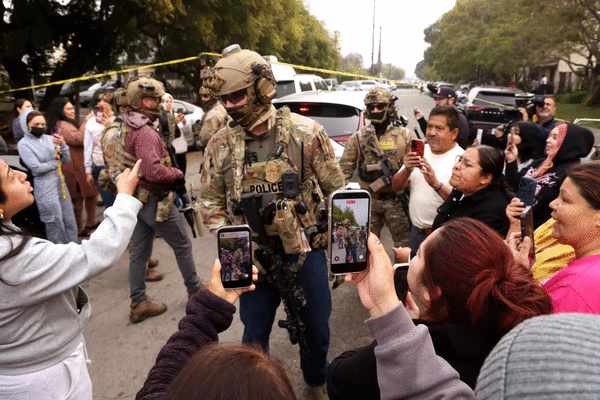
A California federal judge held the Trump administration in civil contempt for violating a court order requiring them to forensically image any cellphone used by agents present at 15 identified immigration operations.
U.S. District Judge Maame Ewusi-Mensah Frimpong ordered the government to pay $500 per day until they complied. The July 28 order was unsealed Tuesday.
The Department of Justice and the Department of Homeland Security did not immediately respond to a request for comment. A Justice Department lawyer filed a notice indicating the government had submitted a $3,500 payment on Tuesday.
Frimpong’s order stems from a class action lawsuit filed last year by the American Civil Liberties Union of Southern California, Public Counsel, other groups and private attorneys calling to end unlawful stops and arrests and for the protection of due process and access to counsel rights for people in immigration detention.
As part of the lawsuit, U.S. Magistrate Judge Sheri Pym had ordered the government in January to forensically image any cellphones used by agents during specific operations. In May, the plaintiffs in the case asked the court to order the government to prove why they should not be held in contempt over the failure to image a single personal phone since Pym’s order.
The plaintiffs also noted in that filing that the government had informed them that Gregory Bovino, the former commander at large for Border Patrol, had lost his previously issued work phone in January 2026 and was issued a new phone.
At a June 25 contempt hearing, Jonathan Robbins, a Justice Department lawyer, said they objected to the order regarding personal phones, stating that those “are not in our custody and control.”
Robbins told the judge that U.S. Customs and Border Protection had sent questionnaires to agents associated with Operation at Large Los Angeles, with more than 1,400 returned. Of those, 885 officers indicated they used their personal phones during operations, according to Robbins.
Although 88 agents consented to the forensic imaging of their personal phones, Robbins said none of those had been imaged at the time of the hearing.
Robbins said government phones were still being imaged at that point, with a capacity for only three phones every two weeks. He told the judge it was “a very, very slow process.”
“It’s a completely overly intrusive way to collect discovery,” Robbins told Frimpong, noting that agents who had been deployed to L.A. were now scattered across the country. “We’re not trying to flout the orders of the court.”
“We’re over four months later and all I’m hearing is that an email and a questionnaire went out,” Frimpong said during the hearing. “We’re not going to wait forever.”
During the hearing, David Fry of Munger Tolles & Olson, which is representing the plaintiffs, told Frimpong that the imaging of the phones was a meaningful measure to address concerns that some agents may not be following the rules. Fry noted that racially insensitive comments had been found in some materials.
The Los Angeles Times reported last week that immigration agents were captured on body camera footage and text messages using slurs to refer to Latinos.
_____
©2026 Los Angeles Times. Visit at latimes.com. Distributed by Tribune Content Agency, LLC.






Comments