Todd Blanche confirmed by Senate as attorney general
Published in News & Features
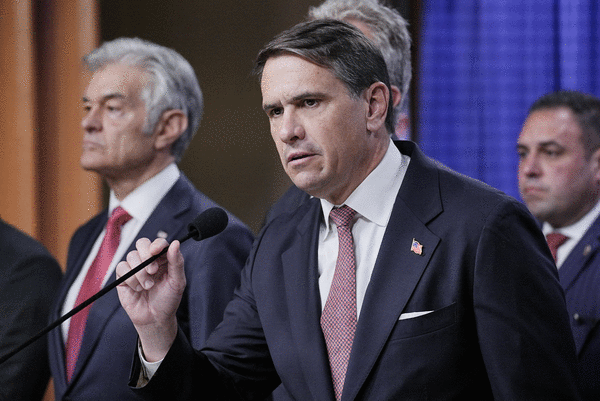
WASHINGTON — The Senate on Saturday approved acting Attorney General Todd Blanche to permanently lead the Department of Justice after a high-drama confirmation process.
The 50-49 vote to confirm Blanche fell mostly along party lines, with two Republicans breaking ranks to oppose him. Sens. Susan Collins of Maine and Lisa Murkowski of Alaska cited concerns ranging from the Epstein files to a so-called “anti-weaponization” fund.
“While I believe Mr. Blanche is a capable lawyer, the Department of Justice has become increasingly political,” Collins said in a statement explaining her thinking.
Murkowski said she wasn’t convinced Blanche would “check the worst impulses of this administration.”
“I hope Mr. Blanche is able to achieve that, if confirmed, but I simply do not have confidence that will be the case,” she wrote in a post.
Last March, the Senate first confirmed Blanche to serve as the deputy attorney general, who is generally responsible for day-to-day operations of the DOJ. At the time, no Republicans voted against him.
This go-around, it was a nail-biter until the end, as several senators voiced worry over the status of a controversial fund meant to compensate people targeted by a “weaponized” government, along with Blanche’s previous experience as one of President Donald Trump’s personal criminal defense attorneys.
With Sen. Mitch McConnell, R-Ky., still away from the Capitol after a hospitalization, Senate Republicans could afford only two defections if all Democrats voted against Blanche. After Collins and Murkowski made up their minds, it came down to Sen. Bill Cassidy of Louisiana, who announced his support in a Friday floor speech.
In his speech, Cassidy acknowledged what he called Blanche’s “poor judgment in approving the anti-weaponization slush fund and exempting the president from IRS audits,” as well as “episodes of apparent lawfare [with the] DOJ bringing suits against political enemies.” But he “slept on it overnight,” he said, and ultimately decided it would be better to have a Senate-confirmed attorney general rather than an acting one.
“Even critics admit that Mr. Blanche knows the law and is a hands-on administrator,” Cassidy said. “He has instructed U.S. attorneys to focus on violent crime, human and drug trafficking, and fraud in programs like Medicare and Medicaid.”
The confirmation vote, which came in the wee hours of Saturday morning, was among the last things standing between senators and their summer recess, as they looked to check items off their list before leaving town for several weeks.
Blanche has been serving as acting attorney general since Pam Bondi’s ouster in April. Trump had urged Republicans to move quickly on the permanent bid, while also suggesting he was willing to wait out the GOP holdouts.
On Tuesday, Blanche cleared a key hurdle when his nomination advanced out of the Senate Judiciary Committee. Two on-the-fence GOP members, Sens. John Cornyn of Texas and Thom Tillis of North Carolina, extracted a deal with the DOJ they said calmed their fears over the weaponization fund and the scope of tax audit immunity for the president and members of his family.
The DOJ said in a statement last weekend that it has “rescinded” the $1.8 billion fund, which many had worried would be used to pay out rioters prosecuted for attacking Capitol Police on Jan. 6, 2021. The fund was part of a settlement brokered by Blanche that resolved Trump’s lawsuit against the Internal Revenue Service tied to the release of his tax returns during his first term in office.
But Democrats argue the Justice Department’s written agreements with Cornyn are only “decorative” and do not ensure the fund is really “done.”
“To state the obvious, Mr. Blanche’s statement on the slush front and the IRS immunity agreement are not signed by the parties of the settlement agreement and are therefore unenforceable,” Senate Judiciary ranking member Richard J. Durbin, D-Ill., said during the committee markup. “The parties could still sue to enforce the agreement, and the cop-beaters fund can easily be revived … 15 minutes after Mr. Blanche is confirmed as attorney general.”
Murkowski aired similar concerns about the fund’s revival.
“I am also keenly aware that the Department’s nearly $2-billion dollar slush fund — which likely would have rewarded January 6 protesters — is only off the table because this nomination is pending and the Senate has leverage,” she wrote. “Once we vote, that will end, and there is no telling what the future holds.”
On Thursday, Cornyn said, “Part of it is a leap of faith that what somebody’s telling you during the nominations process, they’ll stick with after they get confirmed.”
Asked Friday whether he was worried the fund could come back, Tillis told reporters, “What I’m worried about is that there is statutory authority to do this kind of garbage, and I’d like to figure out a way to nuke it before I get out of here.”
Murkowski and Collins had a longer list of grievances against Blanche, including his release of files related to the late sex offender Jeffrey Epstein, which Democrats and other critics have said was mishandled, as well as “the sweeping immunity protections granted to the President, his family, and their businesses; the statements that have been made to anti-abortion groups; and the repeated targeting of individuals ranging from former administration staff to sitting U.S. Senators,” Murkowski wrote.
“More than 1,200 former Department of Justice employees have opposed his nomination, arguing that he has undermined the institution,” Collins wrote.
———
(Jacob Fulton contributed to this report.)
©2026 CQ-Roll Call, Inc., All Rights Reserved. Visit cqrollcall.com. Distributed by Tribune Content Agency, LLC.





Comments