Where do rattlesnakes go when it's hot in California? We asked the experts
Published in News & Features
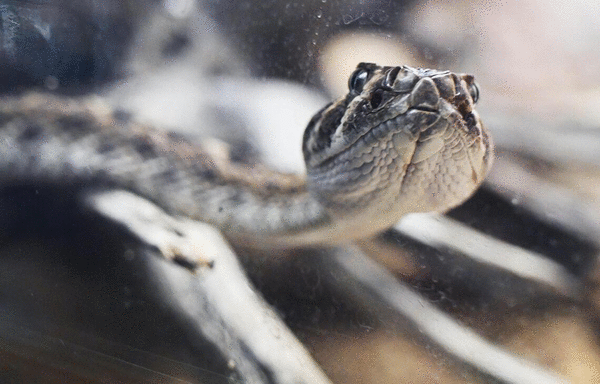
When the temperature soars in California , people and pets stay indoors, seek out air-conditioned spots or head the nearest lake, river or swimming pool.
What about rattlesnakes?
Where do snakes go when highs climb into the triple digits?
Here’s what to know:
What happens to rattlesnakes in hot weather?
As cold-blooded critters, you might assume that rattlesnakes love hot weather.
That’s not entirely true.
“There’s a common misconception that rattlesnakes like heat,” said Cal Poly professor Emily Taylor, director of the Physiological Ecology of Reptiles Lab.
“A rattlesnake that gets stuck outside in the middle of the day is going to overheat and die,” Taylor explained.
“Rattlesnakes are sensitive to ambient temperature and adjust their behavior accordingly,” the California Department of Fish and Wildlife said on its website.
During the spring and summer, the snakes are “most active at dawn, dusk, and night to avoid overheating,” the state wildlife agency explained.
Where do snakes go when it’s hot outside?
According to Taylor, rattlesnakes prefer balmy temperatures in the 70s and 80s.
The more mild the weather, the more likely they are to be out and about,” Taylor explained.
When the mercury climbs into the 90s or 100s, the venomous reptiles go into hiding.
“Rattlesnakes hide away during the hottest and driest time of year in carefully selected retreats” such as rat nests, caves in drainage walls or crevices in rocky outcrops, Arizona’s Rattlesnake Solutions said.
The scaly predators may also seek shelter under or around man-made structures.
Cracks in foundations under houses, shaded pads under pool equipment and backyards with dense, well-watered bushes, offer the “perfect rattlesnake summer sanctuary,” Rattlesnake Solutions said.
What happens to rattlesnakes in cold weather?
Rattlesnakes also seek out shelter when the weather turns cold, The Sacramento Bee previously reported.
When the temperature consistently drops below 60 degrees in the fall and winter, rattlesnakes enter a dormancy period known as brumation, according to wildlife control company Critter Control.
“They don’t really actually sleep,” explained Michael Starkey, founder and executive director of Save the Snakes in Sacramento. “The temperature gets so low that their metabolism gets really slow.”
During the colder months, rattlesnakes look for “large rocks, rodent burrows, fallen trees, tree stumps, wherever there are large crevices or cracks where they can keep them safe during the winter,” Starkey said.
When are rattlesnakes most active in California?
Snakes are most active from April to October, according to the U.S. Forest Service.
“Depending on where you live, you could encounter a rattlesnake at any time of the year,” Taylor said.
Although April and May are “big times for snakes,” she said, you can expect to spot rattlers “all summer long” in places with milder weather such as the Central Coast.
“As it starts to get pretty hot inland, you’ll see less of them,” Taylor said.
Where can I find rattlesnakes in California?
Rattlesnakes typically hang out under rocks, logs and woodpiles, the National Park Service said.
You might also spot rattlers near boulders, stumps and fallen trees, Starkey said.
“Rattlesnakes are everywhere in California,” Taylor said. “The only places where we don’t see are in overly populated urban areas or at the tops of very high mountains. ... They’re in the deserts. They’re in the oak woodlands, even on the beach.”
How can I identify rattlesnakes?
Seven different species of rattlesnake can be found across California.
The most common is the western rattlesnake, which can be found from sea level to elevations of 7,000 feet, according to the California Department of Fish and Wildlife.
Rattlesnakes can be recognized by the distinct sound their rattles make.
You can also identify the venomous snakes by their gray or light brown exteriors and triangular-shaped heads.
Are rattlesnakes dangerous?
“Rattlesnakes aren’t aggressive to humans unless threatened or frightened,” Stephen Nett, a Bodega Bay-based naturalist, wrote on Sonoma County Regional Parks’ blog.
The snakes are typically shy around bigger animals.
They will rattle to express their alarm and try to escape — and you should let them slither away.
“People see (rattling) as a sign of aggression or anger. It couldn’t be further from the truth,” Taylor said, “They’re just terrified. They’re scared people are going to kill them. ... It’s definitely a sign of fear.”
How can I avoid snakes in California?
“Rattlesnakes are part of the natural environment” in California, the National Park Service said.
According to the Park Service and the California Poison Control System, there are steps you can take to stay safe in rattlesnake country:
• Walk or hike in areas where the ground is clear.
• Wear protective clothing such as long heavy pants and high boots.
• Pay attention to your surroundings.
• Carefully inspect logs or rocks before sitting on them.
• Carry a fully charged phone, and let people know where you plan to hike and how long you will be gone.
• Look after children and keep dogs and other pets on a leash.
• Stay on trails, away from underbrush and tall weeds.
• Watch where you step, and never put your hands in areas where you cannot see.
“If you see a rattlesnake, give it a wide berth” of about 10 feet, Taylor said.
Do not touch or disturb the snake, even it appears to be dead.
What should I do if I’m bitten by a rattlesnake?
If you are bitten by a rattlesnake, “stay calm, limit movement and call 911 immediately,” the Ventura County Fire Department said.
“Many emergency rooms have antivenom drugs, which may help you,” the Mayo Clinic said.
While waiting for medical help, “sit or lie down so that the bite is in a neutral, comfortable position,” the Mayo Clinic said.
Remove all jewelry, watches or tight clothing before swelling starts.
You should clean the bite with soap and water, and cover or loosely wrap it with a clean bandage.
The Mayo Clinic said there are actions you should avoid in the case of a rattlesnake bite:
• Don’t tie off the bite area with a tourniquet or apply ice.
• Don’t cut the bite or try to remove the venom.
• Don’t drink caffeine or alcohol.
• Don’t take pain-relieving medicine, as this could increase your risk of bleeding.
____
©2026 The Sacramento Bee. Visit at sacbee.com. Distributed by Tribune Content Agency, LLC.






Comments