Iran rejects US Talks as Trump displays patience for Hormuz deal
Published in News & Features
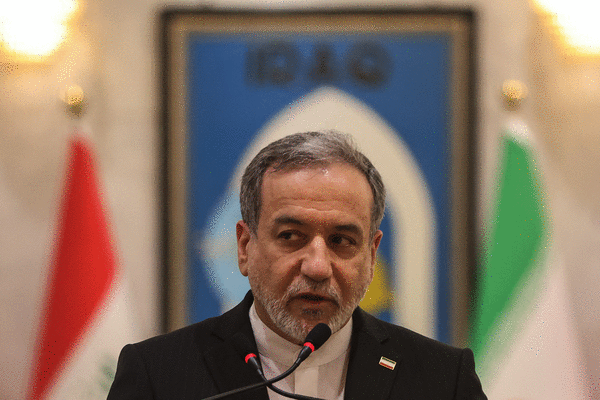
Iran promoted a hard-line ex-commander as its top security official, shaking up its highest decision-making body on national defense after saying it was “very close” to a deal with Oman over shipping through the Strait of Hormuz.
Mohsen Rezaee was appointed the new leader of the Supreme National Security Council, the state-run Islamic Republic News Agency reported late Sunday. He replaces Mohammad Bagher Zolghadr, a fellow hard-liner who accepted a new position as political adviser to the supreme leader.
It’s unclear what the reshuffle means for diplomacy, with U.S. President Donald Trump making periodic threats of escalation as he pushes for a resolution with Iran that would allow traffic to move freely through the Strait of Hormuz. Rezaee, a former commander of the Islamic Revolutionary Guard Corps, has been a key figure in Iran’s security apparatus for years and previously advocated for advancing Iran’s nuclear program.
Over the weekend, Foreign Minister Abbas Araghchi said a pact with Oman to establish a shipping route through the strait was “very close,” without providing details on the substance. He ruled out direct talks with the U.S. for now, citing what he described as repeated violations of a short-lived interim peace agreement signed in June, adding that the two sides are exchanging messages through intermediaries.
“As long as the American violation of the Memorandum of Understanding continues and the U.S. does not make amends for its violations, there is no possibility of resuming negotiations,” Araghchi was cited as saying by state TV.
Oil advanced as Iran rejected talks with the U.S. Global benchmark Brent crude rose 0.9% to $84.30 a barrel, extending a rally of more than 5% over the previous three sessions.
Trump has signaled patience, telling Axios that Washington was “low-keying it.”
“We are only semi-negotiating with them,” he said. “We are just watching Iran with its huge inflation and the fact they have no money.” Iranian year-on-year inflation recently reached 77%, according to the central bank. Trump’s remarks followed weeks of threats of massive airstrikes that he ultimately called off to give negotiations a chance.
Tehran on Saturday renewed a list of demands for Washington as conditions for fully reopening Hormuz, indicating any immediate respite for energy supplies may be limited. It wants the U.S. to lift its naval blockade on Iranian ports, withdraw forces from around Iran, remove sanctions, release frozen assets and pay compensation for war damage.
The Strait of Hormuz, through which one-fifth of the world’s oil and gas is shipped, has become a key factor in the war the U.S. and Israel started on Feb. 28. Trump has demanded the resumption of open navigation for months.
Iran-backed Houthi rebels claimed they struck Saudi Aramco’s Jizan refinery on Sunday. Saudi authorities reported a fire that was quickly extinguished, with no injuries. The incident would mark at least the second blaze at the 400,000 barrel-a-day complex in a month, after satellite images showed a tank fire in late July following another claimed Houthi attack.
Washington has repeatedly suggested it’s involved in negotiations over Hormuz, which Iran disputes. “At present, we are not negotiating with the U.S. — the exchange of messages is taking place through intermediaries,” Araghchi said Sunday.
Oman, which borders the strait across from Iran, said its talks with Tehran were progressing in “a positive and constructive atmosphere.” In a post on X, authorities called for a halt on actions in the strait to give space for diplomatic efforts.
Traffic through the chokepoint has been largely blocked since the start of the war, but some ships have continued to ferry cargoes as part of a shuttle program involving U.S. military help.
Any Hormuz deal will need approval from Supreme Leader Mojtaba Khamenei, who hasn’t been seen in public since the war began. Khamenei said Sunday he’d met with President Masoud Pezeshkian, who has faced criticism from hard-liners for supporting a ceasefire with the U.S., to discuss the war and economy.
_____
(With assistance from Salma El Wardany, Michael Gunn, Daniel Ten Kate, Anand Krishnamoorthy and Michael Heath.)
_____
©2026 Bloomberg L.P. Visit bloomberg.com. Distributed by Tribune Content Agency, LLC.




Comments