As Trump proposes deregulating Head Start, Illinois providers worry what the changes could mean for families
Published in News & Features



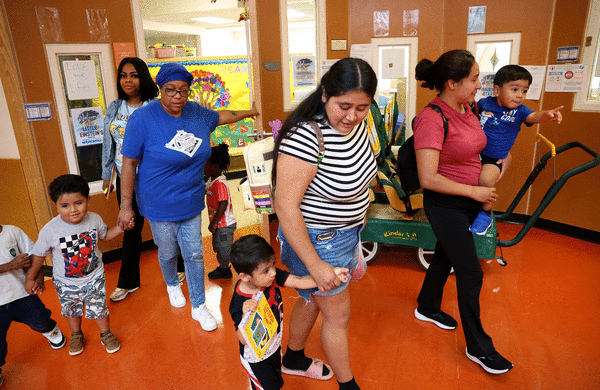




CHICAGO -- Nearly a decade ago, Head Start gave Wendy Mamola and her children the footing to leave an abusive situation.
The federally funded program for low-income families with infants, toddlers and preschoolers at Palatine Community Child Care Center offered her oldest son a safe place to stay during court hearings. It provided consistent adults in his life during a time Mamola struggled with anxiety and, later, postpartum depression.
In the years since, it’s connected all four of her kids with medical care and academic support. Her two oldest have aged out of the program and are thriving in public school, while her youngest, twins, are now enrolled at the Palatine center.
“I wouldn’t have been able to leave their father if it wasn’t for the fact that they were enrolled there,” said Mamola, 34, who lives in Rolling Meadows. “It made all the difference.”
Now, the Trump administration is proposing sweeping changes to the early childhood program that would eliminate federal requirements for services that Head Start leaders say offer crucial support for families in need, such as Mamola’s.
Last Thursday, the Department of Health and Human Services, which oversees Head Start, issued a proposed rule that would scrap 1,400 regulations and replace them with a more “streamlined framework” in an effort to reduce regulatory and administrative costs and expand the program to more families.
“We are removing unnecessary bureaucracy, strengthening nutrition and physical health, trusting parents and local communities, and opening Head Start to hundreds of thousands more children,” HHS Secretary Robert F. Kennedy, Jr. said in a statement. “That’s how we renew the promise of Head Start for the next generation.”
Head Start leaders in Illinois say it’s too soon to tell how the proposed rule will fully affect the low-income families in the state, but many say they are alarmed. Classes could have more students and fewer educators under the proposal, and programs would be required to be taught in English instead of supporting dual-language learners, as current rules require. They are changes that could hit some of Chicago’s most vulnerable families, according to Nadia Gronkowski, director of federal policy and advocacy at Start Early, an Illinois-based organization that advocates for Head Start accessibility.
“Chicago is such a diverse city and has families with so many diverse needs that, whatever challenges are happening across the country, there will be a microcosm of that in Chicago if this rule were to come to pass,” Gronkowski said. “All of the challenges with serving dual-language learners, not supporting bilingualism, not having certain services for children with disabilities — all of those would affect the Chicago community because all of those families live in Chicago.”
The administration has opened up public comments on the proposed changes for a 60-day period, ending on Oct. 6.
Head Start serves nearly 28,000 children and pregnant women in Illinois in 2026, according to the National Head Start Association. In Chicago, roughly 1 in 4 of the city’s child care spots are linked to centers at least partially funded by Head Start, according to an analysis from the Early Childhood Research Alliance of Chicago.
Launched in 1965 as an initiative of President Lyndon B. Johnson’s War on Poverty to provide services to families and children in need, the program currently serves more than 700,000 pregnant women and children under age five. Services include free child care and health services to pregnant women. The program promotes school readiness and supports early learning and development, health and family well-being.
The proposed rule by the Trump administration would reduce administrative spending while expanding the number of children the program enrolls by 236,000. Staff-to-student ratios could be increased, hours and days that services are provided cut and deadlines for health and developmental screenings eliminated.
Mamola said those services helped keep her family afloat. All four of her children received dental cleanings and access to therapy. When the family’s water heater broke and Mamola had no credit to replace it, a program social worker had a new one on their doorstep in days.
If Head Start had been operating under the proposed reductions a decade ago, she said, she’s not sure her family would still be together.
“They would have slipped through the cracks,” said Mamola. “I wasn’t able to fulfill all of their needs, and if it didn’t exist, I don’t know what would have happened.”
A major component of the newly proposed changes is a shift away from federal regulation, instead allowing states to oversee the program, including governing its student group size and ratios, background checks, and transportation practices. Also included is a reduction of administrative spending, from a 15% cap to 5%, that advocacy groups said could have detrimental effects, but it’s too soon to know how much of an impact it may have.
Although most providers say they will try to maintain the current quality of services, the proposal would loosen regulations Head Start programs have operated under for years. Parent advisory committees, long a cornerstone of Head Start and currently required at every center, could become optional.
The proposal also removes federal requirements for how long and how often center-based Head Start preschools must operate and eases requirements for home-based services. For some children, that could mean fewer hours of care, forcing working parents to cut back their own hours or find alternative childcare.
The reach and success of Head Start across the state is tied in part to those existing standards at the program, Illinois Head Start Association Executive Director Lauri Morrison-Frichtl told the Tribune.
Many Head Start classrooms across the state have around 15 students in them along with three teachers, Morrison-Frichtl said. Under the proposed regulations, the classrooms would align with the state’s student-to-teacher ratios, which vary depending on the age group of the children. According to the state’s Department of Human Services website, Illinois standards call for two staff members in the classroom no matter the amount of children and capped classroom sizes of between 16 and 20 students for 3-, 4- and 5-year-olds.
While not drastic, the potential increase of students, coupled with the reduction in spending, could make it difficult to provide individual learning per child, she added.
“They want us to add more kids to our classrooms, and we want to go the other way,” Morrison-Frichtl said. “Our children need more intentional educational opportunities. And when you have a large classroom of, imagine 3- and 4-year-olds or toddlers, the individualized plan or support for that individual child is lost.”
Family service workers, who connect families with resources, could also see their caseloads grow significantly. A 2024 rule capped caseloads at 40 families per worker, but the proposal would eliminate that federal limit and give local programs more discretion over staffing.
Beyond that, the cap on administrative costs — which often cover expenses like human resources that handle background checks and transportation services — is “undoable” for programs across Illinois, Morrison-Frichtl said. The cap could mean major losses of services, especially for those in vulnerable locations like rural parts of the state.
“It will destroy some of our smaller programs. We have programs that serve only 200 kids,” Morrison-Frichtl said. “They won’t be able to function with that movement and will probably have to close or lay off staff …The administration believes we’ll just keep on doing what we’re doing, but we won’t have the funds to do that.”
The potential changes to the program follow years of uncertainty surrounding Head Start, including in the Chicagoland area. The Head Start regional office in Chicago closed in April 2025, and gaps in service have been recurrent worries as the program weathered government shutdowns and periods of withheld funding.
For Morrison-Frichtl, who spent Friday fielding concerns about the proposal from a small childcare center in the western Illinois city of Galesburg, the public comment time period from the government is essential.
“We’re out meeting with programs, trying to assure them that we’re here, we’re going to fight this together…and by working together and using our voice, we can do this,” Morrison-Frichtl said. “We’re here, we’ve been here for over 60 years, we’re not going away and we’re not having these standards disappear because that’s who we are.”
The high-quality early childhood education that Head Start mandates is very different from conventional childcare, according to Brightpoint CEO Mike Shaver, and the children it serves have needs that extend well beyond the basic standards set by state child care licensing requirements.
Brightpoint serves more than 600 children enrolled in Head Start across its six Chicagoland family centers, along with another 250 who receive support through home visits. The model extends to parents and families, and making those services cheaper, Shaver said, would unquestionably come at the expense of quality.
“The [proposal] seems to confuse regulatory burdens and what comprehensive service quality should look like,” he said. “That’s the needle that we have to thread a little more carefully.”
At Brightpoint, Shaver said, the cap would mean a $1.4 million loss while requiring the organization to serve more families without sacrificing results. The nonprofit’s resources and fundraising infrastructure could help absorb that loss, but smaller providers may not have the same cushion.
It’s the Head Start programs run out of churches and county governments, Shaver said, that may struggle to sustain their work amid cuts to administrative costs. And because Head Start was founded on the idea that services should be tailored to the needs of individual communities, the impact of those cuts could extend beyond the children and families they serve.
“Smaller providers have built relationships, in some cases over decades, with libraries in an area, schools and social service providers,” he said. “It actually affects the entire community.”
Brightpoint’s data shows that more than 90% of children in its Head Start and Early Head Start programs statewide are meeting or exceeding developmental milestones considered necessary for kindergarten readiness. In surveys, 86% of parents also reported improved attachment to their children as a result of participating in Head Start.
Associations and centers involved with the program have expressed concern that the proposed changes could weaken the level of care its users receive.
Mamola said that the care was crucial for her family. She said Head Start noticed the first signs of a trauma disorder in her oldest son and connected him with play therapy to help him work through it. When her younger son fell far behind developmental expectations for speech, Head Start found him a speech therapist.
Through it all, the service supported the boys, even when they behaved in ways that Mamola said could have gotten them removed from conventional child care programs. That’s why she’s most concerned about a proposed change that would eliminate current restrictions on suspensions and expulsions due to behavior.
“If that’s what the rule was, he would have been suspended a couple times over and then expelled within the first year of attendance,” said Mamola. “They make sure the child has the skills to not get expelled rather than just say, ‘Okay, go home with the parent that brought you here with these problems.’”
____
©2026 Chicago Tribune. Visit at chicagotribune.com. Distributed by Tribune Content Agency, LLC.






Comments