Severe storms bring two tornadoes and up to 99 mph winds to Chicago area, weather service says
Published in News & Features
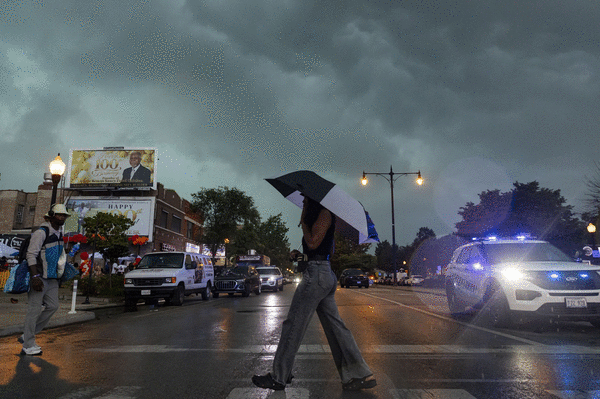
CHICAGO — Extreme weather usually doesn’t scare Mary Beth Uretz, but she spent Tuesday morning crying in her Homewood basement, clutching her pets as the storm pounded.
“Psychologically, it’s a lot to deal with,” said Uretz. “I’ve never gone to bed at night and worried about my house falling over, until this summer.”
Indeed, severe storms swept through a broad swath of the Chicago area Tuesday, tearing down trees, power lines and property alike. Hundreds of thousands of ComEd customers lost power and thousands of flights were delayed at the city’s airports.
Weather officials confirmed Tuesday night that two tornadoes had touched down during the storms, one in southern Cook County and another in eastern Will County. Officials said they were still surveying the extent of damage, and a challenging survey environment was prolonging the process.
These storms came after another round tore through the region over the weekend and a year with a record-breaking number of tornadoes.
One person died in a structure fire in Portage, Indiana, during the storms. Local police said there was an extended response time due to the “hazardous conditions.” The cause of the fire remains under investigation.
In Homewood, officials reported “significant storm damage” from what is believed to be a tornado that touched down just before 11 a.m. Downed power lines, large trees and debris blocked roadways and nearly 70% of the town lost power, officials said.
Uretz initially didn’t expect Tuesday’s storm to add to the damage in the south suburb, which has repeatedly been pummeled this summer. Forecasts called for little more than rain, then her phone lost service, and within minutes powerful winds were sweeping through the neighborhood.
“None of our houses are flattened, but it doesn’t mean there’s not damage and it doesn’t mean we’re not thinking about this constantly,” said Uretz, who has lived in the neighborhood for nearly two decades.
Thousands of dollars’ worth of fallen trees litter her backyard, joining a fence that past storms destroyed. Downed wires in her neighbors’ backyards resembled “spaghetti,” she said.
It was too soon to tell whether there were tornadoes or not as of Tuesday afternoon, said Mike Bardou, a meteorologist with the National Weather Service. But the bigger story, he said, were 80 to 100 mile per hour straight-line winds covering entire communities.
Gusts up to 99 mph were recorded in Gary, 97 mph at Aurora Municipal Airport and 70 mph in DuPage County near Lemont, Bardou said.
“Not that one needs to outdo the other, but a lot of folks sometimes don’t put a lot of credence into the potential power that straight-line damaging winds can bring,” he said, adding that there may be more thunderstorms this week.
As human activities such as fossil-fuel burning release heat-trapping gases into the atmosphere, air in the Midwest is becoming more saturated with humidity, a key ingredient of strong thunderstorms that can produce tornadoes.
Illinois has already set a record for tornadoes in a year, and is approaching 200, according to the weather service. Experts say this pace is not normal: Illinois experienced an average of 54 tornadoes annually between 1990 and 2020.
In 2023, Illinois recorded 121 tornadoes, followed by 142 in 2024 and 126 last year, according to federal data. Before this stretch, the state only had four years on record with over 100 tornadoes. The last time it saw triple-digit tallies was 2006.
Bardou also said damage was fairly widespread south of I-90, including in Kane, DuPage, central Cook, Will and Kendall counties as well as northwest Indiana. Naperville received over 300 requests for service, including 60 reports of trees fully blocking roads. Officials in Hinsdale and Downers Grove said they were responding to reports of localized flooding and downed tree limbs.
Lauralee Camp watched as the sky got progressively darker Tuesday morning, eventually turning a “weird green color” outside the Oakbrook Center mall.
Camp, a Nordstrom employee, said at first she and her co-workers asked shoppers not to go near windows and to avoid taking the escalator. But when phones repeatedly blared with tornado warnings, they knew it was more serious.
Camp led a small group of customers out the emergency exit and down the stairwell to the first floor — including the few who didn’t want to stop shopping, Camp joked. They joined about 40 other people from the mall, waiting for about half an hour until the storms passed.
“I lived out here my whole life, so I’m just like, OK, here we go, another tornado,” the 56-year-old said. “So I wasn’t scared. I’m sure if I was from another state, I’d be a little scared. I feel like we’re from the Chicago area — we’re just kind of used to everything.”
Most of the people waiting passed the time on their phones while one woman said she wished she brought snacks, Camp said.
Kevin Gardner headed to his basement in Dyer, Indiana, with his 17-year-old son and two chihuahuas during the storm. The decision was easy after he saw a “wall of water and wind” outside.
Luckily, he said his chihuahuas are “the most chillest” and snuggled up calmly. He was slightly more worried, though.
“This is the first time I’m like, OK, something’s hitting us, this is not good,” the 61-year-old said. “I was not nervous because, as a Hoosier, I find this kind of cool. But with kids, it’s not as cool anymore.”
He thinks lightning must have struck a tree in his yard, because it was cut clean in half. Other trees scattered the street and water was in his basement. He also lost power.
One of the biggest problems with the repeated storms this summer, according to Irv Anderson, is the repeated power outages. He said his generator ran for more than 100 hours last month, while some neighbors went days without electricity.
In nearly four decades in the same house in Homewood, Anderson said he never experienced winds stronger than 45 mph. But in recent months, storms have brought winds approaching 80 mph.
“The storms we’ve had this year are by far worse than anything we’ve ever seen,” said Anderson, 80. “Some of the other properties are already so badly damaged that there’s nothing left to come down.”
Anderson spent Tuesday afternoon raking fallen branches and leaves into neat piles outside his Gladville Avenue home. Down the block, an uprooted tree had turned up several sections of sidewalk, he said.
Rebuilding the damaged fences in his backyard will cost thousands, though Anderson said some of his neighbors are facing far worse. He and his wife have no plans to leave Homewood, but after months of repeated storms and costly damage, he said other longtime residents may decide differently.
“We can recover, but a lot of people don’t have any backup system,” he said. “If this is a yearly occurrence, it’s not going to be good.”
_____
(Chicago Tribune’s Adriana Pérez and Tess Kenny and Naperville Sun’s Carolyn Stein contributed.)
_____
©2026 Chicago Tribune. Visit chicagotribune.com. Distributed by Tribune Content Agency, LLC.






Comments