California state senator 'deeply troubled' by utility threats
Published in News & Features
SACRAMENTO, Calif. — The chair of the California Senate's utilities committee said Tuesday that he was "deeply troubled" by electric company executives' recent threats to take action to protect their shareholders if they don't get legislation in Sacramento to limit their wildfire liabilities.
In a letter to Southern California Edison and Pacific Gas & Electric, state Sen. Benjamin Allen, a Santa Monica Democrat, wrote that he was considering calling the utility executives to an oversight hearing to have them explain their plans.
Allen sent the letter after the Times reported that the two companies' top executives promised their investors in recent conference calls that they planned to respond if they don't get legislation for which they have been lobbying. Gov. Gavin Newsom and lawmakers are working behind closed doors on a package of wildfire bills.
"While I understand that utility investors seek predictability for their invested dollars, and stable utilities are important to the state of California, we as legislators must balance the additional interests of wildfire victims and survivors, our residents' ability to access affordable insurance, and the need to ensure affordable utility service," Allen wrote.
"We are certainly not interested in being threatened as we seek a balanced path that is right for California," he added.
In response to the letter, PG&E and Edison said Tuesday night that The Times had "mischaracterized" their executives' comments to investors.
"PG&E's objectives remain unchanged: safely and reliably serve our customers, ensure wildfire victims are compensated quickly and fairly, and protect customer affordability," PG&E said in a statement.
Edison declined to comment further.
Besides chairing the Senate's Energy, Utilities and Communications Committee, Allen also is running in November's election to be the state's next insurance commissioner.
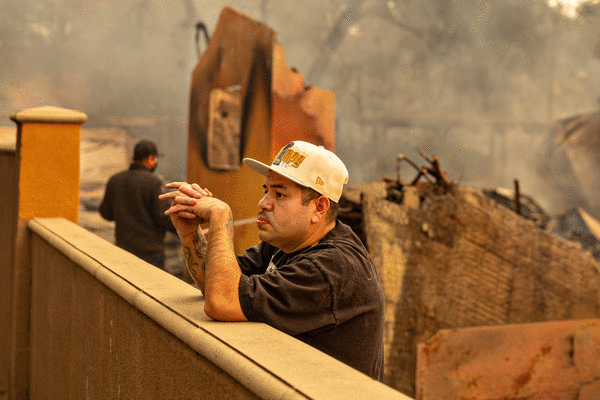
Newsom and lawmakers already passed legislation that cut the state's three biggest electric companies' liabilities for wildfires. Edison's shareholders, for example, may pay little of the billions of dollars of damage from last year's devastating Eaton fire — which killed 19 people and left thousands of families in Altadena homeless — under current laws championed by Newsom to protect the utilities from bankruptcy.
The utilities say more needs to be done. Among the recommendations in a report ordered by Newsom is limiting the amounts that victims can receive for pain and suffering and capping the fees of attorneys who represent them.
The commissioned report also suggested that utilities should no longer reimburse property insurers for damage from fires sparked by electrical equipment. Although this would reduce utilities' liability for fires, insurers say it would increase premiums for homeowners.
"If the Legislature does not act, or if they act and don't actually solve the problem, then we're going to have to take action," Patti Poppe, PG&E's chief executive, said on a July 23 call with Wall Street analysts.
Poppe did not specify what her company would do, but made it clear that any action would protect shareholders' money.
In earlier conversations with analysts, PG&E executives had "alluded to the possibility of opportunistic share repurchases should the legislative process fail to deliver a more durable wildfire liability framework," according to a report by the bank Jeffries.
Such buybacks could raise the company's stock price and benefit shareholders while reducing money available for the utility's California programs.
Last month, Pedro Pizarro, chief executive of Edison International, told Wall Street analysts on a conference call that he too was prepared to make financial changes if the Legislature does not pass a comprehensive bill to cut the utilities' financial wildfire risk before the legislative session ends Aug. 31.
Any legislation that passes without a protective framework for utilities, Pizarro said, would "influence how we prioritize and deploy future capital."
Pizarro declined analysts' requests to say where the company would cut back, but said the utility would continue spending aimed at keeping its grid safe and reliable.
"We're going to evaluate the totality of the package that comes to us and figure out our response that goes along with it," Pizarro said.
This month, state and county officials released their investigation into the Eaton fire, blaming the deadly inferno on Edison's century-old transmission line that the company kept in place even though it hadn't carried electricity since 1971.
Utilities have long known that idle lines could spark fires. In 2019, the Kincade fire in Sonoma County, which destroyed hundreds of homes, was ignited by an old, unused transmission line owned by PG&E.
At least seven of the 20 most destructive fires in California history have been sparked by the three biggest for-profit utilities.
©2026 Los Angeles Times. Visit at latimes.com. Distributed by Tribune Content Agency, LLC.






Comments