Iran risks losing key economic lifeline with UAE halting trade
Published in News & Features
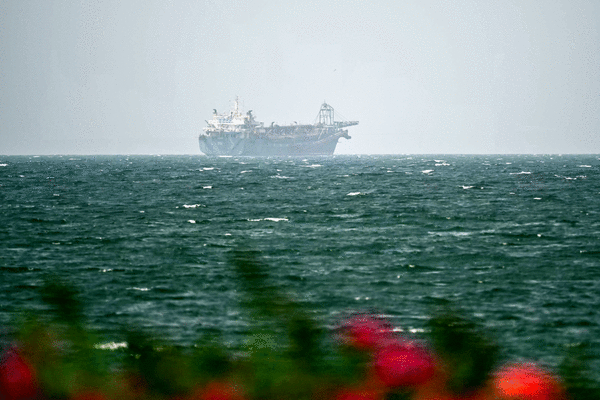
The United Arab Emirates’ decision to cut economic ties with Iran is likely to impose more pain on the Islamic Republic as it faces the loss of a vital trade link amid escalating tensions with the U.S.
As the war drags on, the U.S. is trying to ramp up economic pressure on the Islamic Republic, which an embargo from its most important partner could exacerbate. The UAE acts as a major financial and business hub for Iranians, and has in recent years been the Islamic Republic’s biggest trading partner, with billions of dollars of goods imported.
On Tuesday evening, residents in Dubai received a missile threat alert that the UAE’s defense ministry later said was the result of two ballistic missiles from Iran targeting maritime traffic. Iran denied responsibility for the attack.
Hours later, the UAE’s Ministry of Foreign Affairs said it has stopped all trade and financial transactions with Iran. The statement didn’t mention the missile attack but said “escalations that undermine regional and international peace and security” had prompted its decision.
“Iranian companies have spent decades building extensive commercial networks and contacts in the UAE,” said Cyrus Razzaghi, founder and CEO of Tehran-based consultancy Ara Enterprise. “In this sense, a UAE trade embargo could prove far more effective, and potentially more damaging to the Iranian economy, than U.S. and E.U. sanctions.”
Since the U.S. and Israel launched the war in February, Iran has targeted U.S. allies across the Persian Gulf, none more than the UAE — causing widespread damage across the region and threatening Dubai’s status as an international finance hub. But the two countries had in recent months sought to reduce tensions, including a June meeting between security officials.
“When we had this latest attack, this was a breach of whatever understanding there was, and the UAE is saying enough is enough,” Abdulkhaleq Abdulla, a Dubai-based academic and commentator, said. “We don’t need to trade or exchange finances with Iran.”
The UAE’s announcement comes after U.S. President Donald Trump said he was shifting his focus away from military strikes to imposing as much financial hardship on the oil-rich country as possible. U.S. Treasury Secretary Scott Bessent said last week that the U.S. would squeeze Iran with unprecedented economic pressure.
The U.S. has already been blockading Iran’s sea ports on the Persian Gulf and Gulf of Oman, which are critical for Iranian oil exports and imported goods, exacerbating an economic crisis that’s compounding inflation and poverty.
Iran is also one of the most heavily sanctioned countries in the world and has for years been subject to thousands of U.S. penalties that have effectively cut it off from the international banking system and much of the global economy.
It’s unclear how much of Iran’s trade with the UAE continued after the onset of the war and the effective closure of the Strait of Hormuz, which has greatly disrupted shipping in the waterway.
Iran’s semi-official Tasnim news agency, which is closely aligned to the Islamic Revolutionary Guard Corps, published a report into trade ties with the UAE in May, warning that Iran’s reliance on the Emirates for imports presented an “economic and food security risk.”
In its statement on Tuesday night, the UAE said it reiterated its “steadfast commitment to dialogue, cooperation, and regional integration as essential means of advancing peace, stability, and prosperity in the region.
Geography dictates that the UAE and other Gulf states will have to find some functional way forward, said Aaron David Miller, a senior fellow at the Carnegie Endowment for International Peace and a former State Department official.
—With assistance from Peter Martin and Alex Dooler.
©2026 Bloomberg L.P. Visit bloomberg.com. Distributed by Tribune Content Agency, LLC.





Comments