First round of Venezuela talks bring cautious optimism, but key issues remain
Published in News & Features
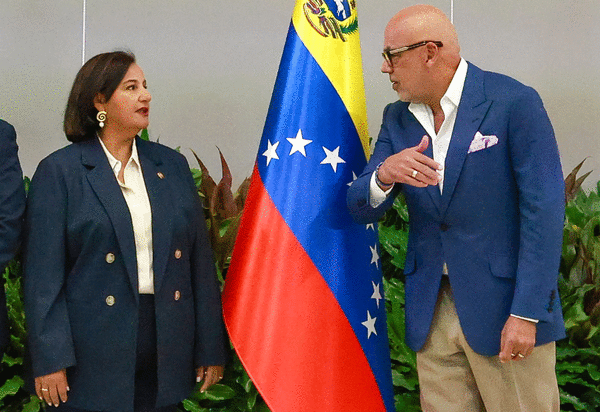
CARACAS, Venezuela — Venezuela’s first round of government-opposition talks has brought cautious optimism to a process intended to produce meaningful political change – but what comes next, and what is not on the formal agenda, is also drawing concern.
The White House-backed talks are intended to discuss political reforms and eventually pave the way for elections.
In the initial phase, which ended last week, the two sides agreed to pursue the recovery of around $4 billion in gold frozen in the Bank of England, with the money to be used for reconstruction after June’s twin earthquakes. They also agreed to reform the Supreme Court.
Since the talks, a number of political prisoners were released over the weekend, which interim President Delcy Rodriguez has said is “a crucial step for the process of national reconciliation.”
The developments have raised hopes that the discussions could produce changes to key institutions and eventually lead to elections. But key opposition figures remain outside the process, many political prisoners remain behind bars or under restrictions, and some of the most consequential questions, including electoral reform, have yet to be addressed. Other issues aren’t even on the agenda.
First round
The government delegation is led by Jorge Rodríguez, president of the National Assembly. The opposition side is headed by Dinorah Figuera, president of the 2015 National Assembly, which was elected with an opposition majority but later sidelined by the government. The U.S. recognizes it as Venezuela’s last democratically elected legislature.
For Orlando Perez, professor of political science at the University of North Texas at Dallas, the agreements represent a “huge step forward”, with both sides walking away with something they wanted.
“Caracas got the opposition co-signing its claim on the gold in London,” he told the Miami Herald.
The government also appears to have had the upper hand on the sequence of the negotiations, with judicial reform coming first and institutions such as the National Electoral Council left until December.
In exchange, the opposition secured an agreement to overhaul the Supreme Court, long viewed as a pillar of the regime. In 2024, when the National Electoral Council proclaimed Nicolás Maduro the winner of the presidential election without publishing the results, opposition tallies indicated the opposition candidate, Edmundo González, had won. The Supreme Court subsequently ratified the result, keeping Maduro in power.
There was also another symbolic gain in the talks.
“The government sat down with Figuera and signed a joint document with her. After years of treating the 2015 Assembly as void or illegitimate, that’s implicit recognition of its standing,” Perez said.
Pressing issues
There is still a long way to go. As well as reforming institutions such as the National Electoral Council and an electoral timetable paving the way for new elections, many Venezuelans have other pressing issues they want on the agenda.
One is political prisoners. Since 2014, according to human-rights group Foro Penal, more than 14,000 people have been detained for political reasons, although many have been charged with crimes including terrorism. The government has consistently denied that political prisoners exist.
While some were released following the capture of Maduro by U.S. forces in January and the passing of an amnesty law, the process had largely stalled.
But on Friday, Delcy Rodríguez announced that 131 people “deprived of their liberty” would be released. So far, 78 of them have been released, according to Foro Penal, most of whom remain subject to restrictions.
Although political prisoners were not formally included in the agreements announced after the first round, analysts say the releases cannot be separated from the talks.
Meanwhile, former political prisoners are pushing for the issue to be addressed at the negotiating table.
Américo de Grazia, a former member of the 2015 National Assembly and ex-political prisoner, spent a year in jail after being accused of terrorism. He says he has never seen his case file or the judge who sentenced him.
He and some other former political prisoners met with Figuera in August while talks were underway to call for the issue to be formally addressed.
De Grazia believes the dialogue can help secure the release of those still imprisoned while addressing what he calls a “corrupt judicial system” that needs to be “cleansed”. He says starting with the Supreme Court was the right choice.
“There’s no better way to start than at the top, with the highest judicial body, to implement corrective measures not only for the current political prisoners but also to address this issue fundamentally,” he said, “so that there are never again political prisoners in our country, nor persecution based on ideological or governmental differences.”
Who is represented?
The talks also face questions over who represents the opposition.
One of the most notable absences is opposition leader María Corina Machado and her ally Edmundo González, who according to evidence presented by the opposition in 2024 won the presidential election.
“We did not participate in the design, construction and functioning of the mechanism, so it is not for us to define its scope or provide answers about its dynamics,” said Pedro Uchurrutu, one of Machado’s closest advisers and coordinator of International Affairs of Vente, the political party headed by Machado.
But he said the talks could still prove important if they deliver results.
“The negotiation announced will be relevant to the extent that it produces real and verifiable results for a society that was not broadly represented in its design and implementation, and that the country knows with absolute transparency what is being discussed at the technical tables,” he said.
What do Venezuelans want?
Pressure to broaden the agenda is also coming from civil society.
Workers’ organisations and pensioners’ groups have been mobilizing around salaries and social security, with small protests held across Venezuela in recent weeks. The minimum public-sector salary and pension is 130 bolívares a month, currently equivalent to around $0.17, supplemented by government bonuses that can be sporadic.
Urimare Capote, a representative of the Committee for the Human Rights of Pensioners and Retirees, met with Figuera recently to press for the concerns of older Venezuelans to be included in the talks. She raised the issues of low pensions, unaffordable medicines and a collapsed public healthcare system.
But ultimately she believed the negotiations could lead to more lasting change.
“We believe that this negotiation now has the strength to modify some institutions, leading us to credible elections where Venezuelans decide their own destiny,” she said. “When a new legitimate government comes to power, our committee will make the necessary proposals and raise legitimate demands that will help improve conditions for older people and guarantee social security for future generations.”
What happens next?
The next round of talks is expected to begin in September, with the process expected to continue until December.
Perez, the University of North Texas professor, argues that an overhaul of the National Electoral Council is ultimately more important than judicial reform because it determines whether Venezuelans can actually vote governments out of power. Yet, it is last on the agenda.
“Leaving the [council] until December means we won’t know for months whether this leads to a viable electoral process,” he cautioned.
There is another issue not on the agenda: the military.
“Delcy Rodriguez is consolidating control of the armed forces while the civilian institutions get negotiated, and nothing at that table touches the [military],” Perez said.
For now, the first round has given both sides something to point to as a success. But some of the thornier issues on the agenda, and those that aren’t, still lie ahead.
©2026 Miami Herald. Visit at miamiherald.com. Distributed by Tribune Content Agency, LLC.






Comments