Burnham hints at new UK taxes to fund major reform to elder care
Published in News & Features
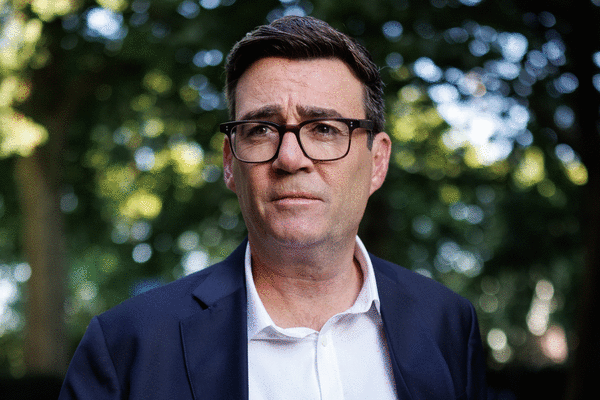
U.K. Prime Minister Andy Burnham displayed a willingness to take on one of the toughest policy traps in British policies by pledging to overhaul care for the elderly. He also indicated he may introduce new taxes to pay for it.
For years successive British prime ministers have tried and failed to improve the means-tested adult social-care system, which can leave older Britons and their families paying steep sums to access basic support. Tackling it is an attempt to show the new leader isn’t prepared to shy away from totemic — and expensive — problems.
Since entering office Burnham has pledged to draw a line under the pessimism and volatility that have frayed the U.K.’s two-party system. Kicking off Labour’s annual gathering in Liverpool, he said the threat of populism must be met with ambitious government.
“I want to set out a really clear direction based on honesty,” Burnham told the BBC. “I think that’s where we get hope again.”
Burnham confirmed he wanted the system to operate “on NHS principles,” meaning it would be universally free at the point of use like the country’s National Health Service, and didn’t deny the implication that could involve tax increases, saying: “Nothing is off the table at this moment in time.”
He pledged more detail in the coming days but implied the fiscal mechanics could be some time coming. He said he’d put a comprehensive plan to voters ahead of the next general election, which needs to be held before August 2029. In the interim he pledged to maintain Labour’s manifesto commitments not to increase income tax or employees’ national insurance contributions.
Burnham has signaled a reluctance to increase taxes ahead of an October budget he’s said will be challenging. “We have to be conscious of the extent to which we have raised revenue,” the prime minister told reporters traveling with him to the United Nations summit in New York this week.
An alternative means of raising the funding could involve reassessing the so-called triple lock protecting pension rises, to which he’s previously committed. According to Office for Budget Responsibility projections, former Chancellor of Exchequer Rachel Reeves’ choices already imply the tax take will rise to a record 38% of economic output at the end of the decade.
While the prime minister is seeking to demonstrate ambition and rally the party around him at his first conference as party’s leader, his social care comments risk fueling concerns over Britain’s precarious fiscal position. Growth in the economy has recently defied expectations, but gilt yields are close to multidecade highs.
Burnham’s career is fast-becoming defined by the issue of social care. As health secretary under Tony Blair’s government, he had proposed a new national care service and then, shortly after becoming leader this summer, placed a promise to reform the sector at the center of his agenda.
The issue is a personal one for the prime minister. His father, Roy, had dementia and was so unwell by the time Burnham entered No. 10 Downing St. he had only a limited understanding of his son’s new job. The elder Burnham died less than two weeks ago.
The expense of providing a universal social care service is central to why previous attempts at reform have failed. Burnham argued that the ailing sector already entailed high costs to both individuals and the NHS, which comes under pressure when vulnerable people end up hospitalized due to inadequate care.
Conservative home affairs spokesman Chris Philp gave a taste of the criticism Burnham could face as he presses ahead. The Tories “will not support more tax rises” to pay for social care and “would find that money through savings elsewhere,” Philp said.
Burnham challenged opposition parties not to label any new funding as a “dementia tax,” a framing that has torpedoed the fortunes of rivals in elections past. The prime minister said he rejected estimates from The Health Foundation that assume the bill for providing free social care across England would add £18 billion ($23.8 billion) a year, to increase current government expenditure by around 50%.
The agenda to reform social care cuts across other contentious aspects of Labour policy that will be on the table in Liverpool. Neil Duncan-Jordan, a left-leaning Labour MP, told Bloomberg it was impossible to fix bigger, more expensive problems in the U.K. such as health without first addressing social care.
“And you can’t fix social care if you start getting rid of thousands of workers under the new settled status proposals,” Duncan-Jordan said, referring to government plans to make it harder for low-paid migrant workers to claim settled status in the U.K. “The PM needs to recognize that this has to change.”
The first day of the conference betrayed hints of a brewing clash over proposals to tighten the rules for U.K. settlement. The government’s plans could significantly impact the care workforce, many of whom are overseas nationals.
Some in the governing party saw Burnham’s announcement Sunday that he would fight the next election on social care as a sign he might not wait three years before calling one. The announcement might stoke speculation about an vote after a review into social care policy is completed in the middle of next year, a Labour official said.
Speaking at a fringe event after Burnham made his comments, Chief Secretary to Treasury Emma Reynolds acknowledged that reforming social care is “obviously not going to be cheap.”
“The prime minister said this morning that in order to solve the challenge overall, he would like to seek a mandate, and that that might involve tax changes,” Reynolds said.
Elsewhere in his BBC interview, Burnham hinted he wasn’t in favor of the development of a third runway at London’s Heathrow airport. The PM repeatedly declined to say whether he supported the plans approved by his predecessor Keir Starmer, saying the expansion was a matter for Londoners.
The prime minister acknowledged concerns about the need for U.K. growth and the “febrile state of the global economy.” He said he would not “take risks” that lead to economic pain.
“I am here to do something, I am here to end the decade of drift and division that we’ve had since Brexit,” he pledged.
He said he wanted voters to be left thinking: “I understand what he’s doing, why he said that, and I can see that as a path that could take Britain to a better place.”
_____
(With assistance from Joe Mayes and Lucy White.)
_____
©2026 Bloomberg L.P. Visit bloomberg.com. Distributed by Tribune Content Agency, LLC.




Comments