Trump resists deeper US role in Saudi Arabia-Houthi conflict
Published in News & Features
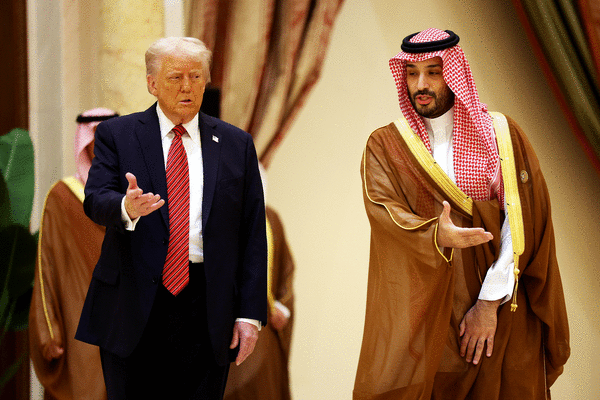
The Trump administration is reluctant to get more involved in Saudi Arabia’s offensive against the Houthis and has tried to restrain Riyadh from sparking a major new conflict in Yemen, according to people familiar with the situation.
While the U.S. has helped Riyadh with intelligence, targeting and refueling assistance, the lack of American offensive attacks against the Iran-backed Houthis left Saudi Arabia casting about unsuccessfully in recent weeks for more countries to join its military operation in Yemen, according to the people, who asked not to be identified discussing private deliberations.
That military campaign began on Sunday, with Yemen’s internationally recognized government — backed by Saudi Arabia — claiming on Tuesday to have recaptured territory held by the Houthis, with fighting intensifying near the Bab el-Mandeb strait, an alternative route to Hormuz.
The militant group, which has attacked Saudi energy facilities in the midst of the Iran war, also said Saudi forces launched around 60 airstrikes overnight.
The fighting adds a new active front to the broader war against Iran, which has proved unpopular in the U.S. as the conflict devolved into a standoff that has left global energy prices elevated and pushed up domestic gas prices before American midterm elections. Few believe renewed fighting will end the threat from the Houthis. The group has endured years of sporadic U.S., Israeli and Saudi bombing, including after it menaced Red Sea shipping in response to Israel’s war on Gaza.
The White House didn’t respond to a request for comment on Tuesday evening. Saudi Arabia’s Foreign Ministry also didn’t respond to a request for comment.
While the U.S. and some other nations are providing limited defensive and logistical support for Saudi Arabia, there are worries the fighting risks spurring new military escalation in the region and could jeopardize shipping in the Bab el-Mandeb strait, some of the people said.
That waterway has served as a key alternative route for Persian Gulf energy flows since Iranian forces targeted Hormuz in the opening weeks of the war.
The U.S. has told the Saudis not to send their own troops into Yemen while the war against Iran continues and shipping in the Strait of Hormuz remains disrupted, two of the people said.
“The real question in Trump’s head is whether there’s a path to success with this current Saudi offensive,” said Allison Minor, director at the Atlantic Council and former deputy US special envoy for Yemen. “We could potentially see gains from the Yemen government, but claims they will take all Houthi-controlled territory are more suspect.”
For President Donald Trump, who retains close ties with the kingdom’s de facto ruler Crown Prince Mohammed bin Salman, the calculation is fraught.
The Houthis are not hitting American assets, and direct airstrikes would break a ceasefire deal the U.S. struck with the Houthis last year after the U.S. hit more than 1,000 targets in an air campaign in Yemen.
The U.S. naval blockade of Iranian ports, designed to pressure Tehran into capitulating, is also using up much of America’s naval and air resources in the region. And there are concerns about strained U.S. munitions stockpiles should Trump choose to restart air strikes against Iran after the midterms, which he has raised as a possibility.
Secretary of State Marco Rubio said Monday that the Saudis “have a right to defend themselves” but declined to comment on the support the U.S. would provide. Trump has told reporters that the counter-offensive “will all work out very well.”
Yet the timeline is unclear. A Saudi official said they expected to be fighting the Houthis for the long run. The kingdom’s leadership expects the fighting could stretch into the new year, at least, said another person familiar with their thinking.
Trump’s predecessor, Joe Biden, once candidly conceded the difficulty of halting attacks against the Houthis despite the ineffectiveness of a bombing campaign. “Are they stopping the Houthis? No. Are they going to continue? Yes,” Biden said in 2024.
“The U.S. largely sees the current fighting as a Saudi problem, in part because it is trying to narrow the Iran theater to focus mainly on the Strait of Hormuz,” Bloomberg Economics analysts Dina Esfandiary and Becca Wasser said in a research note on Tuesday. “While Riyadh will likely keep asking for more, the U.S. is unlikely to go beyond what it is already providing the Saudi-led coalition.”
_____
(With assistance from Kate Sullivan and John Harney.)
_____
©2026 Bloomberg L.P. Visit bloomberg.com. Distributed by Tribune Content Agency, LLC.





Comments