Putin is spending a record $200 billion on the war this year
Published in News & Features
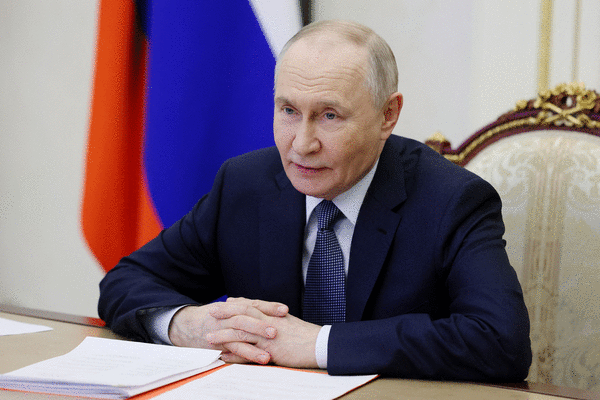
Russia’s military spending is on track to hit a record this year after Vladimir Putin added almost $60 billion to the outlays set out in the budget.
The Russian president ordered the dramatic shift for the war in Ukraine late last year after concluding that talks with the U.S. in Alaska were not going to lead to an acceptable deal to end the fighting.
Defense expenditure is expected to approach 17 trillion rubles ($199 billion) by the end of this year, about 40% higher than the original plan announced by the government at the end of 2025, two people close to the government said, asking not to be identified because the information isn’t public.
The amount is nearly at the level projected for next year under the new budget officials unveiled last week.
It’s the latest signal that Putin is prepared for the war with Ukraine to continue escalating. Moscow has already intensified attacks with missiles and faster, harder-to-intercept drones, striking energy facilities, transportation, hospitals and other civilian infrastructure. Putin has also sounded the alarm on what he said was hawkish rhetoric from European capitals as governments there grow more concerned about Russia’s intentions and the risk of confrontation.
The current budget trajectory is a sharp reversal from a year ago, when Russian was planning to moderate growth in military expenditures as it sought to narrow the budget deficit and rebuild reserves depleted during the war.
Ahead of the 2026 budget plan’s approval, Putin met U.S. President Donald Trump in Anchorage, Alaska. Following the August 2025 meeting, the Russian leader had hoped a peace agreement with Ukraine might be possible during the following year, reducing the need for a significant increase in military spending, according to one of the people.
By January, however, the Kremlin concluded that an agreement with Ukraine was out of reach and that U.S.-led efforts had failed to produce a breakthrough, the person said. The government then began accelerating advance payments to the defense industry and ramping up other war-related spending from the start of the year, they said.
That’s helped push the projected budget deficit for 2026 to more than 7 trillion rubles, compared with 3.8 trillion rubles as originally expected. The government has financed the additional spending in 2026 through increased domestic borrowing and gold sales.
The Finance Ministry didn’t respond to a request for comment.
Russia has stepped up its war effort in Ukraine since this summer. In recent weeks, its forces have repeatedly hit civilian targets, including in Kyiv, while also trying to strike the capital’s bridges with drones.
Meanwhile, attacks on vessels near Black Sea ports have become an almost daily occurrence, while at the same time Ukraine has intensified strikes of its own.
Military expenditures for 2027 are planned at 17.1 trillion rubles, and will only ease slightly to 16.6 trillion rubles in 2028 and 16.3 trillion rubles in 2029, according to the budget plans.
Still, it’s possible actual spending for next year will also exceed those targets, as Moscow has grown doubtful that the Trump administration can broker an agreement with Ukraine on terms acceptable to Russia, the people said.
At the same time, escalating tensions between Europe and Russia were on full display last week when Putin accused European officials of preparing for a potential conflict later this decade, pointing to military exercises in the Baltic Sea and statements about the exclave of Kaliningrad. He said Russia had no plans to attack Europe, but warned that any direct assault on Russian territory would force Moscow to consider using the full range of weapons at its disposal.
“We understand that we would be facing an adversary twice our size in terms of population, with major economic and military potential,” Putin said. “We don’t have that many forces and means to counter this threat. But no one has the means of destruction that Russia has today. And these are our competitive advantages.”
©2026 Bloomberg L.P. Visit bloomberg.com. Distributed by Tribune Content Agency, LLC.






Comments